
Population Studies - IELTS Listening Answers & Explanations
From Cambridge IELTS 04 Academic Listening Test 1 · Part 3 · Questions 21–30
Audio
Questions
Questions 21–22 One Choice
Choose the correct letter, A, B or C.
Questions 23–27 Matching
What recommendations does Dr Johnson make about the journal articles?
Choose your answers from the box and write the letters A-G next to questions 23-27.
A. must read
B. useful
C. limited value
D. read first section
E. read research methods
F. read conclusion
G. don't read
Questions 28–30 Visual Labeling
Label the chart below.
Choose your answers from the box below and write the letters A-H next to questions 28-30.
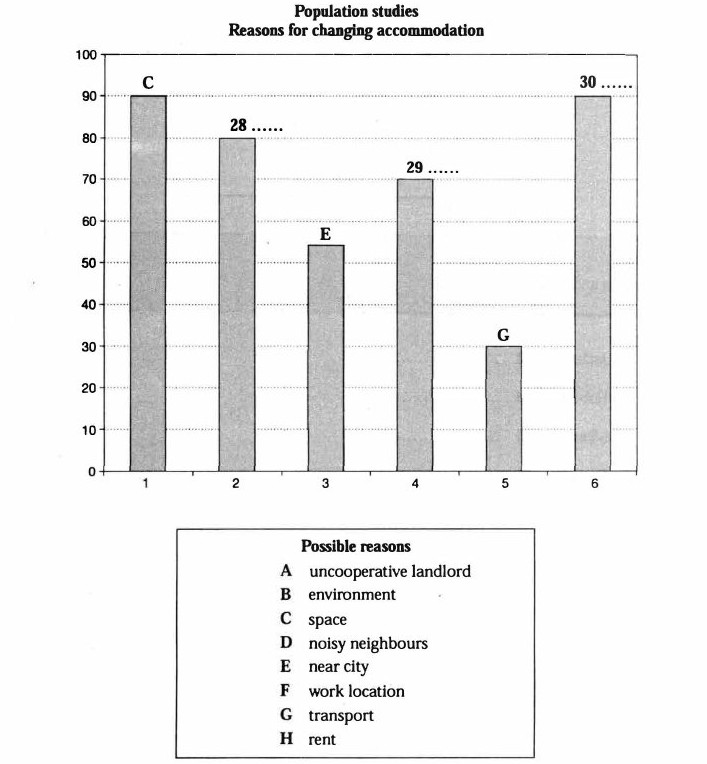
A. uncooperative landlord | B. environment | C. space
D. noisy neighbours | E. near city | F. work location
G. transport | H. rent
Answers & Explanations Summary
| # | Answer | Evidence | Explanation |
|---|---|---|---|
| Q21 | A | Well, I had a really big assignment due in for another course, and I've been spending all my time on that, and I thought | Excerpt/Transcript Explanation: The transcript shows Melanie explaining that her time was taken up by an assignment for a different subject, which is why she hasn't made progress on the current one. Answer Explanation: The answer is that Melanie was busy working on a project for a different class. Reason For Correctness: The correct answer is A because Melanie mentions she had a very large piece of work for a different subject that needed to be finished. Because she spent all her time on that other work, she didn't have time to start this assignment or borrow the books she needed. Keywords to note are 'big assignment' (a large project) and 'another course' (a different class or subject). |
| Q22 | C | Well, yes, it is possible, but extensions are normally given only for medical or compassionate reasons, otherwise it's really a question of organising your study, and we don't like giving extensions to students who simply didn't plan their work properly | Excerpt/Transcript Explanation: The transcript shows the teacher explaining that more time is only for health or personal issues. He believes students should plan their work better instead of asking for more time because of scheduling problems. Answer Explanation: The answer means that getting more time to finish work is okay if a student is sick or has a serious personal problem. Reason For Correctness: The correct answer is C because Dr. Johnson says that he only gives extra time for "medical" or "compassionate" reasons. In English, medical reasons relate to being sick (illness), and compassionate reasons usually refer to personal problems or accidents. He also says he does not like giving extra time for poor planning (organising study), which makes choice A incorrect. |
| Q23 | E | DR JOHNSON: You should also read the article by Jackson, but just look at the part on the research methodology – how they did it | Excerpt/Transcript Explanation: The transcript shows Dr. Johnson giving advice to focus only on the part of the text about how the research was conducted. Answer Explanation: The answer 'E' means Dr. Johnson suggests looking at the specific section of Jackson's article that explains how the study was done. Reason For Correctness: The correct answer is 'E' because Dr. Johnson tells Melanie to look at the 'research methodology' part of Jackson's article. He explains that this part shows 'how they did it.' In school and research, the word 'methodology' means the same thing as 'methods.' Therefore, his advice matches choice E. |
| Q24 | B | And if you have time, the one by Roberts says very relevant things, although it's not essential | Excerpt/Transcript Explanation: The transcript shows that Dr. Johnson describes the article as having "very relevant things," which is another way of saying the article is useful for the student's assignment. Answer Explanation: The answer B means that Dr. Johnson thinks the article written by Roberts is useful and helpful for the study. Reason For Correctness: The correct answer is B because Dr. Johnson says that Roberts' article has "very relevant things" in it. In a school setting, "relevant" means the information is important or useful for the topic you are studying. Even though he says the article is "not essential" (which means it's not something you absolutely must read), he suggests reading it because the information inside is helpful. |
| Q25 | G | DR JOHNSON: Now, the one by Morris. I wouldn't bother with that at this stage, if I were you | Excerpt/Transcript Explanation: The transcript shows Dr. Johnson advising Melanie skip the article by Morris for now. By saying he 'wouldn't bother' with it, he is suggesting that reading it is not a good use of her time. Answer Explanation: The answer G means that Dr. Johnson thinks Melanie should not read the article written by Morris. Reason For Correctness: The correct answer is G because Dr. Johnson tells Melanie that she 'wouldn't bother' with the article by Morris. In English, when someone says they 'wouldn't bother' with a task, they mean that the task is not important or necessary to do. Therefore, he is telling her that she does not need to read it. |
| Q26 | F | Well, yes, in a way, but just look at the last part, where he discusses the research results | Excerpt/Transcript Explanation: The transcript shows Dr. Johnson explaining that while the paper is somewhat useful, the student only needs to focus on the ending section where the author talks about what the study found. Answer Explanation: The answer F means that Dr. Johnson suggests Melanie should only read the final section or the ending of the article written by Cooper. Reason For Correctness: The correct answer is F because Dr. Johnson tells Melanie to look at the 'last part' of Cooper's article to find the 'research results.' In academic papers, the final section where the findings are presented is typically the conclusion. Therefore, his advice to look at the end for the results matches the option to 'read conclusion.' |
| Q27 | C | And lastly, there's Forster – I can't think why I included that one. It's not bad and could be of some help, but not that much | Excerpt/Transcript Explanation: The transcript shows Dr. Johnson talking about the Forster article. He says he is not even sure why he put it on the list and explains that it is not very helpful for the student. Answer Explanation: The answer C means that the article by Forster has 'limited value,' which means it is not very important or helpful for the student's work. Reason For Correctness: The correct answer is C because Dr. Johnson describes the article as being 'not that much' help. In English, 'limited value' is a way to say that something only has a small amount of use or is not very important. Since he says it is only helpful a little bit, it fits the description of having limited value. |
| Q28 | D | Bar two is to do with the people living nearby disturbing them, so they chose to move away to somewhere quieter | Excerpt/Transcript Explanation: The transcript explains that the second part of the chart is about people who moved house because the people living close to them were bothering them and they wanted a place with less noise. Answer Explanation: The answer is 'D', which stands for 'noisy neighbours'. Reason For Correctness: The correct answer is 'D' because Dr. Johnson describes the second bar on the graph as people moving away because those living near them were 'disturbing' them. He mentions they wanted to live 'somewhere quieter.' 'People living nearby' are neighbors, and wanting a quieter place because you are being disturbed specifically points to noise issues, which matches 'noisy neighbours'. |
| Q29 | A | Now bar number four refers to problems when the owner of the property won't help fix things that go wrong. In other words, the owner is not helpful and so the tenants move out |
Excerpt/Transcript Explanation: The transcript states that the fourth bar on the chart is for people who move because the person they rent from (the owner) will not repair things or be helpful. Answer Explanation: The answer is an uncooperative landlord, representing a property owner who does not want to help their tenants with repairs or problems. Reason For Correctness: The correct answer is based on Dr. Johnson's description of Bar 4 in the graph. He explains that this section of the graph represents people who move away because the person who owns the property (the 'owner') refuses to fix things or provide help. In the vocabulary list, 'uncooperative' is a synonym for 'not helpful' or not willing to work together, and 'landlord' is a synonym for 'owner of the property'. |
| Q30 | B | DR JOHNSON: Bar number six is interesting. That reason was given quite a lot – people moving because they wanted to be in a more attractive neighbourhood | Excerpt/Transcript Explanation: The transcript explains that the information for the sixth bar on the graph represents people who moved because they wanted to live in a nicer area or neighborhood. Answer Explanation: The answer B means "environment," which refers to the surrounding area or neighborhood where a person lives. Reason For Correctness: The correct answer is B because Dr. Johnson explains that the sixth bar on the graph shows people moving because they wanted a "more attractive neighbourhood." In English, an "attractive neighbourhood" is a way to describe a nice environment. So, "environment" is the best word to match the description in the transcript. |
Transcript
MELANIE: Excuse me, Dr Johnson. May I speak to you for a minute?
DR JOHNSON: Sure. Come in.
MELANIE: I'm Melanie Griffin. I'm taking your course in Population Studies.
DR JOHNSON: Right. Well, Melanie, how can I help you?
MELANIE: I'm ... having a bit of trouble with the second assignment, and it's due in twelve days.
DR JOHNSON: What sort of trouble are you having? Is the assignment question a problem?
MELANIE: Well, that's part of the problem. I'm also having – been having – trouble getting hold of the books. I've been to the library several times, and all the books are out.
DR JOHNSON: Sounds like you should have started borrowing books a bit earlier.
MELANIE: Well, I had a really big assignment due in for another course, and I've been spending all my time on that, and I thought ...
DR JOHNSON: ... You might get an extension of time to finish your assignment for me?
MELANIE: If that's possible, but I don't know ...
DR JOHNSON: Well, yes, it is possible, but extensions are normally given only for medical or compassionate reasons, otherwise it's really a question of organising your study, and we don't like giving extensions to students who simply didn't plan their work properly. What did you get for your first assignment?
MELANIE: I got eighty-seven per cent.
DR JOHNSON: Mmm, yes, you did very well indeed, so obviously you can produce good work.
MELANIE: I don't think I'll need too much extra time, as long as I can get hold of some of the important references.
DR JOHNSON: Well, since you did so well in your first assignment, I'm prepared to give you an extra two weeks for this one, so that'll mean you'll need to submit it about a month from now.
MELANIE: Thank you.
DR JOHNSON: Now, what about the reading materials? Have you checked out the journal articles in the list?
MELANIE: Umm, no, not yet, there were about twenty of them, and I wasn't sure which ones would be most useful or important.
DR JOHNSON: Well, they're all useful, but I don't expect anyone to read them all, because a number of them deal with the same issues. Let me give you some suggestions. The article by Anderson and Hawker is really worth reading.
MELANIE: Right, I'll read that one.
DR JOHNSON: You should also read the article by Jackson, but just look at the part on the research methodology – how they did it.
MELANIE: OK ... Jackson, got that ...
DR JOHNSON: And if you have time, the one by Roberts says very relevant things, although it's not essential.
MELANIE: So, OK, if it's useful, I'll try and read that one ...
DR JOHNSON: Now, the one by Morris. I wouldn't bother with that at this stage, if I were you.
MELANIE: OK, I won't bother with Morris. Oh, now, someone told me the article by Cooper is important.
DR JOHNSON: Well, yes, in a way, but just look at the last part, where he discusses the research results. And lastly, there's Forster – I can't think why I included that one. It's not bad and could be of some help, but not that much.
DR JOHNSON: Now, let's deal with the assignment question. What's the problem there?
MELANIE: It's the graph on page two.
DR JOHNSON: What seems to be the problem? It's just the bar graph showing reasons why people change where they live.
MELANIE: Well, I've got a photocopy but the reasons at the bottom are missing.
DR JOHNSON: Ah, OK. Look at the first bar on the graph – now that indicates the number of people who move because they want more space.
MELANIE: Oh I see ... bar one. OK ... Now what about the next bar?
DR JOHNSON: Bar two is to do with the people living nearby disturbing them, so they chose to move away to somewhere quieter. Now let's look at bar number three ... another reason people change their place of living is because they want to be closer to the city.
MELANIE: OK. Proximity to the city is an issue ...
DR JOHNSON: Now ... bar number four refers to problems when the owner of the property won't help fix things that go wrong. In other words, the owner is not helpful and so the tenants move out.
MELANIE: OK ... Now what about bar five?
DR JOHNSON: Bar five is about those people who move because they need a bus or train to get them into the city or to go to work.
MELANIE: OK ... And bar six?
DR JOHNSON: Bar number six is interesting. That reason was given quite a lot – people moving because they wanted to be in a more attractive neighbourhood.
MELANIE: Oh, yes, thank you very much.