
Repair Schedule - IELTS Listening Answers & Explanations
From IELTS Recent Actual Test 6 Academic Listening Test 5 · Part 2 · Questions 11–20
Audio
Questions
Questions 11–15 Diagram Labeling
Complete the repair schedule.
Write the correct letter, A-F, for each answer.
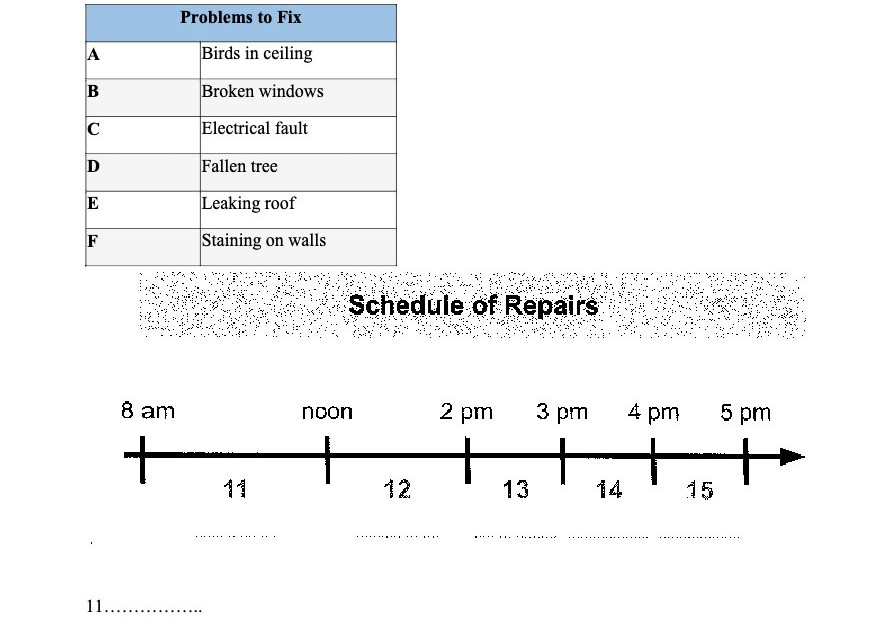
A Birds in ceiling B Broken windows C Electrical fault
D Fallen tree E Leaking roof F Staining on walls
Questions 16–20 Sentence Completion
Complete the sentences.
Write NO MORE THAN TWO WORDS for each answer.
- The stained walls will be painted 16.
- Extra paint will be left in the 17.
- The baby birds will be given to a 18.
- The fallen tree will be used as 19.
- The smaller parts of the tree will be put in a 20.
Answers & Explanations Summary
| # | Answer | Evidence | Explanation |
|---|---|---|---|
| Q11 | E | That’s right, and we were going to remove the fallen tree, but we’ve been told there are exams that morning, and I’m sure the sound of those saws and other heavy equipment will disturb all the students, so instead we’ll fix that leaky roof | Excerpt/Transcript Explanation: The transcript explains that the workers will not work on the tree in the morning because it is too loud for the students taking tests. Instead, they will start by repairing the roof that is letting water in. Answer Explanation: The answer is the leaking roof (option E), which means the roof has a hole or a crack that lets water come inside the building. Reason For Correctness: The correct answer is E because the worker explains that their first job at 8:00 AM was supposed to be moving a tree. However, because students are having exams, they need to do something quiet. They decide to fix the leaky roof first because it does not make as much noise as the saws used for the tree. They also mention that fixing the roof is a four-hour job that needs to be done early. |
| Q12 | A | Officer: So you’ll fix the broken window after that, from midday? Worker: We could do that, but since we’ll be working in the ceiling, it’s more logical to get rid of those birds’ nests there. It’s a small job but will require crawling inside the ceiling cavity, which is not an easy exercise, so that will take about an hour | Excerpt/Transcript Explanation: The transcript shows that at noon (midday), the worker decides to clear bird nests out of the ceiling instead of fixing windows because it is easier to do while they are already working near the ceiling. Answer Explanation: The answer 'A' refers to the task of removing birds' nests from the ceiling. Reason For Correctness: The correct answer is 'A' because the worker explains that after repairing the roof, the team will remove birds' nests from the ceiling before taking their lunch break. The worker mentions that since they are already working in the ceiling area for the roof repair, it makes sense to handle the nests next. This job starts at midday (12:00 PM) and takes about one hour. |
| Q13 | D | But this is good, since by that time the exams should be over, and we can address that tree which has been blown over, after our one-hour lunch break of course. It will be quite noisy dealing with that, but it will be finished by three o’clock | Excerpt/Transcript Explanation: The transcript shows that after the team eats lunch, they will work on the tree that fell down. They wait until this time because the work is loud, and they need to wait for students to finish their tests. They plan to complete this job by 3:00 PM. Answer Explanation: The answer identifies the task of removing or cutting up a tree that fell down during the storm. Reason For Correctness: The correct answer is identified by following the worker's planned schedule. After fixing the roof and removing birds' nests in the morning, the team takes a lunch break. The worker states that at 2:00 PM, once the exams are finished, they will deal with the tree that was blown over and finish it by 3:00 PM. Key phrases like 'blown over' and 'finished by three o’clock' link this task to that specific time slot. |
| Q14 | F | Some of our staff will then leave to fix things on another site — an office nearby needs a new window — but two of us, including myself, will remain here to paint over that discoloured patch of wall in your office | Excerpt/Transcript Explanation: The transcript shows that at three o'clock, most workers will leave, but two people will stay behind to paint a section of the wall that has a mark or is the wrong color. Answer Explanation: The answer is option F, which involves fixing or covering up marks and unwanted colors on the wall surface. Reason For Correctness: The correct answer is F because the worker explains that after they finish cutting the tree at 3 o'clock, he and one other person will stay to paint a 'discoloured patch' of wall. In the list of tasks, 'Staining on walls' is the matching term for fixing a wall that has lost its original color or has marks on it. |
| Q15 | C | and in the last hour of our working day, we’ll fix up that problem with the wiring. Apparently the power doesn’t go to one of the classrooms | Excerpt/Transcript Explanation: The transcript shows that at the end of their work day, the team will repair the wires because one room does not have any electricity. Answer Explanation: The answer is an electrical fault, which means there is a problem with the electricity or the wires in the building. Reason For Correctness: The correct answer is chosen because the worker describes the final task of the day as fixing a problem with the wiring. This matches the term 'electrical fault.' He explains that because power is not reaching a classroom, they will spend the last hour of their shift changing wires and cleaning the fuse box. |
| Q16 | yellow | Officer: Well that’s the point. I’d prefer it to be yellow, to match the furniture. The furniture is orange, actually, but I think yellow is a nice match. Can you do that? Worker: We can certainly do that. Yellow it is | Excerpt/Transcript Explanation: The transcript shows the person in the office asking for yellow paint instead of white paint. The worker says they can definitely do that. Answer Explanation: The answer identifies the color 'yellow' for painting the office walls. Reason For Correctness: The correct answer is 'yellow' because the officer specifically requests a change from white to yellow. The officer explains that this color will better 'match' the orange 'furniture'. The worker agrees and confirms this choice by saying 'Yellow it is.' |
| Q17 | garden shed | And we can leave the paint can with you, in case you need to do some touch-ups, or if the stain reappears. I’ll just leave it in the garden shed, the one next to the main classroom | Excerpt/Transcript Explanation: The transcript shows the worker telling the officer that he will leave the extra paint in a small storage building located in the garden. Answer Explanation: The answer is a small building outside where items, like tools or paint, are stored. Reason For Correctness: The correct answer is 'garden shed' because the worker mentions that he will leave the container (the paint can) in that specific location. He wants to leave it there so the officer can use it later if the wall needs more paint or small repairs. The worker describes the location as being next to the main classroom. |
| Q18 | wildlife reserve | I heard the chirping of little baby birds in there, so there must be some young ones in a nest. I just thought you’d like to know that we can give them to a wildlife reserve. There’s one in the next suburb, so that should not be too much trouble I would say the wildlife reserve is a better option, since the people there are used to dealing with animals |
Excerpt/Transcript Explanation: The transcript shows the worker hearing baby birds in a nest and suggesting they go to a wildlife reserve nearby. He later confirms this is the best plan because the people at the reserve are experts in taking care of animals. Answer Explanation: The answer means the baby birds will be moved to a park or facility that protects and cares for wild animals. Reason For Correctness: The correct answer is wildlife reserve because while investigating the birds' nests in the ceiling, the worker finds baby birds. He explains that they can be taken to a 'wildlife reserve' in the next suburb. Although the officer suggests a teacher could raise them, the worker clarifies that the reserve is the 'better option' because the staff there are professionals at handling animals. |
| Q19 | firewood | as for that fallen tree, we’ll cut it up into small pieces and that can be firewood in my house | Excerpt/Transcript Explanation: The transcript shows the worker talking about the tree that fell over. He says he will cut it into little pieces and use it for his fire at home. Answer Explanation: The answer is the name of the material that the worker will use to burn in his fireplace to keep his house warm. Reason For Correctness: The correct answer is 'firewood' because the worker explains what he plans to do with the tree that fell down during the storm. He says he will chop it into small parts so he can burn them in his home. In the transcript, he explicitly states that these pieces will be used as firewood. |
| Q20 | garden bin | I’ve noticed also that the university has a garden bin, for the smaller items — leaves and sticks and bark, and so on, so we can dispose of material in that, also | Excerpt/Transcript Explanation: The transcript shows the worker noticed a container for garden trash. He mentions it is used for small things like leaves and sticks, and says his team will put those materials inside it. Answer Explanation: The answer "garden bin" refers to a special container for outside trash, such as leaves, sticks, and small wood pieces, which can be recycled. Reason For Correctness: The correct answer is found by looking at the part where the worker talks about smaller items like leaves and sticks from the tree. He mentions that the university has a garden bin and that they will use it to throw away those smaller parts of the tree. Pay attention to keywords like garden bin, smaller items, and dispose of material. |
Transcript
Worker: Hello there. I was asked to tell you about the extent of the damage to the main building, caused by the recent storm.
Officer: Oh, that’s right. I take it that most of the damage is just to the main building?
Worker: It is indeed, since the building is so old. However, luckily, the damage is minor, and all of it can be fixed in one day, given that we have five people in our team.
Officer: What will you be doing first? I understand you start at 8 in the morning.
Worker: That’s right, and we were going to remove the fallen tree, but we’ve been told there are exams that morning, and I’m sure the sound of those saws and other heavy equipment will disturb all the students, so instead we’ll fix that leaky roof. That’s a four-hour job, since it involves substantial repair, not like fixing broken windows, which can be done quite quickly.
Officer: So you’ll fix the broken window after that, from midday?
Worker: We could do that, but since we’ll be working in the ceiling, it’s more logical to get rid of those birds’ nests there. It’s a small job but will require crawling inside the ceiling cavity, which is not an easy exercise, so that will take about an hour. But this is good, since by that time the exams should be over, and we can address that tree which has been blown over, after our one-hour lunch break of course. It will be quite noisy dealing with that, but it will be finished by three o’clock. Some of our staff will then leave to fix things on another site — an office nearby needs a new window — but two of us, including myself, will remain here to paint over that discoloured patch of wall in your office.
Officer: Oh good, it looks so horrible at the moment.
Worker: Well, we’ll certainly make it look good once again, and in the last hour of our working day, we’ll fix up that problem with the wiring. Apparently the power doesn’t go to one of the classrooms. Probably some water has gotten into the fuse box, so we’ll just change a few wires, and clean up the moisture, and it should be fine.
Officer: I certainly appreciate all the effort you and your team are taking to fix things here, but I do have one request.
Worker: And what is that?
Officer: You said you’re going to paint the back wall in my office. Will it be the same colour as before?
Worker: Yes, we’ll make it a nice white colour.
Officer: Well that’s the point. I’d prefer it to be yellow, to match the furniture. The furniture is orange, actually, but I think yellow is a nice match. Can you do that?
Worker: We can certainly do that. Yellow it is. Certainly a prettier colour than just plain white, or the blue in my kitchen at home for that matter. And we can leave the paint can with you, in case you need to do some touch-ups, or if the stain reappears. I’ll just leave it in the garden shed, the one next to the main classroom. And incidentally, about those birds in the ceiling. I was just investigating, and I heard the chirping of little baby birds in there, so there must be some young ones in a nest. I just thought you’d like to know that we can give them to a wildlife reserve. There’s one in the next suburb, so that should not be too much trouble.
Officer: Or you could give them to one of our teachers. I have a colleague who can raise them.
Worker: I would say the wildlife reserve is a better option, since the people there are used to dealing with animals, and as for that fallen tree, we’ll cut it up into small pieces and that can be firewood in my house, so that won’t be wasted either—although the smoke will cause some pollution, but I have a special licence for my fireplace, so no one can object to that. I’ve noticed also that the university has a garden bin, for the smaller items — leaves and sticks and bark, and so on, so we can dispose of material in that, also. You do have some waste piles out the back, but a proper garden bin means that the material will be recycled, and that’s better for the environment, so you can rest assured we will use that.