
The Importance of Soil in Organic Agriculture - IELTS Listening Answers & Explanations
From Road to IELTS Academic Listening Test 3 · Part 4 · Questions 31–40
Audio
Questions
Questions 31–33 Summary Completion
Complete the summary below.
Write NO MORE THAN TWO WORDS for each answer.
If soil is healthy, it is a 31 teeming with life such as worms, fungi and bacteria. If plants are grown in poor soil, they will lack 32 and human health will suffer. Plants are nourished by organic matter, 33 and other essential elements which are broken down by insects and other organisms in a synergistic relationship.
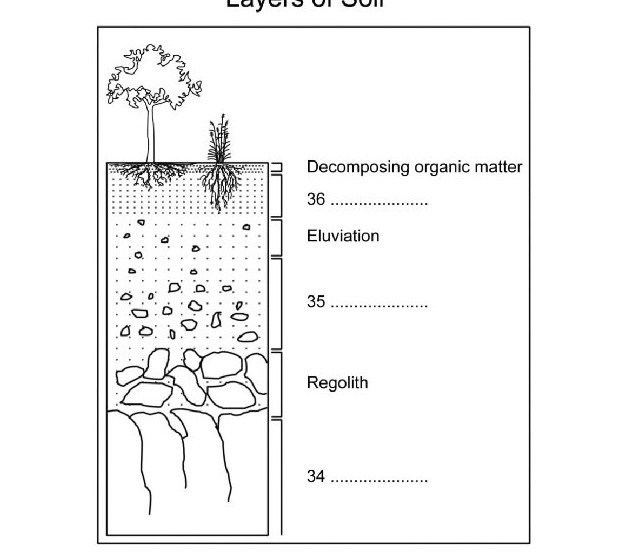
Questions 34–36 Diagram Labeling
Label the diagram below.
Write NO MORE THAN TWO WORDS for each answer.
Questions 37–40 Table Completion
Complete the notes below.
Write NO MORE THAN TWO WORDS for each answer.
Problems:
- Erosion
- 37 from various sources, including chemical fertilisers
| Conventional farming methods | Organic farming methods |
|---|---|
|
|
Answers & Explanations Summary
| # | Answer | Evidence | Explanation |
|---|---|---|---|
| Q31 | living entity | Most people think of it just as a substrate (or medium) in which plants grow, but it's more than that, it's actually a living entity - or it should be if it's healthy - and human health is affected by the health of the soil | Excerpt/Transcript Explanation: The transcript explains that while many people believe soil is just a place where plants grow, it is really something that has life in it if it is in good health. Answer Explanation: The answer 'living entity' means that soil is like a large living thing or a single living organism. Reason For Correctness: The correct answer is 'living entity' because the speaker describes healthy soil as being more than just a place where plants grow; it is alive. The text explicitly states that soil 'is actually a living entity' if it is healthy. The summary says it is 'teeming with life,' which matches the part of the talk where the speaker says soil is 'crawling with life,' such as worms, insects, fungi, and bacteria. |
| Q32 | nutrients | It stands to reason, therefore, that plants grown in poor soil will have few nutrients to pass on to the consumer, whose well-being will be worse-off over the long term | Excerpt/Transcript Explanation: The transcript explains that when plants are grown in bad dirt, they do not have enough healthy parts (nutrients) for the people who eat them, which causes people's health to suffer over time. Answer Explanation: The answer "nutrients" refers to the healthy substances that plants get from the ground to grow strong and provide health to those who eat them. Reason For Correctness: The correct answer is "nutrients" because the speaker explains the relationship between soil quality and human health. According to the talk, if the soil is bad ("poor soil"), the plants will only have a small amount ("few") of healthy substances to give to the people who eat them. This shortage of nutrients leads to the person's health ("well-being") becoming worse. |
| Q33 | minerals | Some nutrients are made up of minerals from the earth, while others come from dead plant and animal matter which is broken down over time by the living insects and other organisms in the soil. Plants depend on these little living creatures to convert minerals and other vital elements into a utilisable form that can be taken up by the plants. And it's a synergistic relationship | Excerpt/Transcript Explanation: The transcript explains that plant food consists of minerals and organic material (dead plants and animals). It notes that insects and other small creatures in the soil break these items down into "vital elements" so the plants can grow, describing this mutual help as a "synergistic relationship." Answer Explanation: The answer "minerals" refers to natural substances found in the ground, like salt or bits of stone, that help plants grow strong and healthy. Reason For Correctness: The correct answer is "minerals" because the transcript says plants get their food (nourishment) from two sources: "minerals from the earth" and "dead plant and animal matter" (which is organic matter). These materials are changed into a form plants can eat by bugs and other small living things in the dirt. This process is part of a "synergistic relationship," which means the plants and the organisms help each other. |
| Q34 | bedrock | Let's start at the bottom - this is the bedrock under all the other layers | Excerpt/Transcript Explanation: The transcript explains that the layer at the bottom of the group is called bedrock. Answer Explanation: The answer is the name of the very lowest part of the earth's layers shown in the picture. Reason For Correctness: The correct answer is bedrock because the speaker describes a picture showing different levels of soil. When the speaker begins talking about the layers, they start at the very bottom and name that specific layer 'bedrock.' This layer sits underneath everything else. |
| Q35 | subsoil | Moving up the chart, to the next layer, we come to the subsoil which contains clay and mineral deposits | Excerpt/Transcript Explanation: The transcript explains that when you look at a picture showing the different levels of soil and move up to the next part, you find the subsoil. Answer Explanation: The answer is the name for a specific layer of earth that is found deep underground, below the top layer. Reason For Correctness: The correct answer is 'subsoil' because the speaker describes the different layers of the earth from the bottom to the top using a diagram. After naming the bottom layers, the speaker identifies the next level up as the subsoil, which is where clay and minerals are found. |
| Q36 | topsoil | As we get near the surface, we find the topsoil. You will hear a lot of talk about topsoil amongst farmers and other agriculturalists. It's the most important layer of all because it's where seeds germinate and roots grow | Excerpt/Transcript Explanation: The transcript tells us that as you move towards the ground's surface, you find "topsoil." It is very important because this is the place where seeds start to grow and where the roots of plants are found. Answer Explanation: The answer "topsoil" is the name of the layer of earth found close to the surface where plants begin to grow. Reason For Correctness: The correct answer is "topsoil" because the speaker explains the structure of the soil in a specific order. When describing the layers moving from the bottom toward the surface, the speaker identifies the layer near the surface as the topsoil, highlighting its importance for seed germination and root growth. Key synonyms used include "top" for surface and identifiers like where "roots grow." |
| Q37 | pollution | And, in addition, soil quality can be affected by pollution due to anything from industrial waste to the artificial fertilisers used by conventional farmers which have been shown to suppress the diverse life forms in the soil | Excerpt/Transcript Explanation: The transcript states that soil health is damaged by pollution. It gives examples of where this pollution comes from, specifically mentioning 'industrial waste' and 'artificial fertilisers' as the sources. Answer Explanation: The answer 'pollution' refers to harmful or dangerous substances that make the ground or soil dirty and unhealthy. Reason For Correctness: The correct answer is identified because the speaker mentions two main problems for soil. The first is erosion, and the second is pollution. The speaker explains that this pollution comes from many different places, such as factory waste and the human-made (artificial) fertilisers used in standard farming. |
| Q38 | pest control | It relies on chemicals for fertiliser and pest control | Excerpt/Transcript Explanation: The transcript states that conventional farming depends on chemicals for two specific jobs. One job is making the soil better for plants to grow (fertiliser). The other job is controlling pests, which are small animals or bugs that eat or destroy the crops. Answer Explanation: The answer means managing or stopping harmful insects and animals from damaging crops. Reason For Correctness: The correct answer is 'pest control' because the transcript describes how many regular (conventional) farms use chemicals. According to the talk, these chemicals are used for two main purposes: to help things grow (fertiliser) and to stop bugs or animals from damaging the plants (pest control). Since the notes already mentioned 'fertiliser', 'pest control' is the missing piece of information. |
| Q39 | production practices / production practises | Also, did you know that there is no requirement for conventional growers to maintain records of their production practices | Excerpt/Transcript Explanation: The transcript states that for farmers using standard methods, there are no rules saying they must keep a written history of how they manage their crops. Answer Explanation: The answer "production practices" refers to the specific methods and steps farmers use to grow their crops from start to finish. Reason For Correctness: The correct answer is "production practices" because the transcript explains that conventional farmers are not required to keep "records" (which serves as documentation) of how they grow their plants. The phrase "no need for documentation" in the notes matches the speaker's mention that there is "no requirement" to "maintain records." |
| Q40 | predator | Organic farmers often release beneficial insects as predators which precludes the need for artificial pesticides | Excerpt/Transcript Explanation: The transcript explains that organic farmers put helpful insects into their fields to act as hunters. These insects eat the pests that would otherwise harm the plants, making chemical sprays unnecessary. Answer Explanation: The answer "predator" refers to an animal or insect that hunts and eats other living creatures to survive. Reason For Correctness: The correct answer is "predator" because the talk explains how organic farmers use helpful insects to hunt and eat the pests that damage crops. By using these natural hunters, farmers do not have to use man-made chemical poisons (pesticides) to kill bad insects. This matches the part of the notes asking about the use of insects as a natural solution. |
Transcript
Section 4
You will hear a talk on the importance of soil in organic agriculture. First you have some time to look at questions 31 to 40.
[20 seconds]
Listen carefully and answer questions 31 to 40.
Welcome to this talk on soil science and organic farming. Dirt, soil, earth, loam, mud or dust - it doesn't matter what you call it - is of primary importance in the production of food and other crops. Most people think of it just as a substrate (or medium) in which plants grow, but it's more than that, it's actually a living entity - or it should be if it's healthy - and human health is affected by the health of the soil.
Healthy, living soil is literally crawling with life - there are the obvious earthworms, which burrow in the soil and help to aerate and improve it, beetles and other hard-backed insects, and various invertebrates like centipedes. Then there are fungi and bacteria - also living forms. Healthy soil needs food, air and water to help plants grow ... and the more nutrients in plants, the more available for humans and livestock. It stands to reason, therefore, that plants grown in poor soil will have few nutrients to pass on to the consumer, whose well-being will be worse-off over the long term.
So, where do plants get their nourishment? Most of it comes from the soil. Some nutrients are made up of minerals from the earth, while others come from dead plant and animal matter which is broken down over time by the living insects and other organisms in the soil. Plants depend on these little living creatures to convert minerals and other vital elements into a utilisable form that can be taken up by the plants. And it's a synergistic relationship - in turn, the plants assist those helpful organisms by releasing sugars and enzymes back into the soil.
Before I go any further, let's take a look at the structure of soil. Now ... if you look at the diagram, you'll see that soil is made up of many different layers. Let's start at the bottom - this is the bedrock under all the other layers. The layer above that is called regolith - here the bedrock is slightly broken up but plant roots don't penetrate this layer. Moving up the chart, to the next layer, we come to the subsoil which contains clay and mineral deposits. On top of that, is the eluviation (or leaching) layer ... this is quite light in colour and is mostly just sand and silt. As we get near the surface, we find the topsoil. You will hear a lot of talk about topsoil amongst farmers and other agriculturalists. It's the most important layer of all because it's where seeds germinate and roots grow. Now, at the top of the chart, you will see a comparatively thin layer - this is organic matter that is still in the process of decomposition. It mostly consists of leaf litter and humus - just think of the surface of the forest floor - partly-decayed leaves and twigs - that sort of thing.
As you can imagine, good soil forms very slowly over time but it can be lost very rapidly through erosion. And, in addition, soil quality can be affected by pollution due to anything from industrial waste to the artificial fertilisers used by conventional farmers which have been shown to suppress the diverse life forms in the soil. This is why organic agriculture is the way of the future.
Let's take a quick look at the conventional system, which is often based on monoculture - the production of a single large crop. It relies on chemicals for fertiliser and pest control. It is also becoming an increasingly common practice to use genetically-engineered seeds. And more chemicals are used to control insects and fungi which attack crops in storage and during transportation. Also, did you know that there is no requirement for conventional growers to maintain records of their production practices?
Organic growers, on the other hand, choose the most environmentally-friendly options for dealing with pests and disease problems, working towards prevention in the first place. Some of the strategies they employ include alternating the crops grown in each field (as opposed to mono-cropping). Because different plants add different nutrients to the soil, by rotating crops, the soil is naturally replenished. This can do away with the need for pesticides, because the problem insects' life cycles are naturally interrupted.
Surrounding crops with green waste can not only conserve moisture in the soil, but it can prevent weeds from springing up and it also feeds the beneficial micro-organisms. When it's ploughed under, it feeds the soil by building more organic matter.
Organic farmers often release beneficial insects as predators which precludes the need for artificial pesticides. Animal manure combined with green waste materials, correctly composted (to kill pathogens and weed seeds), fertilises the soil in a way that encourages life rather than suppressing it. And, by the way, use of manure in organic farming is highly regulated - in fact, all agricultural inputs are evaluated for their long-term effects on the environment, regardless of whether they are synthetic or natural.
To sum up, organic farming is the only sustainable way of feeding the people on this planet and keeping both the planet and the people in good health.
Narrator:
That is the end of section 4. You now have half a minute to check your answers.
[30 seconds]
That is the end of the listening test. You now have 10 minutes to transfer your answers to the listening answer sheet.