
Sharon and Xiao Li’s Presentation - IELTS Listening Answers & Explanations
From IELTS Practice Test Plus 2 Academic Listening Test 4 · Part 3 · Questions 21–30
Audio
Questions
Questions 21–23 Short Answers
Answer the questions below.
Write NO MORE THAN THREE WORDS for each answer.
Questions 24–27 One Choice
Choose the correct letter, A, B or C.
Questions 28–30 Sentence Completion
Complete the sentences below.
Write ONE WORD ONLY for each answer.
- The tutor says that the 28 of the presentation seemed rather sudden.
- The tutor praises the students' discussion of the 29 of their results.
- The tutor suggests that they could extend the 30 review in their report.
Answers & Explanations Summary
| # | Answer | Evidence | Explanation |
|---|---|---|---|
| Q21 | the technique / their technique / technique | Xiao Li: Technique? It's body language and eye contact, isn't it. Well, I didn't think I looked all that confident, but I think that our technique was generally good – like the way we designed and used the PowerPoint slides. Tutor: Mmm. So you both feel happiest about that side of the presentation? OK, now on the negative side, what would you change if you could do it again | Excerpt/Transcript Explanation: The transcript shows Xiao Li suggesting that 'technique' was a strong point because of their slides and body language. The teacher follows up by asking if they are both most happy with that part, which confirms it was their agreed-upon strength. Answer Explanation: The answer means the way they delivered their talk, which includes their body language, eye contact, and the quality of their presentation slides. Reason For Correctness: The correct answer is 'technique' because Xiao Li identifies it as the aspect of the presentation that was 'generally good.' When the teacher asks what the strongest part was, Xiao Li points out that their use of PowerPoint and their physical presence (eye contact and body language) were successful. The teacher then confirms that they 'both' feel happiest about this part of their work. |
| Q22 | answering the questions / answering students' questions / answering questions / the questions / students' questions / questions | the conclusion wasn't too bad but the problem was the questions, we hadn't really expected there'd be any so we hadn't thought about them that much | Excerpt/Transcript Explanation: The transcript shows Xiao Li explaining that although the conclusion was fine, the main problem was dealing with questions from the people watching, as the team had not planned for that part. Answer Explanation: The answer means Xiao Li felt that answering the audience's questions was the weakest or least successful part of the presentation. Reason For Correctness: The correct answer is based on Xiao Li's feedback about the 'negative side' of the talk. Xiao Li mentions that the introduction and conclusion were acceptable, but specifically points out that the real 'problem' was 'the questions' because they had not prepared for them. This indicates it was the part he was least happy with. |
| Q23 | the solutions / their solutions / solutions | Well, like Xiao Li says, I thought the conclusion was OK, but when I watched us on the video I thought the section on solutions seemed rather weak | Excerpt/Transcript Explanation: The transcript shows Sharon's opinion that the part about solutions was not strong enough and needed more work. Answer Explanation: The answer refers to the part of the presentation where the students talked about ways to fix or solve the digital divide. Reason For Correctness: The correct answer is 'solutions' because Sharon specifically mentioned that this part of their talk felt 'weak' after watching the video. She explained that instead of looking closely at the ideas, they only provided a simple list, meaning she felt they should have discussed it in more depth. |
| Q24 | A | They said sometimes it was a bit hard to understand because we were talking quite fast but we didn't think so when we watched the video |
Excerpt/Transcript Explanation: The transcript shows that the audience found the talk difficult to follow because of the fast speed, even though Sharon and Xiao Li did not notice this problem when they watched themselves on video. Answer Explanation: The answer means that the group of students watching the presentation told Sharon and Xiao Li that they were speaking at a speed that was too high. Reason For Correctness: The correct answer is A because Xiao Li and Sharon received feedback from their classmates during the 'peer evaluation.' According to Sharon, the class 'said sometimes it was a bit hard to understand because we were talking quite fast.' This feedback was unexpected or 'surprising' to the presenters because they did not have the same impression when they reviewed the video of their talk later. Keywords to notice are 'hard to understand' and 'talking quite fast,' which is a synonym for speaking 'too quickly.' |
| Q25 | B | Some people said that we could have had more on the slides like some of the other groups had nearly everything they said written up on the visuals as well, but other people said the slides were good, they had just the key points |
Excerpt/Transcript Explanation: The transcript explains that the classmates (peers) gave two different viewpoints regarding the visuals: one group of students preferred more detailed information on the screen, whereas another group preferred a simpler look with just the most important ideas. Answer Explanation: The answer B means that the students in the class gave different and opposite opinions about the group's PowerPoint slides or pictures used during the talk. Reason For Correctness: The correct answer is B because the transcript describes a situation where some classmates wanted more text on the slides, while other classmates liked that the slides only had main points. This shows that the feedback was not the same from everyone. In English, when people have different opinions about the same thing, we call it 'conflicting' feedback. Keywords like 'some people said' and 'other people said' show this disagreement. |
| Q26 | B | but one thing that did come out was that they liked the fact we'd done research on both Northern Ireland and China – most other people had just based their research on one country | Excerpt/Transcript Explanation: The transcript shows that the class liked how the group studied two different countries, while most other students only looked at one country. Answer Explanation: The answer means that the students collected information from more locations (two countries) than the other groups did. Reason For Correctness: The correct answer is B because Xiao Li mentions that the class liked their presentation because they did research on both Northern Ireland and China. He contrasts this with other groups, noting that most other people only researched one country. This variety in research locations is described as 'wide-ranging' data collection. Keywords include 'research' and 'both', which show they gathered more information from different places compared to their classmates. |
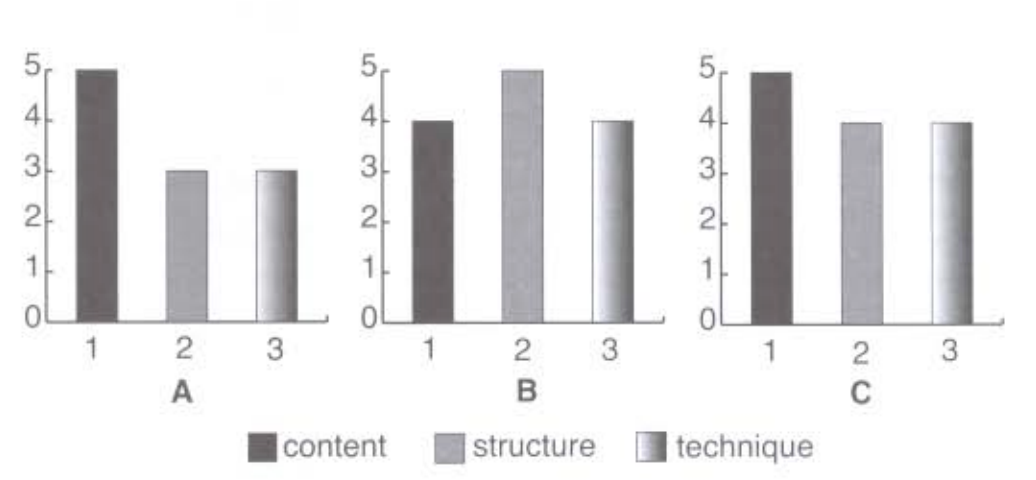
| Q27 | C | so, actually, I'm giving you full marks for content, five. The structure of the presentation was good, but not quite as good as the content, so, I gave that four, and the same for technique | Excerpt/Transcript Explanation: The transcript shows the teacher telling the students their specific grades: a 5 for the information they shared (content), a 4 for how they organized it (structure), and a 4 for their presentation skills (technique). Answer Explanation: The answer is choice C, which is a graph showing the points the teacher gave to the students. Reason For Correctness: The correct answer is C because the teacher clearly states the points for each of the three categories used to grade the presentation. The teacher gives the highest possible score of 5 for content. For the other two categories, structure and technique, the teacher gives a score of 4 for each. Choice C is the graph that matches these specific numbers: 5 for content, 4 for structure, and 4 for technique. |
| Q28 | ending / end | First of all, in your presentation I think your ending was rather abrupt – you suddenly just stopped talking | Excerpt/Transcript Explanation: The transcript shows the tutor specifically naming the "ending" of the presentation as being "abrupt," explaining that it felt like they just stopped talking without a smooth finish. Answer Explanation: The answer "ending" means the final part of the students' talk or presentation. Reason For Correctness: The correct answer is "ending" because the tutor uses the word "abrupt" to describe how the presentation finished. In English, "abrupt" is a synonym for "sudden," which is the word used in the task sentence to describe the transition or the way the talk finished. |
| Q29 | limitations | One thing I forgot to mention earlier was that I felt a very strong point was that after you'd given your results, you explained their limitations | Excerpt/Transcript Explanation: The transcript shows the teacher telling the students that it was very good that they explained why their research results might have some weaknesses or boundaries. Answer Explanation: The answer 'limitations' refers to the factors that might make the research results less certain or perfect, such as having a small or specific group of people to study. Reason For Correctness: The correct answer is 'limitations' because the tutor explicitly describes this part of the students' work as a 'very strong point.' In academia, when a teacher highlights a 'strong point,' they are offering praise. The tutor notes that the students did a good job of explaining these boundaries or weaknesses after presenting their research findings. |
| Q30 | literature | And you had some excellent charts and diagrams, but maybe you could flesh out the literature review a bit – I can give you some ideas for that later on if you want | Excerpt/Transcript Explanation: The transcript shows the teacher giving advice to the students about their written report. The teacher mentions that while their visual aids like charts were very good, they should add more information to the section where they review existing books and articles, called the 'literature review'. Answer Explanation: The answer 'literature' refers to a specific section of an academic project or report where the writers look at and discuss books, papers, or articles that have already been published on their research topic. Reason For Correctness: The correct answer is 'literature' because the tutor suggests that the students should 'flesh out' their 'literature review' in their final report. In English, to 'flesh out' something means to add more information or details to it, which is a synonym for the word 'extend' used in the question. This specific term identifies the part of the work that the tutor wants them to expand. |
Transcript
Tutor: So, Sharon and Xiao Li, in your presentation last week you were talking about the digital divide – the gap between those who can effectively use communication tools such as the Internet, and those who can't. And you compared the situation here in Northern Ireland with South-East China. Right, so I asked you to do some self-evaluation, watching the video of your presentation and thinking about the three main criteria you're assessed by – content, structure and technique. What do you think was the strongest feature of the presentation, when you watched it? Sharon?
Sharon: Well, I was surprised actually, because I felt quite nervous but, when I watched the video, it didn't show as much as I expected.
Tutor: So which of the criteria would that come under?
Sharon: Er, confidence?
Tutor: That's not actually one of the criteria as such. Xiao Li?
Xiao Li: Technique? It's body language and eye contact, isn't it. Well, I didn't think I looked all that confident, but I think that our technique was generally good – like the way we designed and used the PowerPoint slides.
Tutor: Mmm. So you both feel happiest about that side of the presentation? OK, now on the negative side, what would you change if you could do it again?
Xiao Li: Well, at first I'd thought that the introduction was going to be the problem but actually I think that was OK. We defined our terms and identified key issues. It was more towards the end ... the conclusion wasn't too bad but the problem was the questions, we hadn't really expected there'd be any so we hadn't thought about them that much.
Tutor: Uhuh. OK. Anything else?
Sharon: Well, like Xiao Li says, I thought the conclusion was OK, but when I watched us on the video I thought the section on solutions seemed rather weak.
Tutor: Mmm. Can you think why?
Sharon: Well, we explained what people are doing about the digital divide in China and Northern Ireland but I suppose we didn't really evaluate any of the projects or ideas, it was just a list. And that was what people were asking us about at the end, mostly.
Tutor: OK. Now, I also asked you to get some peer evaluation, from the other students.
Sharon: Yes, er, well, people said it was interesting, like the fact that in China the Internet was used more for shopping than in Northern Ireland. They said sometimes it was a bit hard to understand because we were talking quite fast ... but we didn't think so when we watched the video.
Tutor: No, it's a bit different though, because you know all this information already. Mmm. If you're hearing it for the first time, you need more time to process it ... that's why signposting the structure and organisation of the talk is important.
Xiao Li: That seemed OK, no one mentioned that as a problem. Some people said that we could have had more on the slides ... like some of the other groups had nearly everything they said written up on the visuals as well, but other people said the slides were good, they had just the key points.
Tutor: Yes.
Sharon: And most people said we had quite good eye contact and body language. They all pointed out we'd over-run ... they all said we were five minutes over but we timed it afterwards on the video and it was only three minutes.
Xiao Li: We were a bit unsure about the background reading at first, but I think we did as much as we could in the time ... anyway, no one commented on that under content, but one thing that did come out was that they liked the fact we'd done research on both Northern Ireland and China – most other people had just based their research on one country. We managed to get quite a lot of data from the Internet, although we had to do our own analysis and we did our own surveys as well in both countries. So the class gave us best feedback for content but it was all OK.
Tutor: Right. Well, that's quite similar to the feedback I'm giving you. I was very impressed by the amount of work you'd done and by your research methodology ... so, actually, I'm giving you full marks for content, five. The structure of the presentation was good, but not quite as good as the content, so, I gave that four, and the same for technique. So, well done.
Xiao Li/Sharon: Thank you.
Tutor: Now, the next stage is to write up your report. So, just a few pointers for you here. First of all, in your presentation I think your ending was rather abrupt – you suddenly just stopped talking. It wasn't a big problem but think about your closing sentences in your report – you want to round it off well. One thing I forgot to mention earlier was that I felt a very strong point was that after you'd given your results, you explained their limitations.
Xiao Li: The fact that we didn't have a very reliable sample in terms of age in China?
Tutor: Yes, that section. So don't forget to include that. And you had some excellent charts and diagrams, but maybe you could flesh out the literature review a bit – I can give you some ideas for that later on if you want. OK, is there anything else you want to ask?
Xiao Li/Sharon: No ... Thank you. / Thanks.