
Space Management in Supermarkets - IELTS Listening Answers & Explanations
From Cambridge IELTS 01 Academic Listening Test 3 · Part 4 · Questions 33–42
Audio
Questions
Questions 33–37 Table Completion
Complete the table Write NO MORE THAN THREE WORDS for each answer
SPACE MANAGEMENT
| RESEARCH METHOD | INFORMATION PROVIDED |
|---|---|
| Questionnaires | what customers think about 33 |
| 34 | how customers move around supermarket aisles |
| Eye movement 35 | the most eye-catching areas of the shop |
| Computer programs
e.g. 36 |
the best 37 for an article in the shop |
Questions 38–42 Diagram Labeling
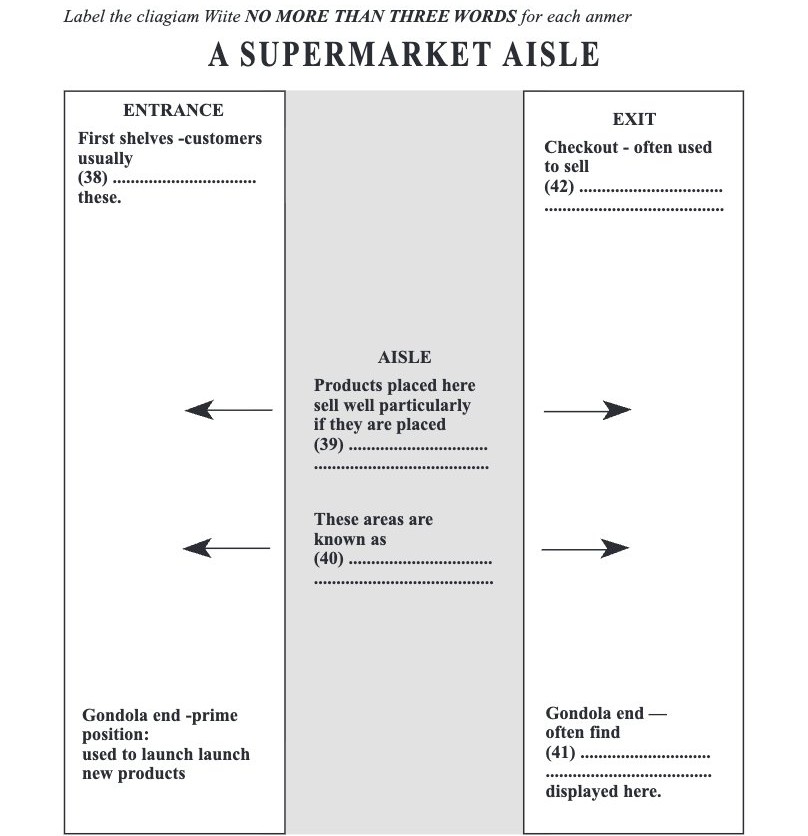
Label the diagram Write NO MORE THAN THREE WORDS for each answer
Answers & Explanations Summary
| # | Answer | Evidence | Explanation |
|---|---|---|---|
| Q33 | displays / products / displays and products | There is, for example, the simple and direct questionnaire which provides information from customers about their views on displays and products and then helps retailers make decisions about what to put where | Excerpt/Transcript Explanation: The transcript explains that stores use a simple survey called a questionnaire. This survey collects what customers think about how items are presented (displays) and the items themselves (products). Answer Explanation: The answer identifies the two things shoppers give their opinions on when they fill out a survey: the way things are shown in the store and the items for sale. Reason For Correctness: The correct answer is found by looking for the section about 'questionnaires.' The transcript says these surveys ask customers for their thoughts or 'views.' Specifically, it mentions they give feedback on 'displays and products.' This information helps store owners decide where to place items. |
| Q34 | hidden TV cameras / TV cameras / hidden television cameras / television cameras | Another method to help managers understand just how shoppers go around their stores are the hidden television cameras that film us as we shop and monitor our physical movement around the supermarket aisles: where do we start, what do we buy last, what attracts us, etc | Excerpt/Transcript Explanation: The transcript explains that one way store bosses learn about shoppers is by using cameras that people cannot see. These cameras record how people walk through the different parts of the store. Answer Explanation: The answer refers to cameras that are tucked away or hard to see, used by stores to watch where people go and what they do. Reason For Correctness: The correct answer is based on the section of the text discussing how supermarkets track people. The text explains that stores use cameras—which it calls 'hidden television cameras'—to watch or 'monitor' how customers walk or 'move' through the rows of the store. |
| Q35 | recorder / recording | More sophisticated techniques now include video surveillance and such devices as the eye movement recorder. This is a device which shoppers volunteer to wear taped into a headband, and which traces their eye movements as they walk round the shop recording the most eye-catching areas of shelves and aisles | Excerpt/Transcript Explanation: The transcript talks about an eye movement recorder, a tool that a shopper wears on a headband. This tool follows the path of their eyes to see which parts of the store are the most attractive to customers. Answer Explanation: The answer refers to a machine that tracks where a person looks or the process of tracking that eye movement. Reason For Correctness: The correct answer is identified from the part of the text describing advanced tools used to study shoppers. The speaker mentions a device called an eye movement recorder, which records where people look. This matches the table's requirement for a tool that identifies the most eye-catching parts of the store. |
| Q36 | Spaceman | Now, an example of this is Spaceman which is a computer program that helps the retailer to decide which particular product sells best in which part of the store | Excerpt/Transcript Explanation: The transcript mentions "Spaceman" as an example of a computer program that helps shop owners (retailers) choose the best places to put their products. Answer Explanation: The answer "Spaceman" is the specific name of a computer program used by shops to help them sell products. Reason For Correctness: The correct answer is identified because the speaker introduces a computer program called Spaceman as a tool for retailers. The speaker explains that this program suggests where products should be placed in the store to make the most money. In the context of the table, Spaceman is the specific example of the research method listed as "Computer programs." |
| Q37 | position / shelf / spot / place | Spaceman then suggests the most profitable combination of an article and its position in the store | Excerpt/Transcript Explanation: The transcript explains that the software finds the best pairing of a product and its physical location in the shop to make the most money. Answer Explanation: The answer refers to the specific location or area within a supermarket where an item is placed for customers to buy. Reason For Correctness: The correct answer is based on the description of the computer program 'Spaceman'. According to the transcript, this software analyzes data from checkouts to determine which items sell best in which areas. It ultimately tells the store owners the most profitable location for each product. Keywords and synonyms used in the text include 'position', 'part of the store', 'spot', and 'shelf areas'. |
| Q38 | walk straight past / walk right past / walk past / ignore / pass | When the film is speeded up, it clearly shows that we walk straight past these areas on our way to the centre of an aisle | Excerpt/Transcript Explanation: The transcript explains that when researchers watched videos of shoppers, they saw that people do not stay at the beginning of the aisle; they simply walk by those areas to get to the center. Answer Explanation: The answer describes what shoppers do when they first enter a supermarket aisle: they do not stop to look at products but instead keep moving toward the middle. Reason For Correctness: The correct answer is based on the consultant's explanation that people generally skip the products located at the start of an aisle. Using video research, experts found that shoppers move quickly through this section without stopping. This behavior explains why items placed there do not sell very well. Keywords to notice are 'walk straight past', which means to go by a place without stopping. |
| Q39 | at eye level / near customers' eyes | Now products displayed here sell well and do even better if they are placed at eye level so that the customer’s eyes hit upon them instantly | Excerpt/Transcript Explanation: The transcript explains that items located in the middle of a store aisle sell optimally when they are positioned at the same height as the shopper's eyes, making them immediately visible. Answer Explanation: The answer identifies the best vertical position for products on a shelf, which is at the same height as a shopper's eyes. Reason For Correctness: The correct answer is based on the logic that shoppers notice items more quickly when they don't have to look up or down. According to the transcript, products in the middle of an aisle sell even better when placed at "eye level" because customers see them "instantly." These specific shelf areas are valuable and are referred to as "hotspots." |
| Q40 | hotspots | Products here are snapped up and manufacturers pay a lot for these shelf areas which are known in the trade as hotspots | Excerpt/Transcript Explanation: The transcript states that people buy many products from these specific shelf locations. Because these spots are so good for selling items, companies pay a lot of money to use them, and they are called "hotspots." Answer Explanation: The answer "hotspots" is the name for the specific areas on supermarket shelves where items are sold most successfully. Reason For Correctness: The correct answer is based on the speaker's description of the middle section of a store aisle. According to the transcript, shoppers usually stop in the center of an aisle to look at products. Items placed there, especially at eye level, are very popular and sell quickly. The speaker identifies these highly valuable shelf locations by their industry name: "hotspots." |
| Q41 | special offers | Also, the end of an aisle may be used for promoting special offers which are frequently found waiting for us as we turn the corner of an aisle | Excerpt/Transcript Explanation: The transcript explains that the space at the end of a shopping row is used to show items with a special price, which shoppers find as they turn the corner. Answer Explanation: The answer "special offers" refers to products that are sold at a lower price or with a special deal to encourage people to buy them. Reason For Correctness: The correct answer is based on the description of the ends of the aisles, which are the best spots in a supermarket for getting people's attention. The consultant says these areas are used for showing new products or promoting "special offers." This means shoppers see these items right when they turn the corner into a new row. |
| Q42 | chocolates | That’s why the shelves at the checkout have long been a favourite for manufacturers of chocolates — perhaps the most sure-fire “impulse” food of all | Excerpt/Transcript Explanation: The transcript explains that the shelves where people wait to pay are the best place for selling chocolates because shoppers often buy them without planning to. Answer Explanation: The answer identifies a specific sweet snack that is commonly placed near the cash register to encourage quick, unplanned purchases. Reason For Correctness: The correct answer is found at the end of the transcript where the consultant explains shopping behavior near the payment area. Shops place items near the checkout because customers have to stand still and wait there. Chocolates are mentioned as the most successful product for this specific location because they are a popular 'impulse' food, meaning customers decide to buy them suddenly. |
Transcript
Marketing Consultant:
Good morning. Welcome to this talk on Space Management. And today I’m going to look particularly at space management in the supermarket.
Now since the time supermarkets began, marketing consultants, like us, have been gathering information about customers’ shopping habits.
To date, various research methods have been used to help promote the sales of supermarket products. There is, for example, the simple and direct questionnaire which provides information from customers about their views on displays and products and then helps retailers make decisions about what to put where.
Another method to help managers understand just how shoppers go around their stores are the hidden television cameras that film us as we shop and monitor our physical movement around the supermarket aisles: where do we start, what do we buy last, what attracts us, etc.
More sophisticated techniques now include video surveillance and such devices as the eye movement recorder. This is a device which shoppers volunteer to wear taped into a headband, and which traces their eye movements as they walk round the shop recording the most eye-catching areas of shelves and aisles.
But with today’s technology. Space Management is now a highly sophisticated method of manipulating the way we shop to ensure maximum profit. Supermarkets are able to invest millions of pounds in powerful computers which tell them what sells best and where.
Now, an example of this is Spaceman which is a computer program that helps the retailer to decide which particular product sells best in which part of the store. Now Spaceman works by receiving information from the electronic checkouts (where customers pay) on how well a product is selling in a particular position. Spaceman then suggests the most profitable combination of an article and its position in the store.
So, let’s have a look at what we know about supermarkets and the way people behave when they walk down the aisles and take the articles they think they need from the shelves.
Now here’s a diagram of one supermarket aisle and two rows of shelves. Here’s the entrance at the top left-hand corner.
Now products placed here, at the beginning of aisles, don’t sell well. In tests, secret fixed cameras have filmed shoppers’ movements around a store over a seven-day period. When the film is speeded up, it clearly shows that we walk straight past these areas on our way to the centre of an aisle. Items placed here just don’t attract people.
When we finally stop at the centre of an aisle, we pause and take stock, casting our eyes along the length of it. Now products displayed here sell well and do even better if they are placed at eye level so that the customer’s eyes hit upon them instantly. Products here are snapped up and manufacturers pay a lot for these shelf areas which are known in the trade as hotspots. Naturally everyone wants their products to be in a hotspot.
But the prime positions in the store are the ends of the aisles, otherwise known as Gondola ends. Now these stand out and grab our attention. For this reason new products are launched in these positions and manufacturers are charged widely varying prices for this privileged spot. Also, the end of an aisle may be used for promoting special offers which are frequently found waiting for us as we turn the corner of an aisle.
Well, now, eventually of course, we have to pay. Any spot where a supermarket can be sure we are going to stand still and concentrate for more than a few seconds is good for sales. That’s why the shelves at the checkout have long been a favourite for manufacturers of chocolates — perhaps the most sure-fire “impulse” food of all.