
Survey On Local Entertainment - IELTS Listening Answers & Explanations
From IELTS Practice Test Plus 1 Academic Listening Test 1 · Part 3 · Questions 23–32
Audio
Questions
Questions 23–24 Note Completion
Complete the notes below.
Write NO MORE THAN THREE WORDS for each answer.
Research details:
Title of project: 23
Focus of project: entertainment away from 24
Questions 25–28 One Choice
Circle the correct letters A-C.

Questions 29–32 Table Completion
Complete the chart about the different music clubs below.
Write NO MORE THAN TWO WORDS or use ONE of the labels for each answer.
A poor B OK C excellent
| Club | Type of music | Quality of venue |
|---|---|---|
| The Blues Club | Blues | 29 |
| The Sansue | 30 | C |
| Pier Hotel | Folk | 31 |
| Baldrock Café | Rock | 32 |
Answers & Explanations Summary
| # | Answer | Evidence | Explanation |
|---|---|---|---|
| Q23 | Out and About | Mike: Yes, so we've called our project 'Out and About' | Excerpt/Transcript Explanation: The transcript shows Mike clearly telling the tutor that the name or title of their work is 'Out and About'. Answer Explanation: The answer 'Out and About' is the specific name or title that the students gave to their research project. Reason For Correctness: The correct answer is found when Mike explicitly states the name of the project. In the conversation, he introduces the title by saying "we've called our project," which is a direct way to announce the name or title they are using. |
| Q24 | the university / university / the campus / campus | Yes, we deliberately omitted those as we really wanted to examine outside entertainment in the town as opposed to on the university campus | Excerpt/Transcript Explanation: The transcript shows that the students chose not to include school facilities in their project. They wanted to research entertainment in the town rather than on the school's property. Answer Explanation: The answer means that the students' project looked for fun activities that are located somewhere other than the school's own grounds. Reason For Correctness: The correct answer is based on Rosie's statement that they specifically left out (omitted) the school's own entertainment options. They did this because their goal was to study entertainment in the town instead of (as opposed to) what is available on the university campus. |
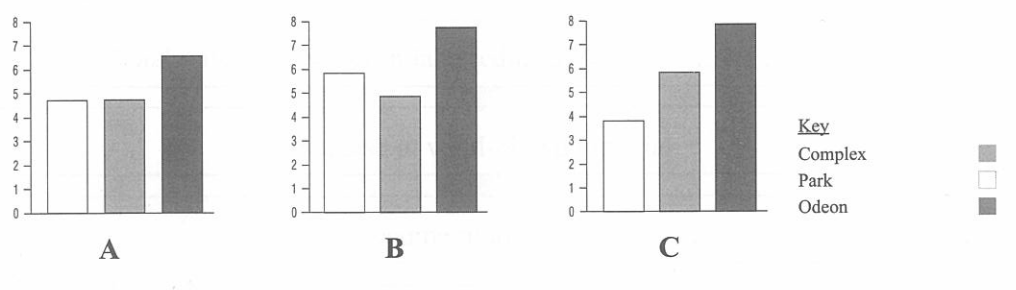
| Q25 | B | Mike: So if you look at this chart in terms of audience size, the multi-screen complex accounts for 75% of all cinema seats, the Park Cinema, accounts for 20% of seats and the late-night Odeon has just 5% of seats |
Excerpt/Transcript Explanation: The transcript shows Mike explaining the data on a chart. He lists three different cinemas and the exact percentage of seats each one provides: 75%, 20%, and 5%. Answer Explanation: The answer is Chart B because it correctly displays the proportions of seats for the three local cinemas mentioned in the survey. Reason For Correctness: The correct answer is B because Mike provides specific percentages for each cinema house during his presentation. He mentions that the multi-screen complex has 75% of the seats, the Park Cinema has 20%, and the late-night Odeon has 5%. Therefore, the chart that shows these specific numbers (75, 20, and 5) is the correct one. |
| Q26 | C | So, when we interviewed the students, we thought the complex would be the most popular choice of cinema but surprisingly it was the late-night Odeon |
Excerpt/Transcript Explanation: The transcript explains that when researchers talked to the students, they found that the late-night Odeon was the cinema students liked the most, even though the researchers expected the larger cinema complex to be the winner. Answer Explanation: The answer is Graph C, which displays the ranking of cinemas based on how much the local students like them. Reason For Correctness: The correct answer is C because the recording highlights that the late-night Odeon was the most popular choice among surveyed students. While the big multi-screen complex has the most seats and feels more modern, students actually preferred the smaller Odeon. Additionally, students liked the Park cinema more than the complex because the complex was too expensive and too far away. |
| Q27 | B | so students tend to buy seats at both and like using both for different reasons | Excerpt/Transcript Explanation: The transcript shows that students go to both theaters and enjoy them for their own special reasons. Answer Explanation: The answer B means that the students liked both theaters in the town about the same amount and visited both of them. Reason For Correctness: The correct answer is B because Mike says that students buy tickets for both theaters. He explains that students like and use both places for different reasons. This suggests that neither theater is more popular than the other; instead, they are liked equally by the students. |
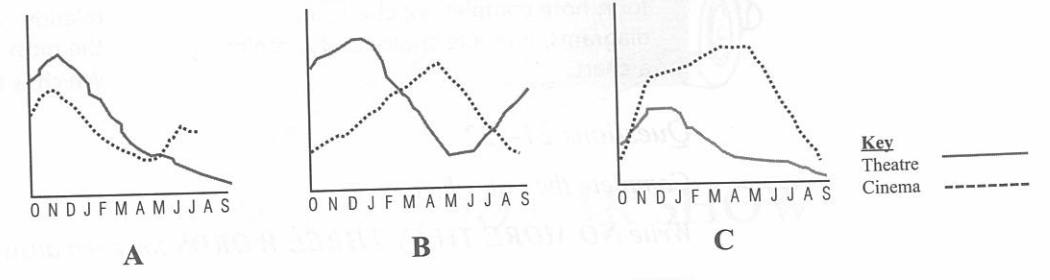
| Q28 | A | If you look at this graph, you can see that there's a peak around November/December when they go to the theatre more and then a period in April/May when neither is particularly popular and then theatre viewing seems to trail off virtually while the cinema becomes quite popular in June/July | Excerpt/Transcript Explanation: The transcript describes the movement of the lines on a graph: theatre is high at the end of the year, both are low in the middle of spring, and cinema goes up while theatre goes down in the early summer. Answer Explanation: The answer is Graph A because it correctly represents the data described about when students visit the cinema and the theatre. Reason For Correctness: The correct answer is A because the student describes specific patterns on the graph. They mention a high point (peak) for theatre visits in November and December. Then, they say that in April and May, both types of entertainment are not popular (meaning the lines on the graph go down). Finally, they note that theatre visits almost stop (trail off) in June and July while cinema visits become very popular. |
| Q29 | A | First of all, The Blues Club, which obviously specialises in blues music. This was a pretty small place and the seating was minimal so we didn't give that a very good rating | Excerpt/Transcript Explanation: The transcript shows that the club was too small and did not have enough seats, so the students gave it a bad score. Answer Explanation: The answer is 'A', which represents a 'poor' rating for the club's venue. Reason For Correctness: The correct answer is 'A' because the speakers describe the Blues Club as a small place with very few chairs (minimal seating). Because the space was not good, they gave it a low rating. In the provided choices, 'poor' is label 'A'. |
| Q30 | South American | Then The Sansue which plays a lot of South American music was a big place, very lively, good performers so two ticks for that one | Excerpt/Transcript Explanation: The transcript says that the music club called The Sansue is a large and fun place that plays many songs from South America. Answer Explanation: The answer is the specific style of music played at a club called The Sansue, which is music from the region of South America. Reason For Correctness: The correct answer is correct because Rosie mentions the name of the club, 'The Sansue,' and immediately says that it plays a lot of 'South American' music. In the presentation, the speakers lists different music places and explains what kind of music people can hear at each one. |
| Q31 | B | The Pier Hotel is a folk venue a good place for local and up-and-coming folk artists to play. Not the best of venues as it's in a basement and a bit dark but the quality of the entertainment was reasonable and the lighting was very warm so we felt it deserved an average rating |
Excerpt/Transcript Explanation: The transcript shows that the students gave the Pier Hotel an 'average rating' because it was okay overall, even though it was a bit dark and in a basement. Answer Explanation: The answer is B, which means the quality of the venue is 'OK' or 'average'. Reason For Correctness: The correct answer is B because Rosie describes the Pier Hotel as having an 'average rating'. In the survey's scoring system, an average score matches with the label 'OK', which corresponds to the letter B. The speakers mentioned the venue was in a dark basement but had good lighting/entertainment, leading them to give it a middle score. |
| Q32 | C | Finally, there's the Baldrock Café which features big rock bands and is pretty popular with students and we enjoyed ourselves there as well, so top marks for that one | Excerpt/Transcript Explanation: The transcript explains that the Baldrock Café is a place that plays rock music and is popular with students. Because it was a high-quality experience, the speakers gave it the best score, which they call 'top marks.' Answer Explanation: The answer is 'C', which is the label code for 'excellent quality' regarding the music club's venue. Reason For Correctness: The correct answer is 'C' because the speaker gives the Baldrock Café 'top marks.' In the ranking system mentioned in the presentation (two ticks for excellent), 'top marks' refers to the best possible category provided in the list (A, B, or C). Since label 'C' stands for 'excellent' and is the highest rating available, it is the correct choice to describe the Baldrock Café. |
Transcript
Tutor: Good morning everyone. Well I think we can start straightaway by getting Rosie and Mike to do their presentation. Would you like to start, Rosie?
Rosie: Yes, well, um, we've done a survey on local entertainment. Basically, we tried to find out how students feel about the entertainment in the town and how much they use it.
Mike: Yes, so we've called our project 'Out and About' ...
Tutor: Yes, that's a good title! 'Out and About'.
Rosie: We wanted to find out how well students use the entertainment facilities in town ... whether they get to see the latest plays, films ... that kind of thing.
Tutor: Now, we have our own facilities on campus of course ...
Rosie: Yes, we deliberately omitted those as we really wanted to examine outside entertainment in the town as opposed to on the university campus.
Mike: Actually there were a lot of areas to choose from but in the end we limited ourselves to looking at three general categories: cinema, theatre and music.
Tutor: Right.
Rosie: OK. Well, first of all cinema. In the town, there are three main places where you can see films. There's the new multi-screen cinema complex, the old Park cinema, and a late-night Odeon.
Mike: So if you look at this chart ... in terms of audience size, the multi-screen complex accounts for 75% of all cinema seats, the Park Cinema, accounts for 20% of seats and the late-night Odeon has just 5% of seats.
Rosie: As you probably know, the complex and the Park show all the latest films, while the late-night cinema tends to show cult films. So, when we interviewed the students, we thought the complex would be the most popular choice of cinema ... but surprisingly it was the late-night Odeon.
Mike: Yeah, and most students said that if they wanted to see a new film, they waited for it to show at the Park because the complex is more expensive and further out of town so you have to pay more to get there as well.
Tutor: Yes, and that adds to the cost, of course, and detracts from the popularity, evidently.
Rosie: Well, next, we looked at theatres. The results here were interesting because, as you know, there's a theatre on campus, which is popular. But there's also the Stage Theatre in town, which is very old and architecturally quite beautiful. And there's the large, modern theatre, the Ashtop, that has recently been built.
Tutor: So you just looked at the two theatres in town?
Mike: Yes. But the thing about the theatres is that there's a whole variety of seat prices. Also, the types of performance vary ... so students tend to buy seats at both and like using both for different reasons and if they want cheap seats at the Ashtop, they can just sit further from the front.
Rosie: What we did find that was very interesting is that there are periods during the year when students seem to go to the theatre and periods when they go to the cinema and we really think that's to do with budget. If you look at this graph, you can see that there's a peak around November/December when they go to the theatre more and then a period in April/May when neither is particularly popular and then theatre viewing seems to trail off virtually while the cinema becomes quite popular in June/July.
Tutor: Mmm. I think you're probably right about your conclusions ...
Mike: Well, lastly we looked at music. And this time we were really investigating the sort of small music clubs that offer things like folk or specialise in local bands.
Tutor: So not musicals as such ...
Mike: That's right.
Rosie: We looked at three small music venues and we examined the quality of the entertainment and venue and gave a ranking for these: a cross meaning that the quality was poor, a tick meaning it was OK and two ticks for excellent. First of all, The Blues Club, which obviously specialises in blues music. This was a pretty small place and the seating was minimal so we didn't give that a very good rating.
Mike: No! We don't recommend that one really.
Rosie: Then The Sansue which plays a lot of South American music was a big place, very lively, good performers so two ticks for that one. The Pier Hotel is a folk venue ... a good place for local and up-and-coming folk artists to play. Not the best of venues as it's in a basement and a bit dark but the quality of the entertainment was reasonable and the lighting was very warm so we felt it deserved an average rating. Finally, there's the Baldrock Café which features big rock bands and is pretty popular with students and we enjoyed ourselves there as well, so top marks for that one.
Tutor: And then did you get any information from the students as to which of the clubs they preferred?