
The Zip Fastener - IELTS Listening Answers & Explanations
From Oxford IELTS Practice Tests Academic Listening Test 2 · Part 4 · Questions 33–42
Audio
Questions
Questions 33–36 Table Completion
Look at the table.
Write NO MORE THAN TWO WORDS OR A NUMBER for each answer.
The Zip Fastener
| Year | Inventor | Name | Commercial success | Country |
|---|---|---|---|---|
| 1851 | Howe | ‘Automatic Continuous Clothing Closure’ | commercial potential only | USA |
| 1893 | Judson | ‘Clasp Locker’ | commercial failure | 33 |
| 1908 | Sundback | ‘34 Fastener’ | commercial success | Sweden |
| 35 | Kynoch | ‘Ready Fastener’ | commercial success | UK |
| 1920s | BF 36 | ‘Zipper’ | commercial success | USA |
Questions 37–41 Diagram Labeling
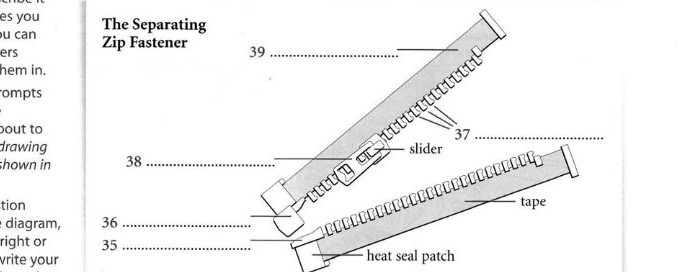
Label the zip. Write NO MORE THAN THREE WORDS for each answer.
Questions 42–42 One Choice
Choose the correct letter, A, B, C or D.
Answers & Explanations Summary
| # | Answer | Evidence | Explanation |
|---|---|---|---|
| Q33 | the US / US / the USA / USA / the America / America | It wasn't until 1893, though, that someone actually tried to market the zip, when Whitcomb Judson, another American inventor, took what he called the Clasp Locker to the World's Fair held that year in the US | Excerpt/Transcript Explanation: The transcript explains that in the year 1893, an American inventor named Whitcomb Judson presented his item, the Clasp Locker, in the US. Answer Explanation: The answer is the country "US", "USA", or "America". Reason For Correctness: The correct answer is (the) US/USA/America because the table asks for the country associated with the inventor Judson and his 1893 invention, the 'Clasp Locker'. The speaker states that Whitcomb Judson was "another American inventor" and brought his invention to the World's Fair in the "US". Therefore, the country is the US/USA/America. |
| Q34 | hookless | this time a more reliable model with facing sets of teeth named the Hookless Fastener, designed by a Swedish engineer called Gideon Sundback. Attached to clothing, purses and other items, it sold quite well | Excerpt/Transcript Explanation: The transcript explains that an engineer from Sweden named Gideon Sundback created a better model with teeth, and this invention was named the "Hookless Fastener". Answer Explanation: The answer is the word "hookless", which is the missing part of the product's name. Reason For Correctness: The correct answer is "hookless" because the table asks for the name of the fastener created by Sundback, written as "‘ Fastener’". In the transcript, the speaker directly states that Sundback's model was named the "Hookless Fastener". Since the word "Fastener" is already in the table, only "hookless" is needed to complete the title. |
| Q35 | 1919 | The British firm Kynoch began producing and selling the Ready Fastener in large numbers in 1919 | Excerpt/Transcript Explanation: The transcript states that a British company named Kynoch started producing and selling the 'Ready Fastener' in the year 1919. Answer Explanation: The answer is the year 1919. Reason For Correctness: The correct answer is 1919 because the speaker mentions that the British company Kynoch started making and selling the Ready Fastener in that year. In the table, this row asks for the year associated with Kynoch and the 'Ready Fastener'. |
| Q36 | Goodrich | and a few years later the Zipper, designed and given its modern American name by BF Goodrich, made Mr Goodrich extremely rich indeed | Excerpt/Transcript Explanation: The transcript explains that the modern item called the 'Zipper' was designed by BF Goodrich, earning him a lot of money. Answer Explanation: The answer means the inventor named BF Goodrich (or Goodrich). Reason For Correctness: The correct answer is Goodrich because the speaker explains that a few years after 1919 (in the 1920s), the 'Zipper' was designed and named by BF Goodrich in America, which became very successful commercially and made him very rich. |
| Q37 | the pin | Now alongside the heat seal patch is a small piece of metal, used only on a separating zip, whose function is to enable the two halves of the zip to join. This is known as the 'pin' | Excerpt/Transcript Explanation: The transcript explains that the small metal part next to the heat seal patch that lets both sides of the zipper join together is called the 'pin'. Answer Explanation: The answer refers to the "pin", which is the small metal piece at the base of a zipper. Reason For Correctness: The correct answer is "pin" because the speaker describes the parts of the zipper shown in the diagram. When describing the part next to the heat seal patch that helps join the two halves of the zipper together, the lecturer clearly identifies it as the "pin". |
| Q38 | the box | Opposite that, on the other half of the zip in the diagram, is a device which correctly aligns the pin. The 'box', as it's called, begins the joining of the zip halves | Excerpt/Transcript Explanation: The transcript explains that on the other side of the zipper, opposite the pin, there is a piece called the "box" that puts the pin in the right position and starts joining the two sides together. Answer Explanation: The answer is "box", which is the part at the bottom of a zipper that holds and aligns the pin to help connect the two sides. Reason For Correctness: The correct answer is "box" because the lecturer describes the separable zip diagram and mentions the part opposite the pin that aligns the pin and begins the joining process. The speaker explicitly names this part "the 'box'". |
| Q39 | the metal teeth / the teeth / metal teeth / teeth | Running up the inside edge of each half are dozens, possibly hundreds, of metal 'teeth', each of which has a small hook and an equally tiny hollow | Excerpt/Transcript Explanation: The transcript explains that many small metal pieces called 'teeth' are placed along the inside edges of both sides of the zip to lock together. Answer Explanation: The answer refers to the "(metal) teeth", which are the small interlocking parts running along the inner edges of a zipper. Reason For Correctness: The correct answer is confirmed because the lecturer describes the parts of the zipper in detail. Along the inside edge of each half, there are many small metal parts with hooks and hollows that lock together, which the speaker specifically identifies as "teeth" or "metal 'teeth'". |
| Q40 | a pull tab / the pull tab / pull tab | Moving up and down the teeth, to open and close the zip, is a piece of metal called the slider. This is operated by means of a 'pull tab', so called because, logically enough, the wearer or user pulls it in one direction or the other | Excerpt/Transcript Explanation: The transcript explains that the slider opens and closes the zipper and is moved by using the part called the "pull tab". Answer Explanation: The answer refers to the "pull tab", which is the small piece you hold and pull to open or close a zipper. Reason For Correctness: The correct answer is "pull tab" because the speaker explains that the metal slider (which moves up and down to open and close the zip) is operated by the "pull tab", named because the user pulls it. |
| Q41 | a top stop / the top stop / top stop | To prevent the slider coming off the teeth at the other end, there is a 'top stop' on both sides of the zip | Excerpt/Transcript Explanation: The transcript explains that the part on both sides of the zipper used to prevent the slider from coming off the teeth is called a "top stop." Answer Explanation: The answer refers to the component called the "top stop," which is fixed at the upper end of a zipper to keep the slider in place. Reason For Correctness: The correct answer is "top stop" because the lecturer describes the parts of a zipper and explains that to stop the slider from sliding off the teeth at the top end, there is a "top stop" positioned on both sides. |
| Q42 | B | Right, as you can see, we are going to be looking at the zip, or zipper as it's known in the US, which is where it had its origins in 1851 | Excerpt/Transcript Explanation: The transcript introduces the topic by stating that the talk will focus on the zip fastener and trace back to when and where it first began in 1851. Answer Explanation: The answer means that the speaker wants to describe the history and progression of how the zipper was created and improved over time. Reason For Correctness: The correct answer is B because throughout the lecture, the speaker traces the history and improvement of the zipper from its invention in 1851 by Elias Howe, through various models and inventors over the years, to its separable design and modern form. The lecturer is not trying to sell a product (advertise), warn people about dangers, or explain multiple different types, but rather giving an overview of its historical development. |
Transcript
LECTURER: I think you all have a copy of the printed notes and diagram ... but I should point out before we go any further that there are a few mistakes in those notes, so please correct any you notice as we go along. Right, as you can see, we are going to be looking at the zip, or zipper as it's known in the US, which is where it had its origins in 1851. In fact, it was initially given the rather less catchy name of the Automatic Continuous Clothing Closure by the person that invented it: Elias Howe, who also designed the first sewing machine. It wasn't until 1893, though, that someone actually tried to market the zip, when Whitcomb Judson, another American inventor, took what he called the Clasp Locker to the World's Fair held that year in the US. His hook and eye system was a commercial disaster, and it was another fifteen years before the buying public began to take an interest: this time a more reliable model with facing sets of teeth named the Hookless Fastener, designed by a Swedish engineer called Gideon Sundback. Attached to clothing, purses and other items, it sold quite well. Gradually this new alternative to buttons caught on, as people realized the advantages of a fastener that only needed one hand to operate, that children could use, that left no visible gaps, and so on. The British firm Kynoch began producing and selling the Ready Fastener in large numbers in 1919, and a few years later the Zipper, designed and given its modern American name by BF Goodrich, made Mr Goodrich extremely rich indeed.
If its use in trousers was a major factor in establishing the zip as a fashion icon, despite its occasional tendency to trap parts of the wearer's anatomy, another major breakthrough came with the separable zip: the kind that opens at both ends. This type, still widely used in a range of items from jackets to tents, is shown in the diagram. Let's look first at the right-hand side of the illustration, at the material attached to the item of clothing, the bag or whatever. This is the tape, which is usually made of fairly tough fabric. At the end of that there's what is known as the heat seal patch: the cotton and nylon laminated material used to reinforce the tape. Now alongside the heat seal patch is a small piece of metal, used only on a separating zip, whose function is to enable the two halves of the zip to join. This is known as the 'pin'. Opposite that, on the other half of the zip in the diagram, is a device which correctly aligns the pin. The 'box', as it's called, begins the joining of the zip halves. Running up the inside edge of each half are dozens, possibly hundreds, of metal 'teeth', each of which has a small hook and an equally tiny hollow. Moving up and down the teeth, to open and close the zip, is a piece of metal called the slider. This is operated by means of a 'pull tab', so called because, logically enough, the wearer or user pulls it in one direction or the other. To close the zip, a wedge inside the slider pushes the hook of each tooth on one side into the hollow of each offset tooth on the other; to open it, the wedge forces them apart. To prevent the slider coming off the teeth at the other end, there is a 'top stop' on both sides of the zip. This basic design has changed little in the many years since it was first introduced, although nowadays, of course, zips – zippers – are available in a whole range of shapes, sizes and materials.