
Visiting The Sheepmarket Area - IELTS Listening Answers & Explanations
From Cambridge IELTS 12 Academic Listening Test 4 · Part 2 · Questions 11–20
Audio
Questions
Questions 11–14 One Choice
Choose the correct letter, A, B or C.
Visiting the Sheepmarket area
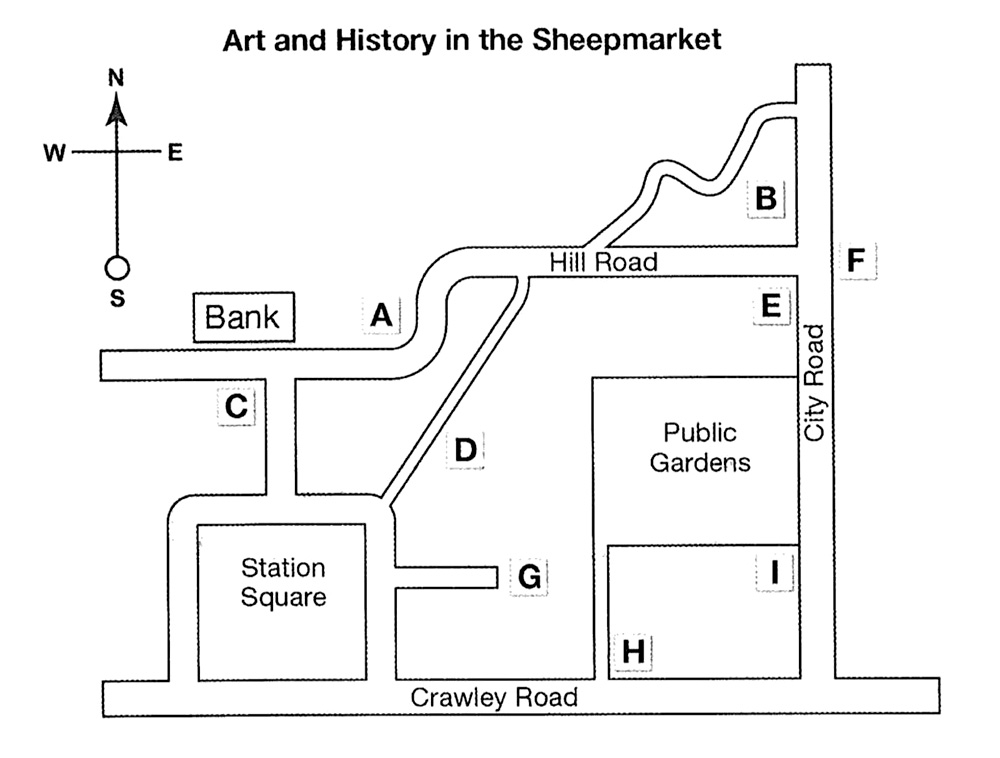
Questions 15–20 Map Labeling
Label the map below
Write the correct letter, A-I, next to Questions
Answers & Explanations Summary
| # | Answer | Evidence | Explanation |
|---|---|---|---|
| Q11 | A | now graduates embarking on careers in the worlds of fashion and design are buying up the new apartments recently built here to replace the small houses where the market workers used to live. | Excerpt/Transcript Explanation: The transcript mentions that young graduates who are starting careers in fashion and design are buying the new apartments in the Sheepmarket area, replacing the small houses where market workers used to live. Answer Explanation: The answer choice A, young professional people, is correct. This group refers to recent graduates who have started working in a field, such as fashion and design. Reason For Correctness: The correct answer is A because the excerpt specifically mentions graduates embarking on careers in fashion and design as the group rapidly growing in the Sheepmarket area. This fits the description of young professional people. |
| Q12 | C | The narrow old side streets are great places for finding original pictures, jewellery and ceramics | Excerpt/Transcript Explanation: The transcript talks about how the small old streets around Sheepmarket have a lot of original pictures, jewelry, and ceramics that you can buy. Answer Explanation: The answer choice C, which is 'arts and crafts,' means things like unique handmade items that you can buy, such as artwork or pottery. Reason For Correctness: The correct answer is C because the excerpt mentions finding original pictures, jewelry, and ceramics in the narrow old side streets, which are examples of arts and crafts. |
| Q13 | B | This year they’ve been asked to design an outfit based on ideas from the music and technology that’s part of their everyday life | Excerpt/Transcript Explanation: The transcript talks about young designers creating clothes that are influenced by the music and technology they encounter daily. Answer Explanation: The answer choice B is saying that the clothes should be inspired by elements of modern culture like music and technology. Reason For Correctness: The correct answer is B because the excerpt mentions that the designers are asked to base their outfits on ideas from music and technology, which aligns with being inspired by aspects of contemporary culture. |
| Q14 | B | if you can present a receipt from one of the local stores, you’ll not be charged at all. | Excerpt/Transcript Explanation: The transcript says that if you show a piece of paper that shows you bought something from one of the nearby stores, you won't have to pay at all. Answer Explanation: The answer means that you don't have to pay for parking if you buy something from the shops close by. Reason For Correctness: The correct answer is 'B' because the excerpt clearly states that if you can show a receipt from a local store, you won't have to pay for parking. This matches with choice 'B' which says 'buy something in the shops'. |
| Q15 | H | The Reynolds House is one of the oldest houses in the city, and is open to the public. It’s on the north side of Crawley Road, next to the footpath that leads to the public gardens. | Excerpt/Transcript Explanation: The transcript talks about a house called the Reynolds House. It mentions that this house is very old and that it is open for anyone to visit. The house is located on the north side of Crawley Road near a path that goes to public gardens. Answer Explanation: The answer 'H' corresponds to the Reynolds House on the map. Reason For Correctness: The correct answer is 'H' because the transcript specifically mentions the Reynolds House being one of the oldest houses in the city and gives details about its location next to Crawley Road and the footpath leading to public gardens. Therefore, 'H' is the correct letter to label for the Reynolds House on the map. |
| Q16 | C | The Thumb’s is just what its name suggests, but it’s about 10 metres high. You’ll see it on Hill Road, across the road from the Bank. | Excerpt/Transcript Explanation: The transcript describes a tall structure, called 'The Thumb,' located on Hill Road opposite the Bank. Answer Explanation: The answer 'C' corresponds to 'The Thumb' on the map. Reason For Correctness: The correct answer is 'C' because based on the description provided in the excerpt, 'The Thumb' is the correct label on the map, matching the location mentioned on Hill Road. |
| Q17 | F | The Museum’s got a particularly fine collection of New Zealand landscapes. It’s on the east side of the Sheepmarket, on City Road. It’s on the other side of the road from the public gardens, immediately facing the junction with Hill Road. | Excerpt/Transcript Explanation: The transcript describes a museum that has a nice collection of New Zealand landscapes. The museum is located on City Road on the east side of the Sheepmarket, across from the public gardens and near the junction with Hill Road. Answer Explanation: The answer F corresponds to the location of 'The Museum' on the map. Reason For Correctness: The correct answer is F because the description in the excerpt matches the location provided for 'The Museum' on the map, which is on the east side of the Sheepmarket, on City Road. This indicates that the museum is at position F on the map. |
| Q18 | G | The Contemporary Art Gallery is on a little road that leads off Station Square, not far from the public gardens. The road ends at the gallery – it doesn’t go anywhere else. | Excerpt/Transcript Explanation: The transcript explains that the Contemporary Art Gallery is located on a small road near Station Square, close to the public gardens. The road only leads to the gallery and does not continue elsewhere. Answer Explanation: The answer 'G' corresponds to the Contemporary Art Gallery on the map. Reason For Correctness: The correct answer is 'G' because it matches the location described in the excerpt, where the Contemporary Art Gallery is situated at the end of a road near Station Square, making it a logical fit for the label on the map. |
| Q19 | I | The Warner Gallery specialises in 19th-century art. It’s on City Road, near the junction with Crawley Road, on the same side of the road as the public gardens. | Excerpt/Transcript Explanation: The transcript talks about the Warner Gallery, which is a place that focuses on art from the 19th century. It is located on City Road, near the junction with Crawley Road, on the same side of the road as the public gardens. Answer Explanation: The answer 'I' matches the location of the Warner Gallery on the map. Reason For Correctness: The correct answer is 'I' because the Warner Gallery, which specializes in 19th-century art, is positioned on City Road, near the junction with Crawley Road. Since the instructions ask for the correct letter corresponding to the Warner Gallery's location, 'I' accurately represents that spot on the map. |
| Q20 | B | Finally, if you’re interested in purchasing high quality artwork, the place to go is Nucleus. You need to go from Crawley Road up through Station Square and east along Hill Road until you get to a small winding road turning off. Go up there and it’s on your right – if you get to City Road you’ve gone too far. | Excerpt/Transcript Explanation: The transcript is giving directions to a place called Nucleus. It mentions that to reach Nucleus, you need to follow specific roads from Crawley Road. Answer Explanation: The answer 'B' corresponds to Nucleus on the map. Reason For Correctness: The correct answer is 'B' because the directions in the excerpt mention going up through Station Square and east along Hill Road until reaching a small winding road turning off, where Nucleus is located on the right. This matches the position of 'B' on the map. |
Transcript
Welcome to this podcast about the Sheepmarket, which is one of the oldest parts of the city. As its name suggests, there was originally a market here where farmers brought their sheep, but now it’s been redeveloped into a buzzing, vibrant area of the city, which is also home to one of the city’s fastest-growing communities. The nearby university has always meant the area’s popular with students, who come in to enjoy the lively nightlife, but now graduates embarking on careers in the worlds of fashion and design are buying up the new apartments recently built here to replace the small houses where the market workers used to live.
The narrow old side streets are great places for finding original pictures, jewellery and ceramics which won’t break the bank, as well as local produce like fruit and vegetables. There’s also lots of pavement cafes where you can have a coffee and watch tourists from all over the world go by. The oldest buildings in the area are on the main streets, including the city’s first department store, built in the 1880s, which is still open today.
The Sheepmarket is a centre for fashion, and there’s a policy of encouraging new young designers. The Young Fashion competition is open to local young people who are passionate about fashion. This year they’ve been asked to design an outfit based on ideas from the music and technology that’s part of their everyday life, using both natural and man-made fibres. The garments will be judged by a panel of experts and fashion designers, and the winning entries will be modelled at a special gala evening.
Parking at the Sheepmarket is easy. There are plenty of pay and display car parking spaces on the roadsides which are fine if you just want to stay for an hour or two, but if you want to spend the day there it’s better to park in one of the four underground car parks. It’s not expensive and if you can present a receipt from one of the local stores, you’ll not be charged at all. After six pm many of the car parks have a flat rate which varies but it is usually very reasonable.
————————
The Sheepmarket is one of the main centres for art and history in the whole of the country. If you look at our map, you’ll see some of the main attractions there. Most visitors start from Crawley Road, at the bottom of the map. The Reynolds House is one of the oldest houses in the city, and is open to the public. It’s on the north side of Crawley Road, next to the footpath that leads to the public gardens.
The area’s particularly interesting for its unusual sculptures. The Thumb’s is just what its name suggests, but it’s about 10 metres high. You’ll see it on Hill Road, across the road from the Bank.
The Museum’s got a particularly fine collection of New Zealand landscapes. It’s on the east side of the Sheepmarket, on City Road. It’s on the other side of the road from the public gardens, immediately facing the junction with Hill Road.
The Contemporary Art Gallery is on a little road that leads off Station Square, not far from the public gardens. The road ends at the gallery – it doesn’t go anywhere else. That’s open every day except Mondays.
The Warner Gallery specialises in 19th-century art. It’s on City Road, near the junction with Crawley Road, on the same side of the road as the public gardens. It’s open on weekdays from 9 to 5, and entry is free.
Finally, if you’re interested in purchasing high quality artwork, the place to go is Nucleus. You need to go from Crawley Road up through Station Square and east along Hill Road until you get to a small winding road turning off. Go up there and it’s on your right – if you get to City Road you’ve gone too far.