
Fracking - IELTS Reading Answers & Explanations
From Collins Practice Tests For IELTS 2 General Training Reading Test 2 · Part 3 · Questions 26–40
Reading Passage
Read the article below and answer Questions 26–40.
Fracking
Fracking refers to a technique for extracting natural gas from shale deep within the earth. Fracking is shorthand for 'hydraulic fracturing' and refers to how shale rock is fractured apart by injecting a mixture of water and chemicals into it at very high pressure. Fracking for shale gas has become big business in the United States, where the search for energy is one of the country's main concerns. However, the procedure is controversial and has as many opponents as supporters.
Fracking is not a new technique. It was first used in the 1860s, and then used industrially in 1949. However, as the oil reserves in America decreased and energy sources from abroad became more expensive, gas trapped in shale became an attractive commercial proposition. Shale gas is natural gas, or methane, trapped in tiny pockets in shale rock formations. Shale rock is a form of mudstone formed between 252 and 66 million years ago. It is distinguishable because it is laminated (made up of thin layers) and fissile (it can be split into thin layers). For the energy industry, black shale is important because it is the source rock for many of the world's most important oil and gas reserves. Black shale gets its colour from organic matter that was deposited along with the mud from which the shale formed. As the mud was compressed and warmed within the earth, the organic material was transformed into oil and natural gas.
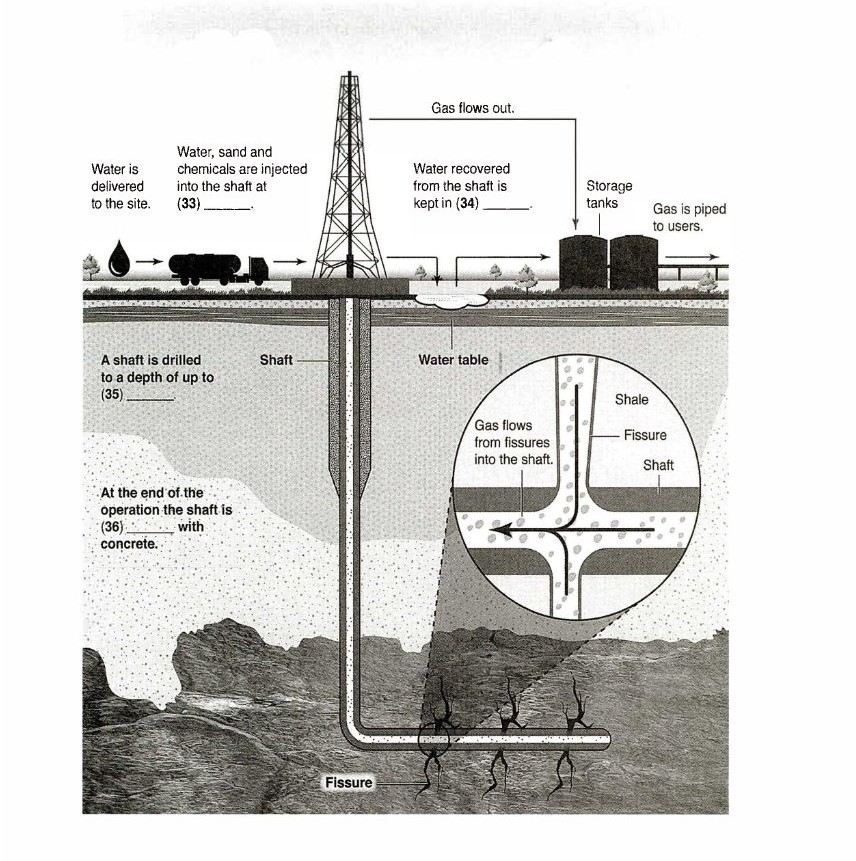
In order to extract shale gas, a shaft, or well, is drilled to over one mile deep into the earth and then horizontally into the shale rock. The vertical well is then encased in steel and/or cement. After that, water needs to be delivered to the site: this can be up to 200 tanker trucks. The water is mixed with sand and chemicals and a pumper truck injects this hydraulic fluid into the shaft at high pressure, causing the shale to crack, or fracture. The sand in the mixture keeps the cracks open, allowing gas to flow to the surface into storage tanks. The gas is then piped to users. Meanwhile, water recovered from the shaft is stored in open pits before being taken to a treatment plant for recycling and eventual reuse. After all the gas has been collected, the shaft is sealed off with concrete to make sure that the injected hydraulic fluid cannot escape into water supplies.
An estimated 250 billion cubic metres of natural gas were brought to the surface using this method in the US in 2013. Since the US government gave out licenses to companies, its carbon emissions have gone down. Indeed, fracking has quite a few things going for it. This is because natural gas is far cleaner to burn than oil or coal in power stations. Furthermore, the area occupied by a fracking well is much smaller than a conventional oil well. So the question is, if fracking is so simple, clean and efficient, why are people concerned about it?
The problem is in the method used to get the gas out. The chemicals in the hydraulic fluid are toxic, consisting of a mixture of lubricants, poisons to stop bacteria growing in the pipes, and hydrochloric acid to dissolve unwanted cement in the pipes. This chemical mix finds its way to the surface through accidents at well-heads, fluids flowing back to the surface and leaks in the system. There is also the economical and environmental cost of transporting and using water – between three and five million gallons of water are needed to fracture a seam.
Furthermore, some experts think that fracking may be linked to the occurrence of earthquakes – earthquakes of magnitude 2.7 on the Richter scale have been increasing near Oklahoma City, an area where gas has been extracted using the technique. But perhaps the most persuasive argument is that fracking simply prolongs our over-reliance on carbon-based fuels, when we should be moving to technologies that do not produce carbon emissions or that are not harmful to the environment, such as solar energy, wind or wave power. In effect, fracking does not deal with the real issue of how we can produce energy without harming the environment. However, many people think fracking could be America's bridge between the carbon-based energy systems of the past and a cleaner way of producing energy in the future.
Questions
Questions 26–32 True / False / Not Given
Do the following statements agree with the information given in the article?
Write
TRUE if the statement agrees with the information
FALSE if the statement contradicts the information
NOT GIVEN if there is no information on this
Questions 33–36 Diagram Labeling
Read the third paragraph again and complete the diagram.
Choose NO MORE THAN TWO WORDS from the article for each answer.
Questions 37–40 Summary Completion
Complete the summary of the final paragraph below.
Choose NO MORE THAN TWO WORDS from the article for each answer.
Opponents of fracking believe that 37 may be caused by the process. In addition, they claim that fracking encourages the United States' 38 on fossil fuels. They say that fracking does not help us to tackle the 39 but it may act as a 40 from carbon-based energy to green energy production.
Answers & Explanations Summary
| # | Answer | Evidence | Explanation |
|---|---|---|---|
| Q26 | TRUE | It was first used in the 1860s, and then used industrially in 1949 | Excerpt/Passage Explanation: The passage says that while fracking was first tried a very long time ago in the 1860s, it began to be used for industry and business in 1949. Answer Explanation: The answer means that the statement is correct and matches the information given in the text. Reason For Correctness: The correct answer is TRUE because the text says fracking was used 'industrially' starting in 1949. In this context, 'industrially' means the same things as 'commercially,' which relates to being used for business and jobs. Since both the text and the question agree on the date of 1949 for this type of use, the statement is true. |
| Q27 | TRUE | As the mud was compressed and warmed within the earth, the organic material was transformed into oil and natural gas | Excerpt/Passage Explanation: The passage explains that when the ground squeezed and heated the old mud, the organic pieces inside changed into oil and natural gas. Answer Explanation: The answer is TRUE because the text says that natural gas is made from organic matter found in the mud that becomes shale rock. Reason For Correctness: The correct answer is supported by the text's explanation of how shale gas is created. It describes how organic matter (remains of living things) was trapped in mud long ago. Over time, heat and pressure from inside the earth changed this material into the natural gas we find in the rocks today. This confirms that the gas comes from organic material. |
| Q28 | NOT GIVEN | Black shale gets its colour from organic matter that was deposited along with the mud from which the shale formed | Excerpt/Passage Explanation: The passage explains that organic material was mixed with mud a long time ago to make shale, but it does not say if that material came from the sea. Answer Explanation: The answer is NOT GIVEN because the text does not tell us if the organic material came from creatures that lived in the sea. Reason For Correctness: The correct answer is NOT GIVEN because while the passage discusses the origin of organic matter in shale, it never mentions "sea water" or "marine life." It only states that the organic matter was put there along with the mud. Since the text lacks specific details about whether this mud or the organic material came from the ocean or somewhere else, we cannot say if the statement is true or false. |
| Q29 | TRUE | The sand in the mixture keeps the cracks open, allowing gas to flow to the surface into storage tanks | Excerpt/Passage Explanation: The passage explains that sand is added to the liquid mixture so that it can hold the breaks in the rock open, which lets the gas come out. Answer Explanation: The answer is TRUE. Reason For Correctness: The correct answer is TRUE because the passage describes the specific role of sand in the fracking process. It states that after the high-pressure fluid causes the rock to crack (or fracture), the sand remains in those cracks to prevent them from closing. This allows the gas to move through the open spaces to be collected. In the question, 'fissures' is used as a synonym for 'cracks' or 'fractures'. |
| Q30 | TRUE | So the question is, if fracking is so simple, clean and efficient, why are people concerned about it | Excerpt/Passage Explanation: The passage asks why people are worried about fracking if it has the characteristics of being easy, clean, and effective, which confirms that the author is using those words to describe the process. Answer Explanation: The answer is TRUE, which means the text describes fracking as a process that is easy to do, not as dirty as other methods, and very good at producing energy. Reason For Correctness: The correct answer is true because the article mentions several benefits of fracking, such as natural gas being 'cleaner' to burn than coal and the wells taking up less space. The author specifically uses the phrase 'simple, clean and efficient' when summarizing these positive traits before moving on to talk about the problems. Therefore, the statement matches the information presented in that part of the article. |
| Q31 | FALSE | The chemicals in the hydraulic fluid are toxic, consisting of a mixture of lubricants, poisons to stop bacteria growing in the pipes, and hydrochloric acid to dissolve unwanted cement in the pipes | Excerpt/Passage Explanation: The passage explains that the liquids used in the fracking process are poisonous and contain strong, harmful acids. Answer Explanation: The answer is FALSE because the chemicals used in fracking are not safe; they are actually dangerous. Reason For Correctness: The correct answer is FALSE because the passage explicitly describes the chemicals used in fracking as toxic. In English, 'toxic' means poisonous or harmful to living things. The text lists specific dangerous substances used in the liquid mix, such as 'poisons' and 'hydrochloric acid,' which directly contradicts the statement that the chemicals are harmless. |
| Q32 | FALSE | This chemical mix finds its way to the surface through accidents at well-heads, fluids flowing back to the surface and leaks in the system | Excerpt/Passage Explanation: The passage states that the chemicals used in the process come back up to the top of the ground through accidents, leaks, or by simply flowing back up. Answer Explanation: The answer is FALSE, which means the statement that chemicals stay underground in the rock is incorrect. Reason For Correctness: The correct answer is FALSE because the text explains that the chemical mixture used in fracking does not stay in the rock. Instead, it often returns to the surface. This happens in several ways, such as when fluids flow back up, through leaks in the pipes, or because of accidents. Keywords like 'finds its way to the surface' and 'flowing back' indicate that the chemicals leave the underground area. |
| Q33 | high pressure | The water is mixed with sand and chemicals and a pumper truck injects this hydraulic fluid into the shaft at high pressure, causing the shale to crack, or fracture | Excerpt/Passage Explanation: The passage explains that to break the underground rocks, a mixture of water and chemicals is pushed into the ground with a lot of force, which the text calls 'high pressure'. Answer Explanation: The answer refers to the very strong force used to push the liquid mixture into the ground to break the rock. Reason For Correctness: The correct answer is found in the third paragraph, which describes the step-by-step process of fracking. It explains that a special truck (a pumper truck) sends a liquid mixture into a deep hole (the shaft) using 'high pressure.' This extreme force is necessary to break, or 'crack,' the hard shale rock underground. |
| Q34 | pits | Meanwhile, water recovered from the shaft is stored in open pits before being taken to a treatment plant for recycling and eventual reuse | Excerpt/Passage Explanation: The passage explains that once the water is collected back from the deep hole, it is kept in open holes or containers called pits until it is ready to be cleaned at a special plant. Answer Explanation: The answer "pits" refers to large, open holes or containers in the ground used to hold the water that comes back out from the fracking well. Reason For Correctness: The correct answer is "pits" because the third paragraph describes what happens to the water after it is used in the fracking process. It states that the water taken back from the shaft (the well) is kept in "open pits" before it is moved to a facility to be cleaned and used again. In a diagram about the fracking process, this term identifies the place where water is stored temporarily. |
| Q35 | one mile | In order to extract shale gas, a shaft, or well, is drilled to over one mile deep into the earth and then horizontally into the shale rock | Excerpt/Passage Explanation: The passage says that to get the gas out, a deep hole is made in the ground. This hole goes down more than one mile. Answer Explanation: The answer tells us that the hole made to get the gas goes down more than one mile into the ground. Reason For Correctness: The correct answer is found in the third paragraph, which explains how people get shale gas. It says that they drill a 'shaft' or 'well' (a deep hole) that goes over 'one mile deep' into the earth. The passage uses the word 'drilled' to describe making this hole. |
| Q36 | sealed | After all the gas has been collected, the shaft is sealed off with concrete to make sure that the injected hydraulic fluid cannot escape into water supplies | Excerpt/Passage Explanation: The passage explains that when the job is finished, the tunnel is closed tight with concrete to keep the chemicals from moving into the water supply. Answer Explanation: The answer is 'sealed', which means that something is closed very tightly so that nothing can get in or out. Reason For Correctness: The correct answer is found in the final section of the third paragraph, which describes the last stage of the fracking process. After the gas has been harvested, workers use concrete to close the hole (shaft) permanently. This step is described as being 'sealed off' to prevent dangerous liquids from leaking into the water people drink. This fits the context of completing a diagram about the steps of fracking. |
| Q37 | earthquakes | Furthermore, some experts think that fracking may be linked to the occurrence of earthquakes | Excerpt/Passage Explanation: The passage says that some people who are experts think that the process of fracking might be related to why earthquakes happen. Answer Explanation: The answer means sudden shaking of the ground. Reason For Correctness: The correct answer is correct because the text notes that some experts believe there is a connection between fracking and the start of earthquakes. In the passage, the phrase 'linked to' is used to show this relationship, suggesting that fracking might be the reason they are happening. |
| Q38 | over-reliance | But perhaps the most persuasive argument is that fracking simply prolongs our over-reliance on carbon-based fuels, when we should be moving to technologies that do not produce carbon emissions or that are not harmful to the environment, such as solar energy, wind or wave power | Excerpt/Passage Explanation: The passage explains that many people believe fracking keeps humans using dirty energy types for too long instead of switching to clean energy sources like the sun or wind. Answer Explanation: The answer means a state where you depend on something too much or more than is healthy. Reason For Correctness: The correct answer is found in the last paragraph. Critics of fracking argue that the process makes the country continue its 'over-reliance' (too much dependence) on carbon-based energy sources. In the summary, 'fossil fuels' is used as a synonym for the passage's phrase 'carbon-based fuels'. |
| Q39 | real issue / issue | In effect, fracking does not deal with the real issue of how we can produce energy without harming the environment | Excerpt/Passage Explanation: The passage explains that fracking is not a solution to the main problem, which is finding ways to make energy that do not hurt nature. Answer Explanation: The answer refers to the main problem that people are trying to solve regarding energy and the environment. Reason For Correctness: The correct answer is supported by the final paragraph of the text. The summary sentence uses the verb 'tackle,' which is a synonym for 'deal with.' The passage states that fracking does not 'deal with the real issue' of creating energy without damaging the environment. Therefore, 'real issue' or just 'issue' fits the blank perfectly to complete the meaning of the summary. |
| Q40 | bridge | However, many people think fracking could be America's bridge between the carbon-based energy systems of the past and a cleaner way of producing energy in the future | Excerpt/Passage Explanation: The passage says that many people see fracking as a way to move from old energy methods to new, cleaner energy methods by acting as a middle step. Answer Explanation: The answer "bridge" means a link or a path that helps connect two different things or stages. Reason For Correctness: The correct answer is supported by the final sentence of the passage. It explains that while some people dislike fracking, many others believe it serves as a connection (a "bridge") between the older style of using oil and coal (carbon-based energy) and the newer, "cleaner" ways of making energy for the future. The summary uses the phrase "act as a bridge" to describe this transition from old energy types to green energy. |