
Grey Water - IELTS Reading Answers & Explanations
From Collins Practice Tests For IELTS 3 Academic Reading Test 1 · Part 1 · Questions 1–14
Reading Passage
You should spend about 20 minutes on Questions 1-14, which are based on Reading Passage 1 below.
Grey water
In Abu Dhabi, where fresh water sources are very limited, sustainable water management is a high priority. The region receives on average just 120 millimetres of rainfall every year but the country is seeing demand for water increase by almost 40% annually. In this situation, it is clear that Abu Dhabi needs to boost the efficiency of water use by increasing water recycling and using treated water safely. An example of how this can be done can be seen at one of Abu Dhabi's airport hotels, which is saving a quarter of its water by recycling grey water. The hotel's new grey water recycling system is reported to save 735,000 litres of water per month, or 60 litres for every one of its guests.
Every building where people live or work, such as homes, hotels, schools and offices uses two types of water, potable and non-potable. Put simply, potable water is drinking water and non-potable water is used for washing and cleaning. Non-potable water is further divided into grey and black water. Black water is waste water that has been contaminated because it has been used to carry away human waste from toilets, for example, and cannot be reused without extensive biological or chemical treatment. Grey water, however, requires less treatment prior to reuse, and although it cannot be used for drinking, as in the case of the hotel, it can help make significant savings to water usage by being used again for different purposes.
Grey water usually comes from showers, washing machines, sinks, dishwashers, and so on, and because of this it contains fats and oils from products such as soap and washing powder as well as flakes of skin and food waste. It typically makes up approximately 6% of a household's waste water but contains fewer harmful bacteria and less nitrogen than black or waste water. However, if it is recycled properly, around 70 litres of drinking water per person per day can be saved by domestic households. To separate grey water from black water, a separate water system is needed in the building because different pipes are required to keep grey water away from the contaminated water and flow it into the recycling process.
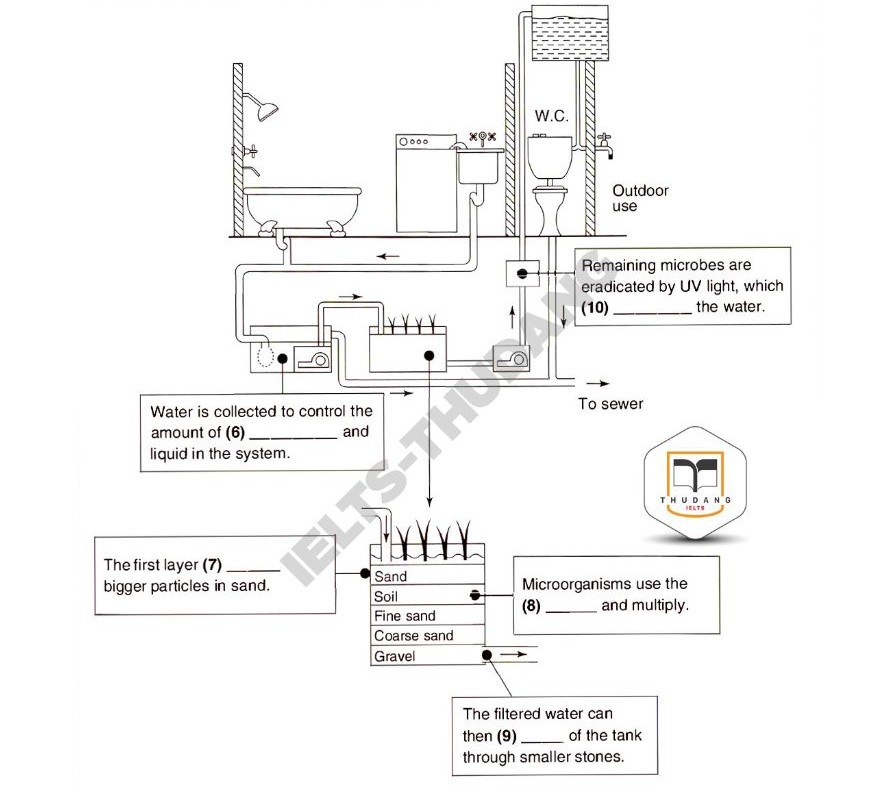
When the grey water undergoes biological cleaning, the water is collected from various sources around the house and fed into a course filter and surge tank. This serves two purposes: first of all, a valve regulates air and water flow into the surge tank so that an even flow and pressure is maintained. This is important for the filtering process to work properly and ensure an even flow of grey water through the filter. The water is then pumped into a second filtration tank, which contains natural materials. In this second tank, the water passes through different layers. The first filtration layer is made up of sand, which traps larger waste particles between the grains. Below this layer there are other layers made up of soil, finer sand and then coarse sand. Each layer traps more and more waste, thus purifying the water as it passes through. A lot of the purifying takes place in the soil layer, where microorganisms feed on the organic waste in the grey water and reproduce. Finally, the water flows through gravel or small stones to allow it to drain out of the system.
It is then pumped into a UV tank for a final mechanical treatment. In the UV tanks, ultraviolet light sterilises the water by killing any remaining microorganisms. Further filtration may also be applied after this. At this point, the water can be reused, not for drinking but for flushing toilets, or outdoor uses like washing the car or watering plants.
In contrast, the mechanical process for treating grey water is much simpler. It usually involves collecting the water from sinks, showers, etc. and passing it through a series of filters, each with a membrane that is finer than that of the previous filter. Chemicals, usually chlorine, can then be used to disinfect the water and it can also be treated with UV light.
In hot dry countries such as Abu Dhabi and in other environmentally sensitive areas, the benefits of recycling grey water are obvious. The main one is that it reduces the pressures on public water supplies. Moreover, the amount of polluted water entering rivers is reduced and the problem of poisonous blue-green algae in water reservoirs is also significantly reduced. Furthermore, grey water recycling can save on water bills in the long term.
However, grey water recycling can be expensive if it involves putting new or extra pipes into a building to move the grey water into the purification system. Furthermore, even after filtration and cleaning, the water still contains chemicals and microorganisms which limit its uses. There are few risks to human health when recycled grey water is used properly; one possible risk comes from eating fruit and vegetables that have been grown with it but the danger seems to be minimal. It is clear that commercial and domestic water use needs to be taken more seriously, and single-use water systems are hard to justify in a world of ever greater water scarcity.
Questions
Questions 1–5 Matching Features
Look at the descriptions and the list of quantities below.
Match each description with the correct quantity.
Write the correct letter, A-E.
A. 60 litres
B. 25%
C. approximately 70 litres
D. 120 millimetres
E. 6%
Questions 6–10 Diagram Labeling
Look at the diagram below and complete the sentences.
Choose NO MORE THAN TWO WORDS from the passage for each answer.
Questions 11–14 True / False / Not Given
Do the following statements agree with the information given in Reading Passage 1?
TRUE if the statement agrees with the information
FALSE if the statement contradicts the information
NOT GIVEN if there is no information on this
Answers & Explanations Summary
| # | Answer | Evidence | Explanation |
|---|---|---|---|
| Q1 | D | The region receives on average just 120 millimetres of rainfall every year | Excerpt/Passage Explanation: The passage says that this area normally gets 120 millimetres of rain in one year. Answer Explanation: The answer is D, which means 120 millimetres of rain falls in Abu Dhabi each year. Reason For Correctness: The correct answer is D because the text specifically mentions the amount of rain Abu Dhabi gets. It uses the words 'rainfall every year,' which means the same thing as 'rainwater falls annually' in the question. |
| Q2 | B | An example of how this can be done can be seen at one of Abu Dhabi's airport hotels, which is saving a quarter of its water by recycling grey water | Excerpt/Passage Explanation: The passage explains that the hotel helps the environment by saving 'a quarter' (1/4) of its water through recycling. This 'quarter' is the same value as 25%. Answer Explanation: The answer is 25%. Reason For Correctness: The correct answer is B because the passage states the airport hotel saves 'a quarter' of the water it uses. In numerical terms, a quarter is equal to 25%. You should look for the word 'quarter' in the text and match it to the mathematical percentage 25%. |
| Q3 | E | It typically makes up approximately 6% of a household's waste water | Excerpt/Passage Explanation: The passage states that about 6% of the water used in a home is grey water. Answer Explanation: The answer means that grey water makes up 6% of the total amount of waste water used in a home. Reason For Correctness: The correct answer is E because the text explains the amount of grey water found in homes. A 'household' is a place where people live, so 'household's waste water' means the same thing as 'domestic waste water.' The text directly says this water is about 6% of the total waste water. |
| Q4 | A | The hotel's new grey water recycling system is reported to save 735,000 litres of water per month, or 60 litres for every one of its guests | Excerpt/Passage Explanation: The passage says that the hotel's machine for cleaning and reusing water saves 60 litres for every person who stays there as a guest. Answer Explanation: The answer is 60 litres. Reason For Correctness: The correct answer is A because the text mentions a specific airport hotel that uses a system to reuse water. It states that this system saves 60 litres for each guest (person) staying at the hotel. While the text also mentions a 'quarter' (25%), that refers to the total water saved by the hotel, whereas the question asks for the amount per person. |
| Q5 | C | However, if it is recycled properly, around 70 litres of drinking water per person per day can be saved by domestic households | Excerpt/Passage Explanation: The passage explains that if families recycle water correctly, they are able to save about 70 liters of clean water for each individual every day. Answer Explanation: The answer identifies that by reusing grey water, a household can save about 70 liters of clean drinking water for every person each day. Reason For Correctness: The correct answer is Choice C because the passage specifically mentions that domestic households can save around 70 litres of drinking water per person per day through proper recycling. The term 'potable water' used in the question is defined earlier in the text as 'drinking water,' making this the direct figure for water savings per person. |
| Q6 | pressure | This serves two purposes: first of all, a valve regulates air and water flow into the surge tank so that an even flow and pressure is maintained | Excerpt/Passage Explanation: The passage explains that a valve controls how air and water go into the tank so they move at a steady speed and have a steady pushing force. Answer Explanation: The answer 'pressure' refers to the steady force or power of the water and air as they move through the recycling system. Reason For Correctness: The correct answer is 'pressure' because the passage describes the mechanical and biological process of cleaning grey water. In the surge tank, a part called a 'valve' is used to 'regulate' (control) the air and water. This control ensures that the movement remains steady (an 'even flow') and that the 'pressure' (force) is 'maintained' (kept the same). Keeping these levels steady is needed for the filtration process to work well. |
| Q7 | traps | The first filtration layer is made up of sand, which traps larger waste particles between the grains | Excerpt/Passage Explanation: The passage says that the first part of the filter is made of sand, and its job is to catch big pieces of dirty materials found in the water. Answer Explanation: The answer "traps" means to catch and hold something so that it cannot move forward or get away. Reason For Correctness: The correct answer is found in the description of the biological cleaning of grey water. The passage explains that the first layer of the filter is made of sand. The main job of this sand is to catch or "trap" the big pieces of waste as the water flows through it, which helps clean the water. Words like "traps" and "waste particles" show how the filter works to remove dirty items from the water. |
| Q8 | organic waste | A lot of the purifying takes place in the soil layer, where microorganisms feed on the organic waste in the grey water and reproduce | Excerpt/Passage Explanation: The passage explains that inside the soil part of the filter, very small living creatures eat the natural waste in the dirty water to help clean it. Answer Explanation: The answer "organic waste" refers to natural materials found in water, such as tiny bits of food or skin, that come from living things. Reason For Correctness: The correct answer is "organic waste" because the text describes a biological cleaning process where water moves through a layer of soil. In this layer, tiny living things called microorganisms clean the water by eating the natural dirt or leftovers (waste) found inside it. |
| Q9 | drain out | Finally, the water flows through gravel or small stones to allow it to drain out of the system | Excerpt/Passage Explanation: The passage explains that at the end of the cleaning steps, the water moves through tiny rocks so it can leave the pipes or machine. Answer Explanation: The answer means for the water to leave or flow away from the machine or system. Reason For Correctness: The correct answer is found in the section describing the biological cleaning process for grey water. After the water passes through various filters like sand and soil, it must eventually exit the system. This final step involves the water moving through gravel or small stones so that it can leave. The phrase 'drain out' specifically describes this action of leaving the system at the very end of that process. |
| Q10 | sterilises / sterilizes | In the UV tanks, ultraviolet light sterilises the water by killing any remaining microorganisms | Excerpt/Passage Explanation: The passage explains that inside the special tanks, the ultraviolet light cleans the water by killing the tiny germs that are still there. Answer Explanation: The answer describes the process of using special light to make the recycled water very clean by killing any tiny germs that are still in it. Reason For Correctness: The correct answer is 'sterilises' because the passage specifically describes the role of the UV tank in the water cleaning process. It explains that inside these tanks, ultraviolet light performs the action of 'sterilising' the water. To sterilise something means to make it completely clean by killing bacteria or other living things that could cause illness. The text notes that this happens by killing any remaining microorganisms (tiny living things). |
| Q11 | TRUE | Moreover, the amount of polluted water entering rivers is reduced and the problem of poisonous blue-green algae in water reservoirs is also significantly reduced | Excerpt/Passage Explanation: The passage explains that when grey water is recycled, the amount of dirty water going into rivers goes down, and there is less harmful blue-green algae in the places where water is kept. Answer Explanation: The answer is TRUE, which means the text agrees that recycling grey water helps lower the amount of dirty substances (pollution) in water storage areas. Reason For Correctness: The correct answer is found in the section describing the benefits of recycling grey water. The text specifically mentions that this process leads to less 'polluted water' going into rivers and a reduction in 'poisonous' algae in 'reservoirs.' In this context, 'reservoirs' is a synonym for 'water reserves.' Thus, the statement that recycling reduces pollution in water reserves matches the information in the passage. |
| Q12 | TRUE | However, grey water recycling can be expensive if it involves putting new or extra pipes into a building to move the grey water into the purification system | Excerpt/Passage Explanation: The passage explains that recycling water is not cheap if you need to install new pipes to carry the water to where it gets cleaned. Answer Explanation: The answer means that if you need to do work on the pipes in a house to recycle grey water, it can cost a lot of money. Reason For Correctness: The correct answer is TRUE because the writer says that grey water recycling might be high in price if it requires adding extra pipes to a building. In this context, the term "plumbing work" is another way to describe the act of "putting new or extra pipes into a building." The text confirms that when this kind of work is needed, the process can be "expensive." |
| Q13 | FALSE | Furthermore, even after filtration and cleaning, the water still contains chemicals and microorganisms which limit its uses | Excerpt/Passage Explanation: The passage explains that even when the water goes through filters and cleaning, it still includes some chemicals and tiny germs, so people cannot use it for everything. Answer Explanation: The answer is FALSE because the statement says something that is the opposite of what is written in the text. Reason For Correctness: The correct answer is FALSE because the text says that even after the water is filtered and cleaned, it still has chemicals and tiny living things (microorganisms) in it. The statement in the question says that the water becomes "completely free" of these things, which is not true. Words like "still contains" prove that these things remain in the water. |
| Q14 | NOT GIVEN | There are few risks to human health when recycled grey water is used properly; one possible risk comes from eating fruit and vegetables that have been grown with it but the danger seems to be minimal | Excerpt/Passage Explanation: The passage says that eating food grown with grey water might have a small risk for humans, but it does not say anything about the plants catching diseases. Answer Explanation: The answer is NOT GIVEN because the text does not mention whether plants or crops get sick when they are grown with grey water. Reason For Correctness: The correct answer is NOT GIVEN because the passage only mentions a small risk to human health when people eat food grown with recycled grey water. It does not provide any information about 'crop diseases' or the health of the vegetables and fruit themselves. Therefore, we cannot know from this text if the plants are more likely to get diseases. |