
Measuring Organisational Performance - IELTS Reading Answers & Explanations
From Cambridge IELTS 03 Academic Reading Test 4 · Part 3 · Questions 29–41
Reading Passage
You should spend about 20 minutes on Questions 28-40 which are based on Reading Passage 3 below.
Measuring Organisational Performance
There is clear-cut evidence that, for a period of at least one year, supervision which increases the direct pressure for productivity can achieve significant increases in production. However, such short-term increases are obtained only at a substantial and serious cost to the organisation.
To what extent can a manager make an impressive earnings record over a short period of one to three years by exploiting the company’s investment in the human organisation in his plant or division? To what extent will the quality of his organisation suffer if he does so? The following is a description of an important study conducted by the Institute for Social Research designed to answer these questions.
The study covered 500 clerical employees in four parallel divisions. Each division was organised in exactly the same way, used the same technology, did exactly the same kind of work, and had employees of comparable aptitudes.
Productivity in all four of the divisions depended on the number of clerks involved. The work entailed the processing of accounts and generating of invoices. Although the volume of work was considerable, the nature of the business was such that it could only be processed as it came along. Consequently, the only way in which productivity could be increased was to change the size of the workgroup.
The four divisions were assigned to two experimental programmes on a random basis. Each programme was assigned at random a division that had been historically high in productivity and a division that had been below average in productivity. No attempt was made to place a division in the programme that would best fit its habitual methods of supervision used by the manager, assistant managers, supervisors and assistant supervisors.
The experiment at the clerical level lasted for one year. Beforehand, several months were devoted to planning, and there was also a training period of approximately six months. Productivity was measured continuously and computed weekly throughout the year. The attitudes of employees and supervisory staff towards their work were measured just before and after the period.
Turning now to the heart of the study, in two divisions an attempt was made to change the supervision so that the decision levels were pushed down and detailed supervision of the workers reduced. More general supervision of the clerks and their supervisors was introduced. In addition, the managers, assistant managers, supervisors and assistant supervisors of these two divisions were trained in group methods of leadership, which they endeavoured to use as much as their skill would permit during the experimental year. For easy reference, the experimental changes in these two divisions will be labelled the ‘participative programme’.
In the other two divisions, by contrast, the programme called for modifying the supervision so as to increase the closeness of supervision and move the decision levels upwards. This will be labelled the ‘hierarchically controlled programme’. These changes were accomplished by a further extension of the scientific management approach. For example, one of the major changes made was to have the jobs timed and to have standard times computed. This showed that these divisions were overstaffed by about 30%. The general manager then ordered the managers of these two divisions to cut staff by 25%. This was done by transfers without replacing the persons who left; no one was to be dismissed.
Results of the Experiment
Changes in Productivity
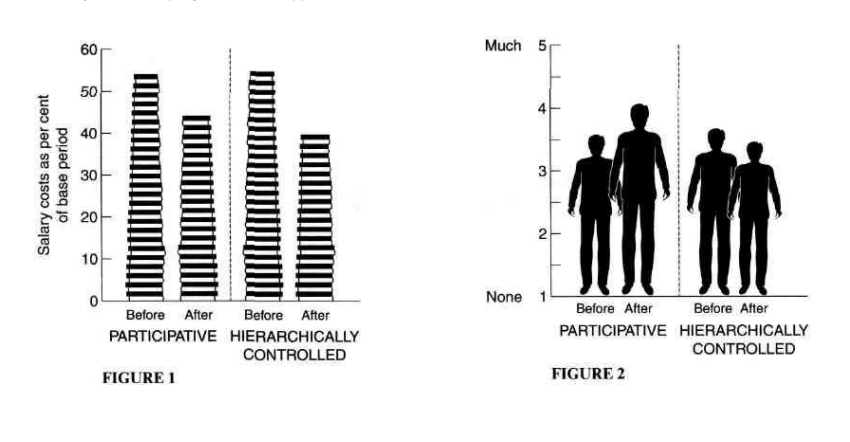
Figure 1 shows the changes in salary costs per unit of work, which reflect the change in productivity that occurred in the divisions. As will be observed, the hierarchically controlled programmes increased productivity by about 25%. This was a result of the direct orders from the general manager to reduce staff by that amount. Direct pressure produced a substantial increase in production.
A significant increase in productivity of 20% was also achieved in the participative programme, but this was not as great an increase as in the hierarchically controlled programme. To bring about this improvement, the clerks themselves participated in the decision to reduce the size of the work group. (They were aware of course that productivity increases were sought by management in conducting these experiments.) Obviously, deciding to reduce the size of a work group by eliminating some of its members is probably one of the most difficult decisions for a work group to make. Yet the clerks made it. In fact, one division in the participative programme increased its productivity by about the same amount as each of the two divisions in the hierarchically controlled programme. The other participative division, which historically had been the poorest of all the divisions, did not do so well and increased productivity by only 15%.
Changes in Attitudes
Although both programmes had similar effects on productivity, they had significantly different results in other respects. The productivity increases in the hierarchically controlled programme were accompanied by shifts in an adverse direction in such factors as loyalty, attitudes, interest, and involvement in the work. But just the opposite was true in the participative programme.
For example, Figure 2 shows that when more general supervision and increased participation were provided, the employees’ feeling of responsibility to see that the work got done increased. Again, when the supervisor was away, they kept on working. In the hierarchically controlled programme, however, the feeling of responsibility decreased, and when the supervisor was absent, work tended to stop.
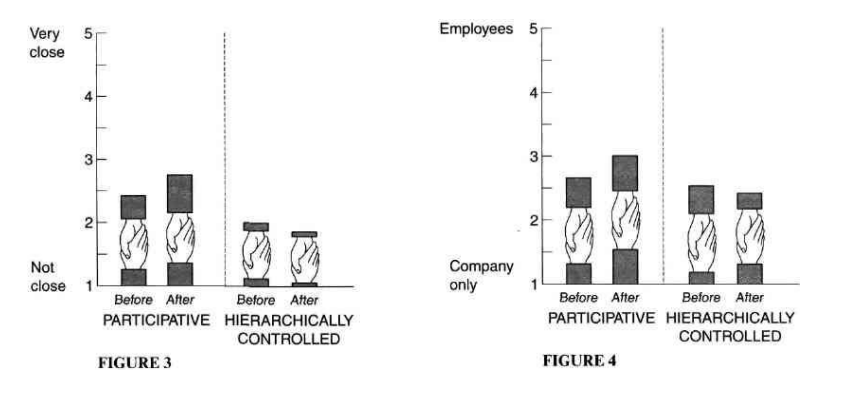
As Figure 3 shows, the employees in the participative programme at the end of the year felt that their manager and assistant manager were ‘closer to them’ than at the beginning of the year. The opposite was true in the hierarchical programme. Moreover, as Figure 4 shows, employees in the participative programme felt that their supervisors were more likely to ‘pull’ for them, or for the company and them, and not be solely interested in the company, while in the hierarchically controlled programme, the opposite trend occurred.
Questions
Questions 29–31 One Choice
Choose the appropriate letters A-D.
Questions 32–37 Summary Completion
Complete the summary below. Choose ONE word from Reading Passage 3 for each answer.
This experiment involved an organisation comprising four divisions, which were divided into two programmes: the hierarchically controlled programme and the participative programme. For a period of one year a different method of 32 was used in each programme. Throughout this time 33 was calculated on a weekly basis. During the course of the experiment the following changes were made in an attempt to improve performance.
In the participative programme:
- supervision of all workers was 34
- supervisory staff were given training in 35
In the hierarchically controlled programme:
- supervision of all workers was increased.
- work groups were found to be 36 by 30%.
- the work force was 37 by 25%.
Questions 38–41 Matching Features
Look at Figures 1, 2, 3 and 4 in Reading Passage 3.
Choose the most appropriate label, A—I, for each Figure from the box below.
A. Employees’ interest in the company
B. Cost increases for the company
C. Changes in productivity
D. Employees’ feelings of responsibility towards completion of work
E. Changes in productivity when supervisor was absent
F. Employees’ opinion as to extent of personal support from management
G. Employees feel closer to their supervisors
H. Employees’ feelings towards increased supervision
I. Supervisors’ opinion as to closeness of work group
Answers & Explanations Summary
| # | Answer | Evidence | Explanation |
|---|---|---|---|
| Q29 | A | To what extent can a manager make an impressive earnings record over a short period of one to three years by exploiting the company’s investment in the human organisation in his plant or division? To what extent will the quality of his organisation suffer if he does so? The following is a description of an important study conducted by the Institute for Social Research designed to answer these questions | Excerpt/Passage Explanation: The passage says that the study was started to answer two big questions: how much can a person use workers to make more money, and how much will the organization be damaged if they do that. Answer Explanation: The answer means the study tried to find out if it is a good idea to make workers do more work even if it causes a lot of problems for the people or the company. Reason For Correctness: The correct answer is A because the text explains that the study was created to see how much a company might lose in quality if it pushes workers to be more productive. The text mentions that while forcing workers to do more can increase production, it often comes at a 'substantial and serious cost' to the business. The experiment was built to see if these gains in work are worth the damage or 'cost' to the human side of the company. Pay attention to keywords like 'cost', 'suffer', and 'extent'. |
| Q30 | C | Each division was organised in exactly the same way, used the same technology, did exactly the same kind of work, and had employees of comparable aptitudes | Excerpt/Passage Explanation: The passage explains that every one of the four groups had the same structure, used the same tools, performed the same tasks, and had workers with similar skills. Answer Explanation: The answer means that all four groups used in the study were set up and structured in the same way. Reason For Correctness: The correct answer is C because the passage explicitly states that each division was organized in exactly the same way. The word 'identical' is a synonym for 'exactly the same,' and 'patterns of organisation' refers to being 'organised.' While the other options mention details from the text, they are incorrect: there were 500 employees in total (not per division), their past productivity levels were different (not equal), and only the assignment to programs was random, not necessarily the selection of the divisions themselves. |
| Q31 | C | Beforehand, several months were devoted to planning, and there was also a training period of approximately six months | Excerpt/Passage Explanation: The passage says that before the study started, several months were spent on planning, and about six more months were spent on training. Answer Explanation: The answer means that the workers and managers spent time getting ready for the study for a long time before it actually started. Reason For Correctness: The correct answer is Choice C because the text explains that before the actual experiment began, there were several months of planning and another six months of training. This time was used to get everything ready for the study. Keywords to note are 'Beforehand', which means 'before', and 'devoted to', which means the time was used for a specific purpose like preparing. |
| Q32 | supervision / leadership / management | No attempt was made to place a division in the programme that would best fit its habitual methods of supervision used by the manager, assistant managers, supervisors and assistant supervisors In addition, the managers, assistant managers, supervisors and assistant supervisors of these two divisions were trained in group methods of leadership, which they endeavoured to use as much as their skill would permit during the experimental year These changes were accomplished by a further extension of the scientific management approach |
Excerpt/Passage Explanation: The passage explains that the study examined different ways to oversee workers (methods of supervision). It also mentions that leaders and supervisors learned specific ways to guide their groups (methods of leadership). Finally, it states that one of the two programs was built using a style called a scientific management approach. Answer Explanation: The answer words "supervision," "leadership," and "management" are terms from the text that describe how the workers were watched, how the bosses were trained to lead their teams, and the specific style used to run the business program. Reason For Correctness: The correct answer identifies three key terms used in the passage to describe the experiment's structure. 'Supervision' is identified as the name for the different methods used to oversee employees throughout the year. 'Leadership' is correct because the passage specifically mentions that managers and supervisors were given training in 'group methods of leadership.' 'Management' is correct because the hierarchical program was based on an extension of the 'scientific management approach.' |
| Q33 | productivity | Productivity was measured continuously and computed weekly throughout the year | Excerpt/Passage Explanation: The passage explains that the amount of work completed was checked all the time and the results were figured out every week during the one-year experiment. Answer Explanation: The answer means how much work is being done or how well a worker is making items or finishing tasks. Reason For Correctness: The correct answer is located in the part of the text describing the experimental process. The passage states that during the one-year study, the researchers tracked how effective the workers were every single week. It uses the word 'computed', which is a synonym for 'calculated', to explain that they arrived at a 'productivity' score on a weekly basis. |
| Q34 | reduced / cut / decreased | In two divisions an attempt was made to change the supervision so that the decision levels were pushed down and detailed supervision of the workers reduced | Excerpt/Passage Explanation: The passage explains that in two specific groups, the bosses changed their style. They let the workers make more of their own choices and stopped watching every little thing the workers did. Answer Explanation: The answer means that the amount of control or checking done by the managers was made smaller or less. Reason For Correctness: The correct answer is based on the description of the 'participative programme' in the passage. The text states that in these divisions, 'detailed supervision of the workers reduced.' This matches the summary sentence which asks what happened to the supervision. A synonym for 'reduced' is 'lessened' or 'made smaller.' Because the goal of this program was to give workers more freedom, the managers had to lower the amount of control they had over them. |
| Q35 | leadership | In addition, the managers, assistant managers, supervisors and assistant supervisors of these two divisions were trained in group methods of leadership, which they endeavoured to use as much as their skill would permit during the experimental year | Excerpt/Passage Explanation: The passage explains that all levels of management in the participative divisions received education on how to use group leadership techniques while they conducted the experiment. Answer Explanation: The answer is the word "leadership," which is the specific focus of the training provided to the managers and supervisors in the participative programme. Reason For Correctness: The correct answer is "leadership" because, within the context of the participative programme, the study aimed to see how a different management style affected workers. The passage explicitly states that the supervisors in this group "were trained in group methods of leadership." This was done to help them shift from giving orders to working more closely with their teams, which matches the summary's requirement for what they were trained in. |
| Q36 | overstaffed | This showed that these divisions were overstaffed by about 30% | Excerpt/Passage Explanation: The passage states that when the managers checked the work times, they realized that the groups had 30% more people than were actually required to do the job. Answer Explanation: The answer "overstaffed" means that there are too many employees working in a company or a team for the amount of work that needs to be done. Reason For Correctness: The correct answer is "overstaffed" because the text describes how the managers in the hierarchically controlled program looked at the time it took to do jobs. When they did their calculations, they found that the offices had thirty percent more workers than was necessary to complete the tasks. This situation where there are extra workers who are not needed is called being overstaffed. |
| Q37 | reduced / cut / decreased | The general manager then ordered the managers of these two divisions to cut staff by 25% | Excerpt/Passage Explanation: The passage explains that the boss told the managers to make the total number of workers smaller by exactly 25%. Answer Explanation: The answer shows that the number of people working in the group was made smaller or lowered. Reason For Correctness: The correct answer is found in the text where it states the manager ordered others to 'cut' the staff by 25%. In this context, 'cut' is a synonym for 'reduced' or 'decreased'. The summary describes the changes made during the study, and the passage confirms that the workforce size was intentionally lowered to see how it affected work. |
| Q38 | C | Figure 1 shows the changes in salary costs per unit of work, which reflect the change in productivity that occurred in the divisions | Excerpt/Passage Explanation: The passage says that Figure 1 shows how the cost of salaries changed for each piece of work, which is how they measured the change in how much work the employees finished (productivity). Answer Explanation: The answer is 'Changes in productivity'. This label describes what the first picture (Figure 1) in the study is showing. Reason For Correctness: The correct answer is C because the text directly states that Figure 1 represents the 'changes in salary costs per unit of work', and then clarifies that these costs 'reflect the change in productivity'. In business, productivity refers to how much work is done compared to the time or money spent. The passage later uses this figure to explain how much productivity went up in both the hierarchically controlled and participative programs. |
| Q39 | D | For example, Figure 2 shows that when more general supervision and increased participation were provided, the employees’ feeling of responsibility to see that the work got done increased | Excerpt/Passage Explanation: The passage explains that Figure 2 illustrates the change in how much pressure or duty employees felt to make sure their work was finished when they were given more freedom and a say in decisions. Answer Explanation: The answer means that Figure 2 shows how workers felt about their duty to finish their tasks. Reason For Correctness: The correct answer is chosen because the text explicitly states that Figure 2 represents the 'employees’ feeling of responsibility to see that the work got done'. This matches option D, which refers to feelings of responsibility toward the completion of work. The study compared how this feeling increased in the 'participative programme' and decreased in the 'hierarchically controlled programme'. |
| Q40 | G | As Figure 3 shows, the employees in the participative programme at the end of the year felt that their manager and assistant manager were ‘closer to them’ than at the beginning of the year | Excerpt/Passage Explanation: The passage states that Figure 3 displays evidence that employees in the participative group felt their managers were more friendly or accessible to them by the end of the experiment. Answer Explanation: The answer identifies what Figure 3 (Fig 3) illustrates based on the text. It shows that employees felt a closer connection to their managers at the end of the study. Reason For Correctness: The correct answer is G because the passage specifically mentions what Figure 3 represents. It states that at the end of the one-year study, workers in the group that allowed for more participation felt that their managers and assistant managers were 'closer to them' than when the study began. The word 'supervisors' in option G is used as a general term for these managers mentioned in the text. |
| Q41 | F | Moreover, as Figure 4 shows, employees in the participative programme felt that their supervisors were more likely to ‘pull’ for them, or for the company and them, and not be solely interested in the company, while in the hierarchically controlled programme, the opposite trend occurred | Excerpt/Passage Explanation: The passage explains that Figure 4 is about workers' feelings on whether their managers would support them or if they only cared about the company's goals. Answer Explanation: The answer means that Figure 4 represents what workers thought about the help and support they received from their bosses. Reason For Correctness: The correct answer is Choice F because the text states that Figure 4 illustrates whether employees felt their supervisors would 'pull' for them—meaning to support or help them—instead of only caring about the company's interests. This 'pulling for them' directly relates to the concept of personal support from management. |