
Meteor Strikes - IELTS Reading Answers & Explanations
From Collins Practice Tests For IELTS 2 Academic Reading Test 4 · Part 1 · Questions 1–13
Reading Passage
You should spend about 20 minutes on Questions 1–13, which are based on Reading Passage 1 below.
Meteor Strikes
On 15 February 2013, just after dawn, the sleepy Russian city of Chelyabinsk was woken by the biggest meteor strike on Earth in over 100 years. Several people videoed the meteor as it crashed through Earth’s atmosphere, passing close above the city and giving scientists vital clues as to where it had come from and how it had travelled to Earth. To the people of Chelyabinsk, the meteor shone 30 times brighter than the sun and had 20–30 times more energy than the atomic bomb dropped on Hiroshima. The meteor did not hit the ground, but due to its enormous speed exploded 29.7 kilometres above the ground, producing a bright flash, a cloud of hot dust and gas, many smaller fragments of meteor and a powerful shockwave. The latter was so strong that it knocked people off their feet and blew out the windows of homes, shops and factories. 1,500 people went to hospital with injuries indirectly caused by the strike, but matters could have been far worse if the meteor had made contact with the Earth.
The meteor was not an uncommon rock. From studying videos of the meteor's flight, scientists have concluded that it originated in the asteroid belt located between the orbits of Mars and Jupiter. At the time it entered Earth’s atmosphere, it weighed between 12,000 and 13,000 metric tonnes and was 10 metres in diameter. It crashed through the upper atmosphere at around 19 kilometres a second – above 50 times the speed of sound, fracturing at an altitude of between 45 and 50 kilometres. Such events happen on average every 10 or so years, mainly over oceans or unpopulated areas. This time the strike was over a city and observed by many people, reminding us how common these occurrences are.
A meteor strike has several phases. Moving through space, a meteor’s temperature can be around –100°C. It travels around 5 kilometres per second until Earth’s gravity accelerates it to 17 kilometres a second. It begins to encounter the atmosphere 140 kilometres above the Earth but there is little air resistance until about three seconds later, when it reaches 100 kilometres above the ground. At this point the air becomes dense, causing the meteor to glow as the material on its surface melts. The mix of burning gas and dust creates a fireball as the meteor loses 3 to 6 millimetres of surface mass per second as it is heated to over 1,800°C. The rate of loss of material through heat is so rapid that the core temperature of the meteor is still very low while at the same time a tail of vaporised dust and gas becomes visible. These tails can often be seen for up to 45 minutes and may be followed by a sonic boom as the meteor crashes through the sound barrier. During its flight to the Earth, the meteor slows down by 70 per cent and it is during this period that it may fracture and split. At this point some meteors explode in a violent airburst while others enter dark flight – the period when the meteor slows down so much that it stops burning and it falls to the ground as a cold rock.
The Chelyabinsk airburst left only a few large pieces of the meteor: one rock was recovered near the town of Timiryazevskiy, another fell on a house in Deputatskiy, and the largest piece was found by divers at the bottom of Lake Chebarkul. The meteor was the largest to crash to Earth since 1908, when a meteor exploded over an area near the Tunguska River in Siberia. Although information about the event is scarce, the theory most scientists share is that an asteroid around 36.5 metres in diameter and travelling at 54,000 kilometres per hour entered the atmosphere above Russia. It exploded in an airburst at 28,000 feet, releasing energy equal to about 185 Hiroshima atomic bombs and flattening trees across an area of 800 square miles. Airbursts the size of Tunguska are estimated to occur every 1,200 years on average. But following the Chelyabinsk meteor, scientists now think the risk of similar objects hitting our planet may be ten times greater than thought previously.
Questions
Questions 1–6 Table Completion
Complete the table below.
Choose NO MORE THAN TWO NUMBERS AND ONE WORD from the passage for each answer.
| The Chelyabinsk meteor strike |
|
|---|---|
| The Tunguska meteor strike |
|
Questions 7–13 Diagram Labeling
Label the diagram below using words from the box.
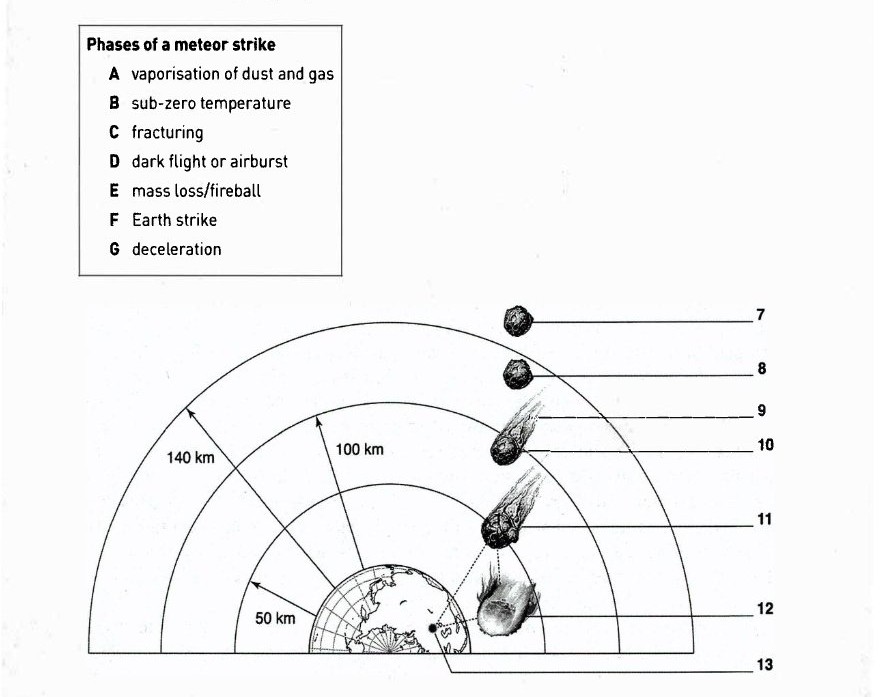
A. vaporisation of dust and gas | B. sub-zero temperature | C. fracturing
D. dark flight or airburst | E. mass loss/fireball | F. Earth strike
G. deceleration
Answers & Explanations Summary
| # | Answer | Evidence | Explanation |
|---|---|---|---|
| Q1 | 50 | It crashed through the upper atmosphere at around 19 kilometres a second – above 50 times the speed of sound, fracturing at an altitude of between 45 and 50 kilometres | Excerpt/Passage Explanation: The passage states that the meteor fell through the sky at a speed of 19 kilometers every second. This speed is more than 50 times faster than the speed at which sound travels. Answer Explanation: The answer "50" describes how many times faster the meteor was moving compared to the speed of sound. Reason For Correctness: The correct answer is 50 because the passage directly provides this comparison when discussing the meteor's entry into the atmosphere. It notes that the object moved at 19 kilometers per second, which is more than "50 times" the speed of sound. The table specifically asks for how many times faster it travelled than sound, making "50" the correct numerical value. |
| Q2 | 29.7 kilometres / 29.7 kilometers | The meteor did not hit the ground, but due to its enormous speed exploded 29.7 kilometres above the ground, producing a bright flash, a cloud of hot dust and gas, many smaller fragments of meteor and a powerful shockwave | Excerpt/Passage Explanation: The passage clearly states that the meteor blew up at a distance of 29.7 kilometres from the ground. Answer Explanation: The answer 29.7 kilometres tells us the height in the sky where the meteor burst into pieces. Reason For Correctness: The correct answer is 29.7 kilometres because the passage mentions this specific number as the altitude where the rock blew up. In the text, it says the meteor "exploded 29.7 kilometres above the ground," which matches the table's request for where it exploded relative to the Earth's surface. Beginners should note that "above the ground" and "above the Earth's surface" mean the same thing in this context. |
| Q3 | 20 to 30 / 20–30 | To the people of Chelyabinsk, the meteor shone 30 times brighter than the sun and had 20–30 times more energy than the atomic bomb dropped on Hiroshima | Excerpt/Passage Explanation: The passage explains that for the people living in Chelyabinsk, the meteor's explosion was much more powerful—specifically 20 to 30 times more powerful—than the atomic bomb dropped on Hiroshima. Answer Explanation: The answer "20 to 30" (or "20–30") refers to the amount of power the Chelyabinsk meteor had compared to the atomic bomb used in Hiroshima. Reason For Correctness: The correct answer is found in the first paragraph. The text explains that the meteor was incredibly powerful, stating it had "20–30 times" more energy than the famous Hiroshima atomic bomb. The table asks for this specific comparison regarding the Chelyabinsk strike. |
| Q4 | 36.5 | the theory most scientists share is that an asteroid around 36.5 metres in diameter and travelling at 54,000 kilometres per hour entered the atmosphere above Russia | Excerpt/Passage Explanation: The passage states that most scientists believe the space rock (asteroid) was about 36.5 meters wide when it entered the air above Russia. Answer Explanation: The answer means that the width (diameter) of the asteroid that exploded over Tunguska was 36.5 meters. Reason For Correctness: The correct answer is located in the final paragraph, which discusses the 1908 event near the Tunguska River. When completing the table for the Tunguska meteor strike, we look for its physical size. The text explicitly states that scientists believe this asteroid was 36.5 metres in diameter. The keyword 'diameter' in the passage confirms it is the correct measurement for the space rock's size. |
| Q5 | 54 000 kilometres / 54,000 kilometres / 54000 kilometres / 54 000 kilometers / 54,000 kilometers / 54000 kilometers | travelling at 54,000 kilometres per hour | Excerpt/Passage Explanation: The passage explains that the large rock from space was moving at a very high speed of 54,000 kilometres for every hour it traveled. Answer Explanation: The answer is the distance the space rock covered in one hour, which was 54,000 kilometres. Reason For Correctness: The correct answer is found in the final paragraph, which talks about the Tunguska meteor strike. The text describes how fast the rock was moving by using the words 'travelling at' followed by the speed. Because the words 'per hour' are already provided in the table, you only need to write '54,000 kilometres' to complete the information about its speed. |
| Q6 | 1 200 / 1,200 / 1200 | Airbursts the size of Tunguska are estimated to occur every 1,200 years on average | Excerpt/Passage Explanation: The passage explains that scientists believe very large meteor explosions like the one in Tunguska happen about once every 1,200 years. Answer Explanation: The answer "1,200" represents the average number of years that pass between meteor strikes of a similar size to the Tunguska event. Reason For Correctness: The correct answer is located in the final paragraph of the text. When discussing the Tunguska meteor strike, the author notes how often such large explosions (airbursts) are likely to happen. The text specifically states they happen every "1,200 years on average," which perfectly fills the last gap in the table regarding the frequency of these occurrences. |
| Q7 | B | Moving through space, a meteor’s temperature can be around –100°C | Excerpt/Passage Explanation: The passage explains that while the meteor is traveling in space, its temperature is about –100°C, which is extremely cold and below zero. Answer Explanation: The answer B corresponds to the label 'sub-zero temperature.' This describes a temperature that is lower than zero degrees Celsius, which is the point where water freezes. Reason For Correctness: The correct answer is 'sub-zero temperature' because the passage describes the different stages of a meteor's journey. At the very beginning, when the meteor is still 'moving through space' and has not yet entered Earth's atmosphere, its temperature is stated as being approximately –100°C. Because this number is far below zero, it matches the definition of 'sub-zero.' |
| Q8 | G | During its flight to the Earth, the meteor slows down by 70 per cent and it is during this period that it may fracture and split | Excerpt/Passage Explanation: The passage says that while the meteor is falling, its speed drops significantly, and this is also the time when the rock might break into smaller pieces. Answer Explanation: The answer identifies the stage of the meteor's journey where it begins to move more slowly. Reason For Correctness: The correct answer is 'G' (deceleration) because the passage explains a specific part of the flight where the meteor loses a large amount of its speed. In paragraph three, the text uses the phrase 'slows down by 70 per cent,' which is the definition of deceleration. This stage occurs as it travels through the air before it potentially breaks apart or explodes. |
| Q9 | A | The rate of loss of material through heat is so rapid that the core temperature of the meteor is still very low while at the same time a tail of vaporised dust and gas becomes visible | Excerpt/Passage Explanation: The passage explains that heat quickly burns away the meteor's surface, creating a tail made of gas and dust that people can see. Answer Explanation: The answer identifies the stage in a meteor's journey where a visible tail of gas and dust is created by heat. Reason For Correctness: The correct answer is supported by the text's description of a meteor's flight phases. As a meteor travels through the atmosphere and gets very hot, its surface material turns into gas and dust. This process is called vaporisation. This specific phase creates a visible tail that can last for many minutes. Choice A—vaporisation of dust and gas—directly matches this description of the tail becoming visible due to heat-induced vaporisation. |
| Q10 | E | The mix of burning gas and dust creates a fireball as the meteor loses 3 to 6 millimetres of surface mass per second as it is heated to over 1,800°C | Excerpt/Passage Explanation: The passage explains that when the meteor gets very hot, it turns into a ball of fire and bits of its surface burn off every second, making it lose weight. Answer Explanation: The answer identifies the phase in a meteor's journey where it becomes a ball of fire and begins to lose its outer material due to extreme heat. Reason For Correctness: The correct answer is 'E' because the text describes a stage where the air becomes dense, resulting in the meteor glowing and melting. During this process, the passage explicitly mentions the creation of a 'fireball' and the loss of 'surface mass' (weight/material) as it heats up to 1,800°C. These terms directly match the label 'mass loss/fireball' in the provided options. |
| Q11 | C | During its flight to the Earth, the meteor slows down by 70 per cent and it is during this period that it may fracture and split | Excerpt/Passage Explanation: The passage explains that as the meteor moves toward the ground, it loses most of its speed, and this is when it might break into pieces. Answer Explanation: The answer refers to the stage where the space rock begins to break into smaller pieces as it travels through the sky. Reason For Correctness: The correct answer is 'C' because the passage describes the various stages of a meteor's journey. After the rock enters the atmosphere and creates a fireball with a visible tail, it begins to slow down significantly. According to the text, it is during this specific time of slowing down that the meteor can 'fracture' or break apart into different pieces before the final stage of an explosion or landing. |
| Q12 | D | At this point some meteors explode in a violent airburst while others enter dark flight – the period when the meteor slows down so much that it stops burning and it falls to the ground as a cold rock | Excerpt/Passage Explanation: The passage explains that near the end of its travel, a meteor will either blow up in a big explosion or enter a quiet phase where it is no longer on fire and just falls to the ground. Answer Explanation: The answer is 'dark flight or airburst', which describes the last stage of a meteor's path through the sky as it either explodes or cools down. Reason For Correctness: The correct answer is identified from the explanation of a meteor's final phases. According to the third paragraph, after the meteor slows down and potentially breaks apart (fractures), it reaches a final stage where it either has a huge explosion in the air (airburst) or stops burning and falls to the Earth as a cold stone (dark flight). |
| Q13 | F | At this point some meteors explode in a violent airburst while others enter dark flight – the period when the meteor slows down so much that it stops burning and it falls to the ground as a cold rock | Excerpt/Passage Explanation: The passage explains that if a meteor does not explode in the air, it slows down, stops glowing, and finally hits the floor as a solid rock. This landing is the 'Earth strike' mentioned in the diagram options. Answer Explanation: The answer 'F' stands for an 'Earth strike,' which happens when a space rock actually hits the ground of our planet. Reason For Correctness: The correct answer identifies the final possible stage of a meteor's journey through the atmosphere. While some meteors explode high in the sky (an airburst), others continue moving until they hit the land. The passage describes this by saying the meteor 'falls to the ground' and calls the event a 'strike' or says it makes 'contact with the Earth.' |