
Age-Related Macular Degeneration - IELTS Reading Answers & Explanations
From Collins Practice Tests For IELTS 2 Academic Reading Test 1 · Part 3 · Questions 27–40
Reading Passage
You should spend about 20 minutes on Questions 27-40, which are based on Reading Passage 3 below.
Reading Passage 3
A A major cause of blindness in the industrialised world is age-related macular degeneration (AMD). It affects approximately three million people globally and accounts for around nine per cent of all blindness. These statistics are expected to double by the year 2020 as the world population increases. Scientists have been working on a new treatment for one type of the disease by using stem cells to repair damage to the retina, with positive results. Two women in America, both registered as blind, were given the new treatment and say their vision improved just weeks after they were injected with the stems cells. With such promising results for a condition which previously had no treatment, researchers are positive about the direction of the stem cell treatment.
B AMD usually affects the elderly although younger people can also develop a version of the condition. People with AMD typically have dark patches at the centre of their vision – the deterioration takes place over months and years. Although people with AMD do not lose their sight completely, they do lose central vision, which is vital for detailed work and activities like reading and driving, so that leading a normal life can become impossible over time. In the cases of the two American women, one was a graphic artist who began to lose her vision in her twenties. As she lost most of her central vision, she became unable to work, and then eventually it became impossible for her to recognise people or watch TV. The second woman became unable to recognise faces, had to stop driving and in the end could not leave her home.
C To understand AMD, we need to understand how our eyes work. Essentially a hollow ball, the eye has a number of layers. The outer layer consists of the white of the eye and the cornea. The cornea is the transparent area in front of the coloured iris and the black pupil at the centre of the iris. The middle layer of the eye includes blood vessels and the iris, which regulates the amount of light entering the eye. Just behind the iris is the lens, which focuses images on the retina, which covers the inside of the eyeball. The retina is the part of the eye that contains photoreceptors – cells that sense light. Nerve fibres from the photoreceptors in the retina join together to form the optic nerve, which then exits the eyeball and transmits visual information to the brain. The photoreceptors are of two types, rods and cones: the rods are sensitive to light intensity and the cones are sensitive to colour. They are mostly concentrated in the part of the retina called the macula. This is only the size of a grain of rice, but it is responsible for our central vision, most of our colour vision and our visual acuity, or sharpness of vision. The photoreceptor cells lie on a thin layer of cells that provide them with nutrients and carry away waste. When these underlying cells die or are damaged, the photoreceptor cells cannot function properly, and this leads to a loss of vision.
D Damage to the macula can result from a variety of factors. Age is the main risk factor but smoking also damages blood vessels and the structure of the eye. Smokers are three times more likely to develop AMD, as are people with poor diets. A diet lacking in fruit and vegetables cannot help the body defend itself against free radical molecules which damage cells. Fruit and vegetables contain antioxidants, which protect the body against these free radicals. Finally, people with high blood pressure are one and a half times more likely to contract AMD, as are those people with a family history of the disease.
E The new treatment for AMD, developed by Dr Robert Lanza at Advanced Cell Technology, involves changing embryonic stem cells into more specialised eye stem cells and injecting 50,000 of them into the layer of the eye that supports the photoreceptors. A stem cell is a primary cell that has the ability to divide and form specialised cells that perform various functions within the body. First, a single stem cell was taken from a human embryo and grown into a colony of millions of cells. The cells were checked to make sure they were healthy. Then another procedure encouraged the stem cells to develop into the type of cell that forms the layer under the photoreceptor cells. The eye stem cells were injected below the retina through a cut into the eyeball, where they filled in the gaps left by dead and damaged cells and began functioning again.
F For the two patients, the results have been stunning. Tests have indicated that healthy cells have grown where the stem cells were injected. The first woman has regained enough vision to be able to cycle. Meanwhile, the second woman can read, cook and go shopping by herself again. The hope is that the treatment could be a way forward for other currently incurable conditions so that other people can lead normal lives again.
Questions
Questions 27–32 Matching Information
Reading Passage 3 has six paragraphs, A-F.
Which paragraphs, A-F, contain the following information?
Write the correct letter, A-F.
Questions 33–35 Diagram Labeling
Label the diagram below using words from the box.
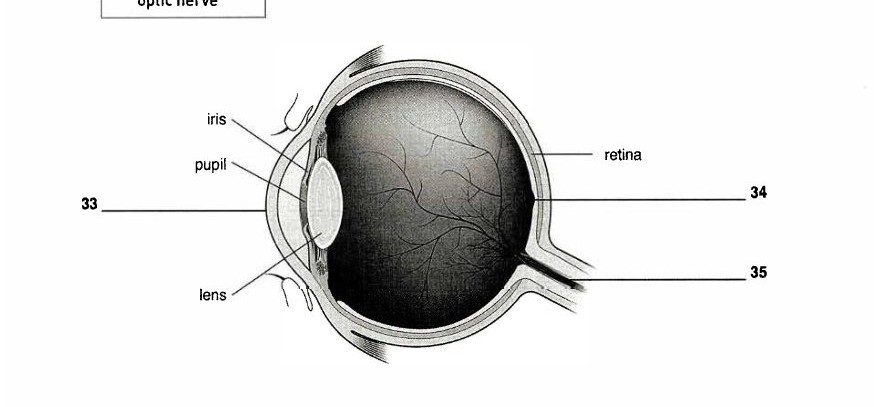
macula | cornea | optic nerve
Questions 36–40 Summary Completion
Complete the summary below.
Choose NO MORE THAN TWO WORDS from the passage for each answer.
Age-related macular degeneration (AMD) is one of the main causes of loss of sight in the 36. Although AMD can affect 37, the majority of sufferers are older. Despite being very small, the macula is essential to our 38 as well as detailed vision and some colour vision. AMD happens when the cells beneath the 39 cells are damaged or die. A new treatment to repair the damaged cells involves 40 50,000 stem cells under the retina, after which they regenerate the damaged area.
Answers & Explanations Summary
| # | Answer | Evidence | Explanation |
|---|---|---|---|
| Q27 | B | People with AMD typically have dark patches at the centre of their vision – the deterioration takes place over months and years. Although people with AMD do not lose their sight completely, they do lose central vision, which is vital for detailed work and activities like reading and driving, so that leading a normal life can become impossible over time | Excerpt/Passage Explanation: The passage explains that people with this condition see dark spots in the middle of their vision. It says that they lose their ability to see things clearly in the center, which makes it very difficult for them to do common activities like reading or driving a car. Answer Explanation: The answer means that Paragraph B is the part of the text that describes the signs of the disease and how it changes a person's sight. Reason For Correctness: The correct answer is B because this paragraph explains what patients see and experience. It mentions 'dark patches' and the loss of 'central vision' as the main signs (symptoms) of the disease. It also lists how these changes affect a person's ability to do things like reading, driving, and recognizing faces. |
| Q28 | E | The new treatment for AMD, developed by Dr Robert Lanza at Advanced Cell Technology, involves changing embryonic stem cells into more specialised eye stem cells and injecting 50,000 of them into the layer of the eye that supports the photoreceptors. A stem cell is a primary cell that has the ability to divide and form specialised cells that perform various functions within the body. First, a single stem cell was taken from a human embryo and grown into a colony of millions of cells. The cells were checked to make sure they were healthy. Then another procedure encouraged the stem cells to develop into the type of cell that forms the layer under the photoreceptor cells. The eye stem cells were injected below the retina through a cut into the eyeball, where they filled in the gaps left by dead and damaged cells and began functioning again | Excerpt/Passage Explanation: The passage explains the way the new medical treatment works by explaining the steps: starting with a single cell, growing many cells, turning them into eye cells, and then putting them into the eye through a small cut. Answer Explanation: The answer is E, which means paragraph E describes the steps of the medical procedure used to help patients with AMD. Reason For Correctness: The correct answer is E because this paragraph explains the specific steps used in the new medical care. It uses words like 'treatment' and 'procedure' to tell us how the doctors take cells, grow them, and put them into the patient's eye. It explains the process from the beginning to the end of the operation. |
| Q29 | D | Damage to the macula can result from a variety of factors. Age is the main risk factor but smoking also damages blood vessels and the structure of the eye. Smokers are three times more likely to develop AMD, as are people with poor diets. A diet lacking in fruit and vegetables cannot help the body defend itself against free radical molecules which damage cells. Fruit and vegetables contain antioxidants, which protect the body against these free radicals. Finally, people with high blood pressure are one and a half times more likely to contract AMD, as are those people with a family history of the disease | Excerpt/Passage Explanation: The passage explains that several things can cause the disease. It points out that being old, smoking, eating poorly, and having high blood pressure are all reasons why someone might get AMD. Answer Explanation: The answer D refers to the fourth paragraph of the text, which lists the reasons or causes that can lead to someone developing age-related macular degeneration (AMD). Reason For Correctness: The correct answer is D because this paragraph specifically lists various things that increase the risk of getting AMD. It describes several 'factors' such as getting older, smoking, eating unhealthy food (a poor diet), having high blood pressure, and having family members who also had the disease. The text explains how these different elements contribute to harming the eyes. |
| Q30 | C | When these underlying cells die or are damaged, the photoreceptor cells cannot function properly, and this leads to a loss of vision | Excerpt/Passage Explanation: The passage explains that when the cells underneath the light-sensing cells get hurt or die, the light-sensing cells cannot do their job correctly, which results in the person losing their ability to see. Answer Explanation: The answer is Paragraph C. Reason For Correctness: The correct answer is C because this paragraph explains the physical parts of the eye and explains exactly what internal failure leads to AMD. It describes how the photoreceptor cells (the cells that see light) depend on a layer of cells beneath them for food and waste removal. When this specific layer of cells stops working because of death or damage, the sight begins to fail. This describes the 'physical cause' of the condition. |
| Q31 | F | The hope is that the treatment could be a way forward for other currently incurable conditions so that other people can lead normal lives again | Excerpt/Passage Explanation: The passage states that people hope this medical treatment can be used in the future to help heal other sicknesses that doctors cannot fix right now. Answer Explanation: The answer F means that the sixth paragraph contains information about how stem cell treatment might be used for other things in the future. Reason For Correctness: The correct answer is F because this paragraph discusses the positive results of the treatment and then looks toward the future. It explains that there is a 'hope' that this same method could be a 'way forward' to help fix 'other currently incurable conditions.' This clearly outlines the potential future uses of the treatment beyond just the eye disease discussed earlier in the text. |
| Q32 | A | It affects approximately three million people globally and accounts for around nine per cent of all blindness. These statistics are expected to double by the year 2020 as the world population increases | Excerpt/Passage Explanation: The passage provides data about how common this eye disease is, stating it affects millions of people and accounts for a specific portion of blindness cases worldwide. Answer Explanation: The answer is paragraph A because it talks about how many people in the world have age-related macular degeneration (AMD). Reason For Correctness: The correct answer is paragraph A because it provides specific statistics regarding the frequency and occurrence of the disease. It mentions that it affects "three million people globally" and represents "nine per cent of all blindness." It also mentions that these numbers are expected to "double" in the future. These numbers and percentages describe how often the condition occurs in the population. |
| Q33 | cornea | The outer layer consists of the white of the eye and the cornea. The cornea is the transparent area in front of the coloured iris and the black pupil at the centre of the iris | Excerpt/Passage Explanation: The passage explains that the eye has several parts. The cornea is one of the parts on the very outside. It is clear (transparent) and is located in front of the iris and the hole in the middle called the pupil. Answer Explanation: The answer is 'cornea', which is the clear, protective outer part at the front of the eye. Reason For Correctness: The correct answer is determined by looking at the description of the eye's structure in Paragraph C. The text explains that the cornea is part of the eye's outer layer and is located right in front of the iris (the colored part) and the pupil (the black center). Since it is part of the outermost section, it is the correct word to use for that part of the diagram. Key terms to look for are 'outer layer' and 'transparent area in front'. |
| Q34 | macula | They are mostly concentrated in the part of the retina called the macula. This is only the size of a grain of rice, but it is responsible for our central vision, most of our colour vision and our visual acuity, or sharpness of vision | Excerpt/Passage Explanation: The passage explains that most light-sensing cells are found in the macula. Even though this part is as small as a piece of rice, it is what allows us to see things directly in front of us, see different colors, and have clear, sharp eyesight. Answer Explanation: The answer is the macula, which is a tiny but very important area in the back of the eye that lets us see clearly and recognize colors. Reason For Correctness: The correct answer is identified based on the description of the eye's anatomy in paragraph C. It defines the macula as a specific part of the retina where light-sensing cells are gathered or concentrated. These cells are essential for central vision and visual acuity, which refers to how sharp and clear we see objects. |
| Q35 | optic nerve | Nerve fibres from the photoreceptors in the retina join together to form the optic nerve, which then exits the eyeball and transmits visual information to the brain | Excerpt/Passage Explanation: The passage explains that special fibers in the eye group together to make the optic nerve. This nerve then goes out of the eye to send what we see to the brain. Answer Explanation: The answer is the optic nerve, which is the part of the eye that connects it to the brain. Reason For Correctness: The correct answer is identified in paragraph C, which describes the parts of the human eye. The text explains that nerve fibers meet at one point to create the optic nerve. This specific part is responsible for leaving the eye and carrying visual messages to the brain. Therefore, in a diagram of the eye, 'optic nerve' would label the section that extends out from the back of the eyeball. |
| Q36 | industrialised world / world / industrialized world | A major cause of blindness in the industrialised world is age-related macular degeneration (AMD) | Excerpt/Passage Explanation: The passage states that a big reason why people cannot see in modern, developed countries is a condition called AMD. Answer Explanation: The answer means the parts of the globe that have many modern factories and advanced businesses. Reason For Correctness: The correct answer is 'industrialised world' because the very first sentence of the text specifies this as the location where AMD is a leading reason for people losing their vision. The text uses the word 'blindness', which is another way to say 'loss of sight' as used in the summary task. |
| Q37 | younger people | AMD usually affects the elderly although younger people can also develop a version of the condition | Excerpt/Passage Explanation: The passage explains that even though old people usually get AMD, it is also possible for young people to have a form of this disease. Answer Explanation: The answer "younger people" refers to individuals who are not yet old but can still get the eye disease called AMD. Reason For Correctness: The correct answer is "younger people" because paragraph B explains that while the disease is most common in the elderly (older people), a form of it can also be found in those who are not yet old. The text uses the word "elderly," which matches the word "older" in the summary. |
| Q38 | central vision | This is only the size of a grain of rice, but it is responsible for our central vision, most of our colour vision and our visual acuity, or sharpness of vision | Excerpt/Passage Explanation: The passage states that even though the macula is as small as a grain of rice, it provides us with the vision in the center of our eyes, the ability to see colors, and the ability to see small details clearly. Answer Explanation: The answer means the ability to see things clearly in the middle of your field of view. Reason For Correctness: The correct answer is 'central vision' because the text describes the macula as a tiny part of the retina (size of a grain of rice) that performs several critical jobs. It is responsible for three main things: central vision, color vision, and visual acuity (which means detailed or sharp vision). In the summary provided, 'detailed vision' and 'colour vision' are already mentioned, so the missing piece of information is 'central vision'. |
| Q39 | photoreceptor | The photoreceptor cells lie on a thin layer of cells that provide them with nutrients and carry away waste. When these underlying cells die or are damaged, the photoreceptor cells cannot function properly, and this leads to a loss of vision | Excerpt/Passage Explanation: The passage explains that cells which sense light (photoreceptors) sit on top of another layer of cells. If those cells underneath (the underlying cells) are hurt or die, the light-sensing cells stop working, causing the disease. Answer Explanation: The answer is a specific type of cell in the eye that is responsible for detecting light. Reason For Correctness: The correct answer is photoreceptor. The passage explains that AMD (age-related macular degeneration) occurs when a thin layer of support cells fails. These support cells are located directly beneath the photoreceptor cells. When the cells in this bottom layer die or get damaged, the photoreceptor cells above them cannot work, which leads to vision loss. |
| Q40 | injecting | The new treatment for AMD, developed by Dr Robert Lanza at Advanced Cell Technology, involves changing embryonic stem cells into more specialised eye stem cells and injecting 50,000 of them into the layer of the eye that supports the photoreceptors | Excerpt/Passage Explanation: The passage explains that the new medical method for fixing this eye disease works by putting (injecting) 50,000 special cells into a part of the eye to help repair it. Answer Explanation: The answer "injecting" refers to the medical process of putting a liquid or substance, like medicine or cells, into a person’s body using a needle. Reason For Correctness: The correct answer is "injecting" because Paragraph E specifically describes the steps of the new treatment for AMD. It mentions that the procedure involves taking stem cells and "injecting 50,000 of them" into a specific layer of the eye. This matches the summary's description of how many cells are used and where they are placed. |