
Roman Roads - IELTS Reading Answers & Explanations
From Cambridge IELTS 18 General Training Reading Test 3 · Part 3 · Questions 28–40
Reading Passage
==== Read the text below and answer questions 28-40 ====
Roman Roads
A The long straight roads built by the Romans have in many cases become just as famous in history as their greatest emperors and generals. Building upon more ancient routes and creating a huge number of new ones Roman engineers were fearless in their plans to join one point to another in as straight line as possible whatever the difficulties in geography and the costs in manpower. Consequently roads required bridges tunnels, viaducts and many other architectural and engineering features to create a series of breathtaking but highly useful monuments which spread from Europe to eastern parts of the Roman Empire.
B The Romans did not invent roads, but as in so many other areas, they took an idea which went back as far as the Bronze Age and extended that concept daring to squeeze from it the fullest possible potential. The first and most famous great Roman road was the Via Appia or Appian Way. Constructed from 312 BCE and covering 196 kilometers it linked Rome to ancient Capua in Italy in as straight a line as possible and was appropriately known to the Romans as the Regina Viarum or ‘Queen of Roads’. Much like a modern highway it bypassed small towns along the way and it largely ignored geographical obstacles. The road would later be extended to 569 kilometers in length.
C The network of public Roman roads covered over 120,000 kilometers. Besides permitting the rapid deployment of troops and more importantly the wheeled vehicles which supplied them with food and equipment, Roman roads allowed for an increase in trade and cultural exchange. Roads were also one of the ways Rome could demonstrate its authority. For this reason, many roads began and ended in a triumphal arch, and the imperial prestige associated with a road project was demonstrated in the fact that roads were very often named after the officials who funded them; for example, the Via Appia takes its name from the Roman magistrate Appius Claudius Caecus.
D To achieve the objective of constructing the shortest routes possible between two points, all manner of engineering difficulties had to be overcome. Once extensive surveying had been carried out, to ensure the proposed route was actually straight and to determine what various engineering methods were needed, marshes had to be drained, forests cut through, creeks diverted, bedrock channelled, mountainsides cut into rivers crossed with bridges, valleys traversed with viaducts and tunnels built through mountains. When all that was done, roads had to be levelled, reinforced with support walls or terracing and then, of course, maintained which they were for over 800 years.
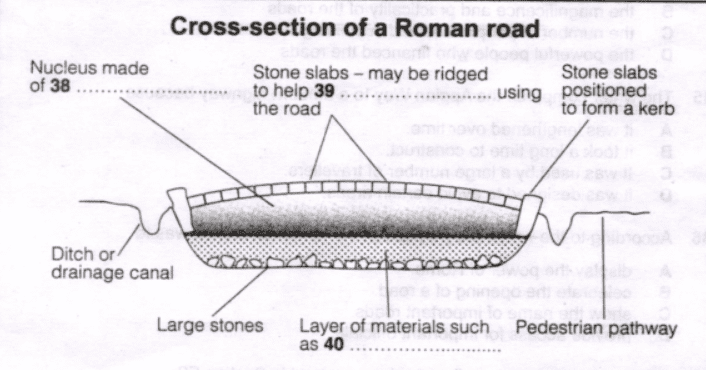
E Major roads were around a standard 4.2 metres wide, which was enough space for two vehicles to pass each other. First a trench was dug in the earth, and a layer of large stones was used to form the foundation. This was followed by a substantial deposit of smaller broken materials – often crushed brick was used for this purpose, and on top of this, a layer of fine gravel was added. This upper section of the road was referred to as the nucleus and was then surfaced with blocks or slabs. Mountain roads might also have ridges running across the surface of the slabs, to give animals better grip, and have ruts cut into the stone to guide wheeled vehicles.
Roads were purposely inclined slightly from the centre down to the kerb to allow rainwater to run off along the sides. Many also had parallel ditches that collected the runoff and formed a drainage canal on each side of the road. A path of packed gravel for pedestrians typically ran along each side of the road, varying in width from 1 to 3 metres. Separating the path from the road were the kerb stones, which were regular upright slabs. Busier stretches of main roads had areas where vehicles could pull over, and some of these had services for travellers and their animals. Milestones were also set up at regular intervals along the road and these often recorded who was responsible for the upkeep of that stretch of the road and what repairs had been made.
F Lasting symbols of the imagination of Roman engineers are the many arched bridges and viaducts still standing today that helped achieve the engineers’ straight-line goal. The Romans built to last, and the piers of bridges which crossed rivers, for example, were often built with a resistant prow-shape and used massive durable blocks of stone, while the upper parts might be built of stone blocks strengthened with iron clamps. Perhaps the most impressive bridge was at Narni; 180 metres long, 8 metres wide and as high as 33 metres, it had 4 massive semicircular arches, one of which, stretching 32.1 metres, ranks as one of the longest block-arch spans in the ancient world. Recently hit by earthquakes, it is now having to undergo restoration work to repair the effects.
Such was the engineering and surveying skill of the Romans that many of their roads have provided the basis for hundreds of today’s routes across Europe and the Middle East. Many roads in Italy still use the original Roman name for certain stretches, and some bridges, such as at Tre Ponti in Venice, still carry road traffic today.
Questions
Questions 28–33 Matching Information
The text has six sections, A-F. Which section mentions the following?
Questions 34–37 One Choice
Choose the correct letter, A, B, C or D.
Questions 38–40 Diagram Labeling
Label the diagram below. Choose NO MORE THAN TWO WORDS from the text for each answer.
Answers & Explanations Summary
| # | Answer | Evidence | Explanation |
|---|---|---|---|
| Q28 | C | Besides permitting the rapid deployment of troops and more importantly the wheeled vehicles which supplied them with food and equipment, Roman roads allowed for an increase in trade and cultural exchange. Roads were also one of the ways Rome could demonstrate its authority. | Excerpt/Passage Explanation: The passage says that Roman roads helped move troops and their supplies, increased trade and sharing of culture, and showed Rome's power. Answer Explanation: The answer is C. This means that section C talks about the different uses of Roman roads. Reason For Correctness: The correct answer is C because this section explains how Roman roads helped move soldiers quickly, allowed for trade, and showed Rome's power. It also mentions that roads were often named after important people, which shows their significance. |
| Q29 | F | Such was the engineering and surveying skill of the Romans that many of their roads have provided the basis for hundreds of today's routes across Europe and the Middle East. | Excerpt/Passage Explanation: The passage says that the Romans were very skilled at building roads, and because of this, many of their roads are still used for today's routes in Europe and the Middle East. Answer Explanation: The answer means that section F talks about some Roman roads and bridges that are still standing today. Reason For Correctness: The correct answer is F because this section talks about how the bridges and roads built by the Romans are symbols of their engineering skills and that many of them still exist today, showing their lasting impact. |
| Q30 | D | To achieve the objective of constructing the shortest routes possible between two points, all manner of engineering difficulties had to be overcome. Once extensive surveying had been carried out, to ensure the proposed route was actually straight and to determine what various engineering methods were needed, marshes had to be drained, forests cut through, creeks diverted, bedrock channelled, mountainsides cut into rivers crossed with bridges, valleys traversed with viaducts and tunnels built through mountains. | Excerpt/Passage Explanation: The passage explains that to make the shortest roads, engineers had to solve many problems. They surveyed the land to make sure the path was straight and figured out what work was needed. This included draining marshes and cutting through forests. Answer Explanation: The answer is D. This section talks about the work and planning needed to build a road. Reason For Correctness: The correct answer is D because it explains how engineers prepared for building roads. It discusses surveying to make sure the route was straight and the challenges faced, like draining marshes and cutting through forests. All these preparations were essential for constructing roads. |
| Q31 | B | The first and most famous great Roman road was the Via Appia or Appian Way. Constructed from 312 BCE | Excerpt/Passage Explanation: The passage says that the first big Roman road called the Via Appia was built starting in the year 312 BCE. This tells us when the Romans began their road building. Answer Explanation: The answer is B. This section tells us when road building started. Reason For Correctness: The correct answer is B because it explains that the Romans did not create roads but used old ideas and started building roads around 312 BCE. This shows the beginning of their road construction efforts. |
| Q32 | F | Recently hit by earthquakes, it is now having to undergo restoration work to repair the effects. | Excerpt/Passage Explanation: The passage says that the bridge was hit by earthquakes and now needs work to be fixed. This explains that because of the earthquake, repairs are necessary. Answer Explanation: The answer is F. This means the section F talks about what happens because of damage from something like an earthquake. Reason For Correctness: The correct answer is F because this section mentions that Roman bridges were damaged by earthquakes and now need to be fixed. This shows the result (or consequence) of the damage caused by a natural disaster. |
| Q33 | C | The network of public Roman roads covered over 120,000 kilometers. | Excerpt/Passage Explanation: The passage says that the Roman roads made a big network that was over 120,000 kilometers long. This shows how many roads the Romans built. Answer Explanation: The answer is C. This means that section C talks about the total distance of the Roman roads. Reason For Correctness: The correct answer is C because this section tells us that the public Roman roads covered more than 120,000 kilometers. This distance is highlighted as a key fact about the Roman roads. |
| Q34 | B | Consequently roads required bridges tunnels, viaducts and many other architectural and engineering features to create a series of breathtaking but highly useful monuments | Excerpt/Passage Explanation: The passage says that the roads needed special features like bridges and tunnels, which made them look amazing and also very useful. Answer Explanation: The answer means that the writer talks about how the roads were amazing to look at and also very useful. Reason For Correctness: The correct answer is B because the passage mentions that Roman roads were not only impressive structures but also important for connecting places and helping in trade and military movement. It highlights both their beauty and usefulness by referring to them as 'breathtaking but highly useful monuments.' |
| Q35 | D | Much like a modern highway it bypassed small towns along the way and it largely ignored geographical obstacles. | Excerpt/Passage Explanation: The passage says that the Appian Way was like a modern highway because it went around small towns and did not let mountains or rivers stop it. Answer Explanation: The answer means that the Appian Way was made to not go through some areas. Reason For Correctness: The correct answer is D because the passage says the Appian Way 'bypassed small towns along the way and it largely ignored geographical obstacles.' This shows that it was designed to avoid certain areas, similar to how modern highways work. |
| Q36 | A | For this reason, many roads began and ended in a triumphal arch, and the imperial prestige associated with a road project was demonstrated | Excerpt/Passage Explanation: The passage tells us that many roads started and ended with a triumphal arch. This means the arches were there to show off how important and powerful the Roman Empire was. Answer Explanation: The answer means that the triumphal arches were built to show how strong and powerful Rome was. Reason For Correctness: The correct answer is A because the passage explains that roads often began and ended in triumphal arches to show Rome's authority. This implies that the purpose of these arches was to demonstrate power. |
| Q37 | C | Milestones were also set up at regular intervals along the road and these often recorded who was responsible for the upkeep of that stretch of the road and what repairs had been made. | Excerpt/Passage Explanation: The passage says that milestones were put along the roads to keep track of who took care of that part of the road and what repairs happened. This helps people know about road maintenance. Answer Explanation: The answer means that milestones along the road showed who was responsible for taking care of that part of the road and what repairs had been done. Reason For Correctness: The correct answer is C because Section E mentions that milestones recorded who was responsible for the upkeep of that stretch of the road and what repairs had been made. This shows that milestones had an important role in maintaining the roads. |
| Q38 | gravel / fine gravel | This was followed by a substantial deposit of smaller broken materials – often crushed brick was used for this purpose, and on top of this, a layer of fine gravel was added. | Excerpt/Passage Explanation: The passage explains that after putting down large stones for the foundation, smaller broken materials and fine gravel were added on top to build the road. Answer Explanation: The answer is 'gravel' and 'fine gravel'. Reason For Correctness: The correct answer is 'gravel' and 'fine gravel' because the passage describes how the Roman roads were built. It mentions that after digging a trench, a layer of broken materials was added and then a layer of fine gravel on the top. These are important materials used in the construction of Roman roads. |
| Q39 | Animals | Mountain roads might also have ridges running across the surface of the slabs, to give animals better grip | Excerpt/Passage Explanation: The passage says that mountain roads had special ridges on them. These ridges helped animals walk better on the roads. Answer Explanation: The answer is 'Animals'. Reason For Correctness: The correct answer is 'Animals' because the passage mentions that mountain roads had features to give animals better grip, indicating that the roads were designed for animal use. |
| Q40 | brick / crushed brick | This was followed by a substantial deposit of smaller broken materials – often crushed brick was used for this purpose | Excerpt/Passage Explanation: The passage says that after the first layer of stone, they added a layer of smaller broken materials, which often included crushed brick. Answer Explanation: The answer means that in the construction of Roman roads, they used 'brick' and 'crushed brick' as materials. Reason For Correctness: The correct answer is 'brick' and 'crushed brick' because the passage mentions that smaller broken materials, often crushed brick, were used for making the road's foundation. |