
The History Of Kites - IELTS Reading Answers & Explanations
From IELTS Trainer 2 General Training Reading Test 6 · Part 3 · Questions 28–40
Reading Passage
You should spend about 20 minutes on Questions 28-40, which are based on Reading Passsage 3. Read the text on page 176 and answer Questions 28-40.
The history of kites
A
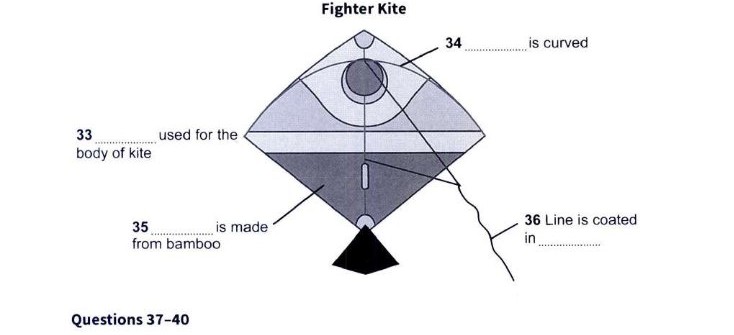
The fighter kite is an ancient design that became popular in Asia. While there were some variations, fighter kites tended to be small, flat and diamond-shaped and were flown throughout Asia, including in Japan and India. The main part of this kite was made of paper, while its spine consisted of a piece of tapered bamboo. There was also a rounded, balanced bow. These kites did not have tails, which were thought to affect their manoeuvrability. Most of the line was made of cotton but part of this was covered with an abrasive, which could cut an opponent's line in a competition.
European kites developed later, possibly crafted out of flags. Nowadays there are eight main kinds of kite worldwide: the flat, bowed, box, sled, delta and compound, all of which have frames, and now the parafoil which is somewhat like a parachute, and the rotor which has a spinning vane between two cylinders. Perhaps most significantly, the materials used to build kites remained basically unchanged for hundreds of years, but today the materials that comprise the various components of kites are often synthetic.
B
In Europe, kites were curiosities at first rather than being part of the culture, but they were soon used as vehicles for discovery and innovation. In 1893, William A Eddy introduced a tailless kite that was in the shape of an elongated diamond. He was interested in the potential kites had for the purposes of meteorology and aerial photography. Besides being responsible for a renewed interest in kite-flying throughout Europe, Eddy's kite was also utilised by the United States Weather Bureau.
In 1752, the American inventor and statesman Benjamin Franklin went out in a thunderstorm with his son to fly a flat kite with a pointed wire. They attached a metal key to the kite's line and watched as it became electrified, both miraculously avoiding electrocution. This proved that lightning was a natural occurrence called electricity, and this experiment led to Franklin inventing the lightning rod, a metallic rod that protects a structure from lightning damage by guiding currents from lightning flashes into the ground.
C
Kites also contributed greatly to the development of the airplane. The first recorded aircraft with a person inside was British aviator Sir George Cayley's glider in 1853. He used modified kites to test whether his glider idea would work. This was a big step in aviation, as it dispelled the former assumption that an aircraft would need wings that flapped like a bird's.
Around 1900 Orville and Wilbur Wright started using kites to test their ideas for planes. These brothers ran a bicycle shop in Ohio in the United States and were obsessed with aviation. It was the Wright brothers who concentrated on how to control the aircraft, something that had, until then, baffled many other inventors. The Wright brothers made a box kite that was wired in a way that meant the kite could be made to turn. Not long after that, they successfully flew the first manned airplane. Without experiments with kites, modern aircraft would have taken much longer to be developed.
D
Whatever the design of a kite, in order to fly, it needs to have certain characteristics. Firstly, it needs to be able to lift in the wind and this requires an aerodynamic structure. It also needs to have something that stops it from flying away; this is called a tether. One end of the tether is connected to the kite and the other is usually on a hand-held spool for a person to manage the length of the line. Another necessary component is the bridle, which is two or more lines that are attached to each other at a point and this can be adjusted according to the strength and direction of the wind.
E
There are three forces that control kite flight; these are lift, gravity and drag. If the wind is stronger than the resistance of the air (drag) and the pull of gravity, the kite should be able to fly. One way in which a kite differs from a plane is that when the kite is fixed (using the tether) so that the wind gives it lift, it maintains what is called 'perpetual stall'. This is essential for a kite to fly but would not be a suitable design for an aeroplane. If a kite is flat, it should have a tail to provide drag so that the nose of the kite is pointing upwards.
Although many people try it, running with a kite is not an effective way to send it into the sky. It is better to start off with two people, one holding the kite and the other with the line unravelled about 30 metres, holding the reel or spool. The bridle of the kite should be facing the person who is not holding it and the breeze should come from behind the kite. If all this has been done, the kite should be launched successfully when the person holding it lets go of it.
Questions
Questions 28–32 Matching Headings
The text above has five sections, A-E.
Choose the correct heading for each paragraph from the list of headings below.
NB you may use any letter more than once.
i. Using kites for scientific research
ii. Types of kite
iii. Factors that determine whether a kite will fly
iv. The beginning of manned flight
v. The popularity of kites throughout the years
vi. Basic features shared by all kites
Questions 33–36 Diagram Labeling
Label the diagram below.
Choose ONE WORD ONLY from the text for each answer.
Questions 37–40 One Choice
Choose the correct letter, A, B, C or D.
Answers & Explanations Summary
| # | Answer | Evidence | Explanation |
|---|---|---|---|
| Q28 | ii | Nowadays there are eight main kinds of kite worldwide: the flat, bowed, box, sled, delta and compound, all of which have frames, and now the parafoil which is somewhat like a parachute, and the rotor which has a spinning vane between two cylinders | Excerpt/Passage Explanation: The passage explains that there are currently eight different types of kites used across the world and lists their specific names. Answer Explanation: The answer means that the best title for Section A is 'Types of kite'. Reason For Correctness: The correct answer is correct because Section A focuses on describing different styles of kites. It mentions the 'fighter kite' as an old style from Asia and then provides a list of 'eight main kinds' of kites used around the world today, such as the flat, box, and parafoil kites. |
| Q29 | i | He was interested in the potential kites had for the purposes of meteorology and aerial photography This proved that lightning was a natural occurrence called electricity, and this experiment led to Franklin inventing the lightning rod, a metallic rod that protects a structure from lightning damage by guiding currents from lightning flashes into the ground |
Excerpt/Passage Explanation: The passage explains that William A Eddy explored how kites could help with meteorology (the study of weather). It also describes Benjamin Franklin's scientific test (experiment) where he used a kite to show that lightning is electricity. Answer Explanation: The answer 'i' means that Section B is about people using kites for science projects to learn about the world. Reason For Correctness: The correct answer is 'i' because Section B describes how kites were used as tools for science. It mentions William A Eddy, who used kites for 'meteorology' (the science of weather), and Benjamin Franklin, who performed a famous scientific 'experiment' using a kite to prove that lightning is 'electricity.' Both are examples of using kites for scientific research. |
| Q30 | iv | The first recorded aircraft with a person inside was British aviator Sir George Cayley's glider in 1853 Not long after that, they successfully flew the first manned airplane |
Excerpt/Passage Explanation: The passage explains that in 1853, there was an aircraft where a person could sit inside, and later, the Wright brothers flew the first airplane with a person to control it. Answer Explanation: The answer is heading iv, which describes the early stages and start of people flying in aircrafts. Reason For Correctness: The correct answer is heading iv because Section C focuses on how kites helped people create the first machines that could carry a human into the air. It mentions Sir George Cayley's glider, which was the first aircraft to have a person inside, and the Wright brothers, who flew the first manned airplane. The word 'manned' means that a person is on board to operate the vehicle, which matches the theme of 'manned flight'. |
| Q31 | iii | Whatever the design of a kite, in order to fly, it needs to have certain characteristics | Excerpt/Passage Explanation: The passage states that no matter how a kite is made, it must have specific features to be able to go up and stay in the sky. Answer Explanation: The answer iii means this section describes the necessary conditions or parts required for a kite to stay in the air. Reason For Correctness: The correct answer is iii because Section D lists the specific requirements a kite must meet to fly, regardless of its shape. It mentions 'characteristics' like an aerodynamic structure for 'lift', a 'tether' to keep it connected, and a 'bridle' for control. These requirements are the 'factors' that 'determine' if the flight will be possible (or whether the kite will fly). |
| Q32 | vi | There are three forces that control kite flight; these are lift, gravity and drag. If the wind is stronger than the resistance of the air (drag) and the pull of gravity, the kite should be able to fly | Excerpt/Passage Explanation: The passage explains that for a kite to fly, the power of the wind must be stronger than the things holding it back or pulling it down. Answer Explanation: The answer iii means this section explains the conditions and rules that allow a kite to fly successfully. Reason For Correctness: The correct answer is iii because Section E describes the balance of forces — lift, gravity, and drag — that must occur for a kite to stay in the air. It also explains how factors like wind strength and the correct launching method determine whether the flight will be successful. |
| Q33 | Paper | The main part of this kite was made of paper, while its spine consisted of a piece of tapered bamboo | Excerpt/Passage Explanation: The passage states that the primary surface of the kite is made from paper, and the support stick (the spine) is made from a type of wood called bamboo. Answer Explanation: The answer is paper, which is the material used for the largest section of the kite. Reason For Correctness: The correct answer is paper because paragraph A describes the design of the Asian fighter kite. It explains that while the frame or 'spine' was made of bamboo, the 'main part' of the kite was created using paper. The question asks for the material that makes up the body of this kite. |
| Q34 | Bow | There was also a rounded, balanced bow | Excerpt/Passage Explanation: The passage states that this kind of kite has a curved, steady part known as a bow. Answer Explanation: The answer is the name of a specific part of a kite, which is the curved frame piece. Reason For Correctness: The correct answer is found in Section A, where the text describes the physical parts of a 'fighter kite.' It mentions that the kite has a 'spine' (a straight middle piece) and a 'rounded, balanced bow.' In a diagram labeling task, the 'bow' refers to the curved horizontal component of the frame. |
| Q35 | Spine | The main part of this kite was made of paper, while its spine consisted of a piece of tapered bamboo | Excerpt/Passage Explanation: The passage explains that while the body of the kite is paper, the middle supporting rod is called the "spine" and is made from a piece of shaped bamboo. Answer Explanation: The answer "Spine" refers to the long, thin central stick (often made of bamboo) that acts as the main frame or backbone of the kite. Reason For Correctness: The correct answer is "Spine" because the text describes the construction of the Asian fighter kite. It identifies the different materials used, explaining that the central rod or vertical support structure that holds the kite together is known as the "spine." This part is typically made of bamboo to provide strength and shape. |
| Q36 | abrasive | Most of the line was made of cotton but part of this was covered with an abrasive, which could cut an opponent's line in a competition | Excerpt/Passage Explanation: The passage explains that most of the string used for the kite is made of cotton, but one section has a rough coating on it. This rough coating is used to cut the strings of other people's kites during a game. Answer Explanation: The answer refers to a rough or sharp material added to the kite's string. Reason For Correctness: The correct answer is found in the section about 'fighter kites.' The text describes how these kites were used for competitions. It explains that while the string was mostly cotton, a specific part was coated with a rough material to help cut the strings of other kites. This material is called an 'abrasive'. |
| Q37 | A | Perhaps most significantly, the materials used to build kites remained basically unchanged for hundreds of years, but today the materials that comprise the various components of kites are often synthetic | Excerpt/Passage Explanation: The passage explains that for a very long time, the materials to make kites stayed the same. But now, the parts of a kite are often made of man-made materials instead of natural ones. Answer Explanation: The answer says that the things used to build kites today are not the same as the things used to build kites a long time ago. Reason For Correctness: The correct answer is A because the passage highlights a major change in the materials (substances) used for kites. For a very long time, these materials did not change. However, the text states that today, kite parts are often 'synthetic,' which means they are man-made. This is different from the natural materials like paper and 'bamboo' mentioned earlier in the text as part of older designs. |
| Q38 | A | This proved that lightning was a natural occurrence called electricity, and this experiment led to Franklin inventing the lightning rod, a metallic rod that protects a structure from lightning damage by guiding currents from lightning flashes into the ground | Excerpt/Passage Explanation: The passage explains that Franklin’s experiment with the kite and electricity resulted in him making a lightning rod. This rod is a metal stick that keeps a building or house safe from lightning strikes. Answer Explanation: The answer means that Benjamin Franklin's flight with a kite helped him create a brand-new, helpful tool. Reason For Correctness: The correct answer is A because the passage describes how Benjamin Franklin's experiment with a kite during a storm resulted in a new invention. Specifically, the text explain that this experiment led him to create the 'lightning rod,' which is a device used to keep buildings safe from lightning strikes. An 'innovation' is a word for a new idea or invention, which perfectly matches the description of the lightning rod being created after the experiment. |
| Q39 | B | It was the Wright brothers who concentrated on how to control the aircraft, something that had, until then, baffled many other inventors. The Wright brothers made a box kite that was wired in a way that meant the kite could be made to turn | Excerpt/Passage Explanation: The passage explains that Orville and Wilbur Wright focused on how to steer a flying machine. They built a special kite that could be moved in different directions to turn, which was a problem other inventors had not solved yet. Answer Explanation: The answer means that the Wright brothers focused on finding ways to guide or steer a kite so it could move in different directions, such as turning. Reason For Correctness: The correct answer is correct because the passage points out that while many inventors were confused by how to steer a plane, the Wright brothers focused specifically on this problem. They differ from other engineers because they created a kite that could be controlled and 'made to turn,' which means they figured out how to control its direction. Other inventors, like Sir George Cayley, also used kites as models, so that part was not unique to the Wright brothers, but their focus on steering ('control') was. |
| Q40 | C | It is better to start off with two people, one holding the kite and the other with the line unravelled about 30 metres, holding the reel or spool the kite should be launched successfully when the person holding it lets go of it |
Excerpt/Passage Explanation: The passage explains that to launch a kite well, it is best to have two people. One person holds the string reel while the string is stretched out for 30 meters, and the kite is only launched when the other person holding it lets go. Answer Explanation: The answer means that the most effective way to start flying a kite is to have one person hold the kite and let it go while another person stands far away holding the control string. Reason For Correctness: The correct answer is C because the text describes a specific method for launching a kite that is "better" than running with it. This method requires two people: one to hold the kite and one to hold the string. These two people should be separated by a distance of about "30 metres" (where the string is pulled out or "unravelled"). Finally, the person holding the kite must "let go" of it to launch it successfully, which is another word for "release". |