
Snow-makers - IELTS Reading Answers & Explanations
From IELTS Practice Test Plus 2 Academic Reading Test 1 · Part 1 · Questions 1–13
Reading Passage
You should spend about 20 minutes on Questions 1-13, which are based on Reading Passage 1 on pages 18-19.
Snow-makers
Skiing is big business nowadays. But what can ski resort owners do if the snow doesn't come?
A In the early to mid twentieth century, with the growing popularity of skiing, ski slopes became extremely profitable businesses. But ski resort owners were completely dependent on the weather; if it didn't snow, or didn't snow enough, they had to close everything down. Fortunately, a device called the snow gun can now provide snow whenever it is needed. These days such machines are standard equipment in the vast majority of ski resorts around the world, making it possible for many resorts to stay open four months or more a year.
B Snow formed by natural weather systems comes from water vapour in the atmosphere. The water vapour condenses into droplets, forming clouds. If the temperature is sufficiently low, the water droplets freeze into tiny ice crystals. More water particles then condense onto the crystal and join with it to form a snowflake. As the snowflake grows heavier, it falls towards the Earth.
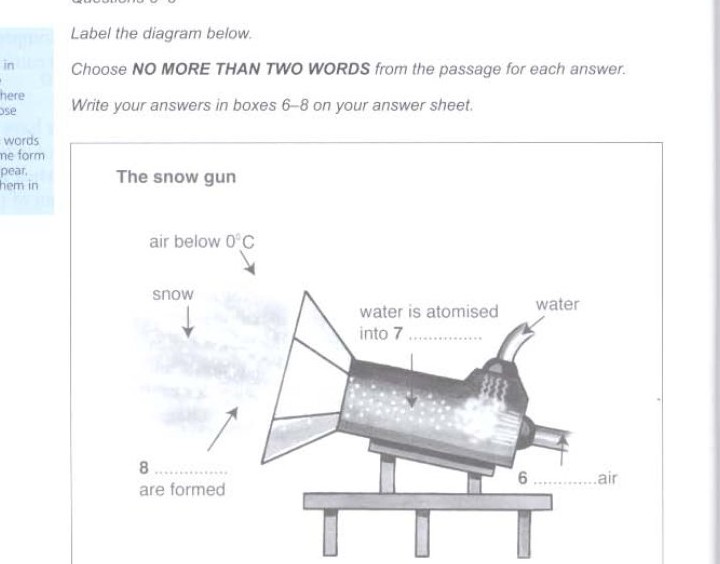
C The snow gun works very differently from a natural weather system, but it accomplishes exactly the same thing. The device basically works by combining water and air. Two different hoses are attached to the gun, one leading from a water pumping station which pumps water up from a lake or reservoir, and the other leading from an air compressor. When the compressed air passes through the hose into the gun, it atomises the water - that is, it disrupts the stream so that the water splits up into tiny droplets. The droplets are then blown out of the gun and if the outside temperature is below 0°C, ice crystals will form, and will then make snowflakes in the same way as natural snow.
D Snow-makers often talk about dry snow and wet snow. Dry snow has a relatively low amount of water, so it is very light and powdery. This type of snow is excellent for skiing because skis glide over it easily without getting stuck in wet slush. One of the advantages of using a snow-maker is that this powdery snow can be produced to give the ski slopes a level surface. However, on slopes which receive heavy use, resort owners also use denser, wet snow underneath the dry snow. Many resorts build up the snow depth this way once or twice a year, and then regularly coat the trails with a layer of dry snow throughout the winter.
E The wetness of snow is dependent on the temperature and humidity outside, as well as the size of the water droplets launched by the gun. Snow-makers have to adjust the proportions of water and air in their snow guns to get the perfect snow consistency for the outdoor weather conditions. Many ski slopes now do this with a central computer system that is connected to weather-reading stations all over the slope.
F But man-made snow makes heavy demands on the environment. It takes about 275,000 litres of water to create a blanket of snow covering a 60 x 60 metre area. Most resorts pump water from one or more reservoirs located in low-lying areas. The run-off water from the slopes feeds back into these reservoirs, so the resort can actually use the same water over and over again. However, considerable amounts of energy are needed to run the large air-compressing pumps, and the diesel engines which run them also cause air pollution.
G Because of the expense of making snow, ski resorts have to balance the cost of running the machines with the benefits of extending the ski season, making sure they only make snow when it is really needed, and when it will bring the maximum amount of profit in return for the investment. But man-made snow has a number of other uses as well. A layer of snow keeps a lot of the Earth's heat from escaping into the atmosphere, so farmers often use man-made snow to provide insulation for winter crops. Snow-making machines have played a big part in many movie productions. Movie producers often take several months to shoot scenes that cover just a few days. If the movie takes place in a snowy setting, the set decorators have to get the right amount of snow for each day of shooting either by adding man-made snow or melting natural snow. And another important application of man-made snow is its use in the tests that aircraft must undergo in order to ensure that they can function safely in extreme conditions.
Questions
Questions 1–5 Matching Headings
Reading Passage 1 has seven paragraphs A-G.
Choose the correct heading for each paragraph from the list of headings below.
i. Considering ecological costs
ii. Modifications to the design of the snow gun
iii. The need for different varieties of snow
iv. Local concern over environmental issues
v. A problem and a solution
vi. Applications beyond the ski slopes
vii. Converting wet snow to dry snow
viii. New method for calculating modifications
ix. Artificial process, natural product
x. Snow formation in nature
Questions 6–8 Diagram Labeling
Label the diagram below.
Choose NO MORE THAN TWO WORDS from the passage for each answer.
Questions 9–13 Sentence Completion
Complete the sentences below.
Choose NO MORE THAN THREE WORDS from the passage for each answer.
- Dry snow is used to give slopes a level surface, while wet snow is used to increase the 9 on busy slopes.
- To calculate the required snow consistency, the 10 of the atmosphere must first be measured.
- The machinery used in the process of making the snow consumes a lot of 11 which is damaging to the environment.
- Artificial snow is used in agriculture as a type of 12 for plants in cold conditions.
- Artificial snow may also be used in carrying out safety checks on 13.
Answers & Explanations Summary
| # | Answer | Evidence | Explanation |
|---|---|---|---|
| Q1 | ix | The snow gun works very differently from a natural weather system, but it accomplishes exactly the same thing The droplets are then blown out of the gun and if the outside temperature is below 0°C, ice crystals will form, and will then make snowflakes in the same way as natural snow |
Excerpt/Passage Explanation: The passage explains that the snow gun works very differently from how snow is made in nature, but it still makes the same kind of snow. It also says that the tiny water drops blown out of the gun turn into ice crystals and then make snowflakes, just like natural snow. Answer Explanation: The answer means that Paragraph C talks about a man-made way of doing something, but the final thing it creates is just like what nature makes. Reason For Correctness: The correct answer is 'Artificial process, natural product' because Paragraph C explains how a snow gun, which is an artificial process, makes snow. The passage says the snow gun 'works very differently from a natural weather system,' highlighting the 'artificial process.' However, it 'accomplishes exactly the same thing' and makes 'snowflakes in the same way as natural snow,' which means it creates a 'natural product.' The paragraph details the steps the machine takes to combine water and air to form snow, showing a man-made method to achieve a natural outcome. |
| Q2 | iii | Snow-makers often talk about dry snow and wet snow. Dry snow has a relatively low amount of water, so it is very light and powdery. This type of snow is excellent for skiing because skis glide over it easily without getting stuck in wet slush. One of the advantages of using a snow-maker is that this powdery snow can be produced to give the ski slopes a level surface. However, on slopes which receive heavy use, resort owners also use denser, wet snow underneath the dry snow. Many resorts build up the snow depth this way once or twice a year, and then regularly coat the trails with a layer of dry snow throughout the winter | Excerpt/Passage Explanation: The passage explains that people who make snow talk about two types: 'dry snow' and 'wet snow'. It says that 'dry snow' is light and good for skiing easily. But, for ski areas that are used a lot, owners also put 'denser, wet snow' under the dry snow. This shows why different kinds of snow are important and how they are used together. Answer Explanation: The answer 'iii' means that the paragraph talks about why different kinds of snow are needed. Reason For Correctness: The correct answer is 'iii. The need for different varieties of snow' because Paragraph D clearly explains that snow-makers use two main types of snow: 'dry snow' and 'wet snow'. It describes the qualities of each type (e.g., dry snow is light and powdery, good for skiing; wet snow is denser) and explains *why* both varieties are needed and used side-by-side on ski slopes. For example, dry snow is used for the top layer, while denser, wet snow is used underneath, especially where many people ski, to build depth. |
| Q3 | viii | Snow-makers have to adjust the proportions of water and air in their snow guns to get the perfect snow consistency for the outdoor weather conditions. Many ski slopes now do this with a central computer system that is connected to weather-reading stations all over the slope | Excerpt/Passage Explanation: The passage says that people who make snow need to change the amount of water and air in their machines to make good snow. It then says that many ski places now use a main computer system, which is connected to machines that read the weather all over the mountain, to help them make these changes. Answer Explanation: The answer means that Paragraph E talks about a new way to figure out how to make changes. Reason For Correctness: The correct answer is 'viii. New method for calculating modifications' because Paragraph E explains that snow-makers must change or 'adjust the proportions of water and air' in their snow guns to make the correct type of snow for the outside weather. The passage then describes a 'new method' for doing this: many ski resorts 'now do this with a central computer system that is connected to weather-reading stations all over the slope'. This computer system helps to 'calculate' or determine the necessary 'modifications' to the snow gun settings based on real-time weather data. |
| Q4 | i | But man-made snow makes heavy demands on the environment. It takes about 275,000 litres of water to create a blanket of snow covering a 60 x 60 metre area. Most resorts pump water from one or more reservoirs located in low-lying areas. The run-off water from the slopes feeds back into these reservoirs, so the resort can actually use the same water over and over again. However, considerable amounts of energy are needed to run the large air-compressing pumps, and the diesel engines which run them also cause air pollution | Excerpt/Passage Explanation: The passage explains that making snow by machines is bad for nature. It uses a lot of water and energy, and the engines that power the machines make the air dirty. This shows the problems or 'costs' for the environment. Answer Explanation: The answer 'i' means looking at the environmental expenses or how making snow affects nature negatively. Reason For Correctness: The correct answer is explanation 'i. Considering ecological costs' because Paragraph F talks about the negative impact that making man-made snow has on the environment. It explains that making snow 'makes heavy demands on the environment' by using 'considerable amounts of energy' and causing 'air pollution'. These are all examples of 'ecological costs' or harm to the environment. |
| Q5 | vi | But man-made snow has a number of other uses as well. A layer of snow keeps a lot of the Earth's heat from escaping into the atmosphere, so farmers often use man-made snow to provide insulation for winter crops. Snow-making machines have played a big part in many movie productions. Movie producers often take several months to shoot scenes that cover just a few days. If the movie takes place in a snowy setting, the set decorators have to get the right amount of snow for each day of shooting either by adding man-made snow or melting natural snow. And another important application of man-made snow is its use in the tests that aircraft must undergo in order to ensure that they can function safely in extreme conditions | Excerpt/Passage Explanation: The passage says that man-made snow has 'other uses' besides skiing. It then gives examples: farmers use it to keep plants warm in winter, movie makers use it for film scenes, and it's used to test airplanes in very cold weather. This means the snow is used for many different things outside of ski areas. Answer Explanation: The answer means that Paragraph G talks about how snow made by humans can be used for many things, not just for skiing. Reason For Correctness: The correct answer is 'vi. Applications beyond the ski slopes' because Paragraph G specifically lists several uses for man-made snow that are not related to skiing. The paragraph mentions that farmers use it to protect crops, movie producers use it for filming, and it's used to test aircraft. These examples show its 'applications' or uses that go 'beyond the ski slopes'. The phrase 'other uses' in the passage is a key indicator of this topic. |
| Q6 | compressed | When the compressed air passes through the hose into the gun, it atomises the water | Excerpt/Passage Explanation: The passage explains that when the 'compressed air' goes into the snow gun, it breaks the water into very small drops. 'Compressed' tells us that the air has been squeezed together, making it powerful enough to do this. Answer Explanation: The answer 'compressed' means that the air used in the snow gun is squeezed into a smaller space, making it have more pressure. Reason For Correctness: The correct answer is 'compressed' because the passage describes how the snow gun uses air and water. It specifically states that one hose leads from an 'air compressor' and that 'compressed air' passes into the gun. This shows that the air is made denser and more powerful before it is used to create snow. |
| Q7 | tiny droplets / droplets | When the compressed air passes through the hose into the gun, it atomises the water - that is, it disrupts the stream so that the water splits up into tiny droplets | Excerpt/Passage Explanation: The passage says that when air is pushed into the snow gun, it breaks the water into 'tiny droplets.' This means the water stream is separated into many very small drops. Answer Explanation: The answer, 'tiny droplets,' means very small drops of water. These small drops are what the snow gun makes from water before it turns into snow. Reason For Correctness: The correct answer is 'tiny droplets' because the passage explains how a snow gun changes water into snow. It states that compressed air breaks the water stream into very small pieces, which are called 'tiny droplets.' These droplets then freeze if the weather is cold enough, forming snowflakes. This step is essential in the snow-making process. |
| Q8 | ice crystals | The droplets are then blown out of the gun and if the outside temperature is below 0°C, ice crystals will form, and will then make snowflakes in the same way as natural snow | Excerpt/Passage Explanation: The passage explains that when the tiny drops of water come out of the snow gun, if the temperature outside is very cold (colder than 0°C), these water drops will become 'ice crystals'. After these small frozen pieces form, they will grow into 'snowflakes', just like how real snow is made. Answer Explanation: The answer, "ice crystals," means very tiny pieces of frozen water. Reason For Correctness: The correct answer identifies a key stage in the creation of snow, both naturally and with snow-making machines, which is the main topic of the passage. The passage explains that when water droplets are released from a snow gun, or form in the atmosphere, and the temperature is cold enough (below 0°C), these droplets will transform into 'ice crystals'. These 'ice crystals' are the building blocks that then join with more water particles to ultimately form larger 'snowflakes'. Therefore, 'ice crystals' represent the initial frozen state of water before it develops into complete snow. |
| Q9 | snow depth / depth | However, on slopes which receive heavy use, resort owners also use denser, wet snow underneath the dry snow. Many resorts build up the snow depth this way once or twice a year, and then regularly coat the trails with a layer of dry snow throughout the winter | Excerpt/Passage Explanation: The passage says that on ski slopes where many people ski, the owners put heavy, 'wet snow' first. This is done to make the 'snow depth' — how thick the snow layer is — much bigger. After that, they put the light, 'dry snow' on top. Answer Explanation: The answer, 'snow depth,' means how thick or deep the snow is on the ground. Reason For Correctness: The correct answer is 'snow depth' because the passage explains that ski resort owners use 'denser, wet snow' to 'build up the snow depth' on slopes that are used a lot. This type of snow is placed underneath the lighter, dry snow, especially on areas that 'receive heavy use,' meaning busy slopes. |
| Q10 | temperature and humidity / humidity and temperature | The wetness of snow is dependent on the temperature and humidity outside, as well as the size of the water droplets launched by the gun. Snow-makers have to adjust the proportions of water and air in their snow guns to get the perfect snow consistency for the outdoor weather conditions | Excerpt/Passage Explanation: The passage says that how wet the snow is depends on how hot or cold it is ('temperature') and how much water is in the air ('humidity') outside. It also says that people who make snow must change their machines to get the best 'snow consistency' (how thick or thin the snow is) for the weather outside. Answer Explanation: The answer is 'temperature and humidity'. These are two things in the air that need to be measured to make the right kind of snow. Reason For Correctness: The correct answer is 'temperature and humidity' because the passage explains that the 'wetness of snow' depends on these two factors. Snow-makers need to adjust their machines to get the 'perfect snow consistency' based on the 'outdoor weather conditions'. This means they must measure the temperature and humidity of the surrounding air to make snow correctly. |
| Q11 | energy | However, considerable amounts of energy are needed to run the large air-compressing pumps, and the diesel engines which run them also cause air pollution | Excerpt/Passage Explanation: The passage states that a 'lot of energy' is needed to power the big pumps that press air. It also notes that the engines that run these pumps release bad air, which pollutes the environment. Answer Explanation: The answer is 'energy'. This means that the machines that make snow use a lot of power. Reason For Correctness: The correct answer is 'energy' because the passage states that making snow requires a significant amount of power for the machines. In paragraph F, it explicitly says, "However, considerable amounts of energy are needed to run the large air-compressing pumps," which directly addresses the idea that the machinery 'consumes a lot of' something that is damaging to the environment, as the passage also mentions 'air pollution' from the diesel engines that run them. |
| Q12 | insulation | A layer of snow keeps a lot of the Earth's heat from escaping into the atmosphere, so farmers often use man-made snow to provide insulation for winter crops | Excerpt/Passage Explanation: The passage says that snow stops the ground's warmth from going into the air. So, farmers use man-made snow to give a protective layer, called 'insulation,' to their plants that grow in winter, keeping them warm. Answer Explanation: The answer, 'insulation,' means that man-made snow acts like a protective blanket. It helps keep things warm and safe from the cold, just like a warm coat protects you in winter. Reason For Correctness: The correct answer is 'insulation' because the passage states that farmers use man-made snow to protect their 'winter crops' from the cold. The snow creates a layer that stops the Earth's heat from escaping, which is what 'insulation' does. The passage directly links man-made snow with providing 'insulation' for plants in cold weather. |
| Q13 | aircraft | And another important application of man-made snow is its use in the tests that aircraft must undergo in order to ensure that they can function safely in extreme conditions | Excerpt/Passage Explanation: The passage says that making snow is also important for checking flying machines. These checks make sure that these machines, called aircraft, can fly in a safe way even when the weather is very bad, like in very cold or stormy conditions. Answer Explanation: The answer "aircraft" means things that fly, like airplanes or helicopters. Reason For Correctness: The correct answer is "aircraft" because the passage explains that man-made snow has several uses, and one of them is for important tests. These tests are performed on 'aircraft' to make sure they can work well and safely even in very difficult weather, which the passage calls 'extreme conditions'. This directly matches the idea of 'safety checks'. |