
The Construction Of Roads And Bridges - IELTS Reading Answers & Explanations
From IELTS Practice Test Plus 3 Academic Reading Test 7 · Part 1 · Questions 1–13
Reading Passage
You should spend about 20 minutes on Questions 1–13, which are based on Reading Passage 1 below.
The construction of roads and bridges
Roads
Although there were highway links in Mesopotamia from as early as 3500 BC, the Romans were probably the first road-builders with fixed engineering standards. At the peak of the Roman Empire in the first century AD, Rome had road connections totalling about 85,000 kilometres.
Roman roads were constructed with a deep stone surface for stability and load-bearing. They had straight alignments and therefore were often hilly. The Roman roads remained the main arteries of European transport for many centuries, and even today many roads follow the Roman routes. New roads were generally of inferior quality, and the achievements of Roman builders were largely unsurpassed until the resurgence of road-building in the eighteenth century.
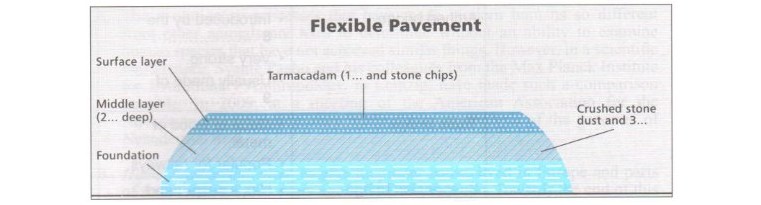
With horse-drawn coaches in mind, eighteenth-century engineers preferred to curve their roads to avoid hills. The road surface was regarded as merely a face to absorb wear, the load-bearing strength being obtained from a properly prepared and well-drained foundation. Immediately above this, the Scottish engineer John McAdam (1756–1836) typically laid crushed stone, to which stone dust mixed with water was added, and which was compacted to a thickness of just five centimetres, and then rolled. McAdam’s surface layer – hot tar onto which a layer of stone chips was laid – became known as ‘tarmacadam’, or tarmac. Roads of this kind were known as flexible pavements.
By the early nineteenth century – the start of the railway age – men such as John McAdam and Thomas Telford had created a British road network totalling some 200,000 km, of which about one sixth was privately owned toll roads called turnpikes. In the first half of the nineteenth century, many roads in the US were built to the new standards, of which the National Pike from West Virginia to Illinois was perhaps the most notable.
In the twentieth century, the ever-increasing use of motor vehicles threatened to break up roads built to nineteenth-century standards, so new techniques had to be developed.
On routes with heavy traffic, flexible pavements were replaced by rigid pavements, in which the top layer was concrete, 15 to 30 centimetres thick, laid on a prepared bed. Nowadays steel bars are laid within the concrete. This not only restrains shrinkage during setting, but also reduces expansion in warm weather. As a result, it is possible to lay long slabs without danger of cracking.
The demands of heavy traffic led to the concept of high-speed, long-distance roads, with access – or slip-lanes – spaced widely apart. The US Bronx River Parkway of 1925 was followed by several variants – Germany’s autobahns and the Pan American Highway. Such roads – especially the intercity autobahns with their separate multi-lane carriageways for each direction – were the predecessors of today’s motorways.
Bridges
The development by the Romans of the arched bridge marked the beginning of scientific bridge-building; hitherto, bridges had generally been crossings in the form of felled trees or flat stone blocks. Absorbing the load by compression, arched bridges are very strong. Most were built of stone, but brick and timber were also used. A fine early example is at Alcantara in Spain, built of granite by the Romans in AD 105 to span the River Tagus. In modern times, metal and concrete arched bridges have been constructed. The first significant metal bridge, built of cast iron in 1779, still stands at Ironbridge in England.
Steel, with its superior strength-to-weight ratio, soon replaced iron in metal bridge-work. In the railway age, the truss (or girder) bridge became popular. Built of wood or metal, the truss beam consists of upper and lower horizontal booms joined by vertical or inclined members.
The suspension bridge has a deck supported by suspenders that drop from one or more overhead cables. It requires strong anchorage at each end to resist the inward tension of the cables, and the deck is strengthened to control distortion by moving loads or high winds. Such bridges are nevertheless light, and therefore the most suitable for very long spans. The Clifton Suspension Bridge in the UK, designed by Isambard Kingdom Brunel (1806–59) to span the Avon Gorge in England, is famous both for its beautiful setting and for its elegant design. The 1998 Akashi Kaikyo Bridge in Japan has a span of 1,991 metres, which is the longest to date.
Cantilever bridges, such as the 1889 Forth Rail Bridge in Scotland, exploit the potential of steel construction to produce a wide clearwater space. The spans have a central supporting pier and meet midstream. The downward thrust, where the spans meet, is countered by firm anchorage of the spans at their other ends. Although the suspension bridge can span a wider gap, the cantilever is relatively stable, and this was important for nineteenth-century railway builders. The world’s longest cantilever span – 549 metres – is that of the Quebec rail bridge in Canada, constructed in 1918.
Questions
Questions 1–3 Diagram Labeling
Label the diagram below.
Choose NO MORE THAN TWO WORDS AND/OR A NUMBER from the passage for each answer.
Questions 4–7 True / False / Not Given
Do the following statements agree with the information given in Reading Passage 1?
Write
TRUE if the statement agrees with the information
FALSE if the statement contradicts the information
NOT GIVEN if there is no information on this
Questions 8–13 Table Completion
Complete the table below.
Use ONE WORD ONLY from the passage for each answer.
| Type of bridge | Features | Example(s) |
|---|---|---|
| Arched bridge |
|
Alcantara, Spain
Ironbridge, UK |
| Truss bridge |
|
|
| Suspension bridge |
|
Clifton, UK
Akashi Kaikyo, Japan (currently the 11 span) |
| Cantilever bridge |
|
Quebec, Canada |
Answers & Explanations Summary
| # | Answer | Evidence | Explanation |
|---|---|---|---|
| Q1 | hot tar | McAdam’s surface layer – hot tar onto which a layer of stone chips was laid – became known as ‘tarmacadam’, or tarmac | Excerpt/Passage Explanation: The passage explains that to make the top of the road, hot tar was poured down, and then small pieces of stone (stone chips) were put on it. This specific way of building roads was given the name ‘tarmacadam’ or ‘tarmac’. Answer Explanation: The answer "hot tar" is a black, sticky substance that is heated up and used to build the top part of a road. Reason For Correctness: The correct answer is "hot tar" because the text describes how John McAdam made a new kind of road surface. He used this material to hold small pieces of stone together. The text specifically says that his "surface layer" was made of this liquid with "stone chips" on top, which created what we call "tarmac" today. |
| Q2 | 5 centimetres / five centimetres / 5 centimeters / five centimeters | Immediately above this, the Scottish engineer John McAdam (1756–1836) typically laid crushed stone, to which stone dust mixed with water was added, and which was compacted to a thickness of just five centimetres, and then rolled | Excerpt/Passage Explanation: The passage explains that John McAdam added a layer of small stones and stone dust to the road. This layer was pressed down until it was exactly five centimeters thick. Answer Explanation: The answer is the specific thickness—5 centimeters—of a layer of road material used by the engineer John McAdam. Reason For Correctness: The correct answer is found in the section describing John McAdam's road-building methods. According to the text, he used crushed stone and dust to create a layer. This material was pressed down, or 'compacted,' until it reached a specific depth or 'thickness' of five centimetres. |
| Q3 | water | Immediately above this, the Scottish engineer John McAdam (1756–1836) typically laid crushed stone, to which stone dust mixed with water was added, and which was compacted to a thickness of just five centimetres, and then rolled | Excerpt/Passage Explanation: The passage explains that when building a road, McAdam used crushed stone and then added a mixture of stone dust and water before pressing it all together. Answer Explanation: The answer is a common liquid that was mixed with dust from stones to help build roads. Reason For Correctness: The correct answer is found in the section about road construction in the 1700s and 1800s. The text explains that the engineer John McAdam mixed stone dust with water and put it over crushed stones. This process helped create a solid top layer for the road once it was pressed down and rolled. The word 'water' identifies the specific liquid used in this mixture. |
| Q4 | FALSE | New roads were generally of inferior quality, and the achievements of Roman builders were largely unsurpassed until the resurgence of road-building in the eighteenth century | Excerpt/Passage Explanation: The passage explains that for a long time, new roads were not as good as the ones the Romans made. It stayed this way until road building started to get better again in the 1700s (the eighteenth century). Answer Explanation: The answer is FALSE because the statement is incorrect according to the text. Reason For Correctness: The correct answer is FALSE because the passage says that for many hundreds of years after the Romans, roads were actually worse, not better. Between the first century and the eighteenth century, people did not make roads better in a steady way. Instead, the quality of roads dropped and stayed lower until people began to focus on building them well again in the 1700s. Keywords like 'inferior quality' mean that newer roads were not as good as the old Roman ones, and 'unsurpassed' means no one did a better job than the Romans for a very long time. |
| Q5 | NOT GIVEN | By the early nineteenth century – the start of the railway age – men such as John McAdam and Thomas Telford had created a British road network totalling some 200,000 km, of which about one sixth was privately owned toll roads called turnpikes | Excerpt/Passage Explanation: The passage states that in the early 1800s, there were 200,000 km of roads in Britain and about one-sixth of them were private roads where people had to pay a fee (tolls) to use them, but it does not say who could afford those fees. Answer Explanation: The answer is NOT GIVEN because the text does not mention whether only rich people could use toll roads. Reason For Correctness: The correct answer is NOT GIVEN because the passage mentions that 'toll roads' (called turnpikes) were a part of the British network in the nineteenth century, but it never mentions the cost or the wealth of the people who used them. Therefore, we cannot know if only the 'very rich' could afford them based on this text. |
| Q6 | TRUE | In the twentieth century, the ever-increasing use of motor vehicles threatened to break up roads built to nineteenth-century standards, so new techniques had to be developed | Excerpt/Passage Explanation: The passage explains that in the 1900s, using more cars began to destroy roads made with older styles, which forced people to find better ways to build roads. Answer Explanation: The answer means that the way roads were built in the 1800s was not strong enough to handle many cars and trucks. Reason For Correctness: The correct answer is TRUE because the passage says that in the 1900s (twentieth century), the growing number of cars and trucks was damaging or ‘breaking up’ roads that were built using the older 1800s (nineteenth-century) methods. Because these roads were falling apart under the weight of the traffic, they were not good enough—or 'inadequate'—and engineers had to invent new ways to build them. |
| Q7 | NOT GIVEN | The demands of heavy traffic led to the concept of high-speed, long-distance roads, with access – or slip-lanes – spaced widely apart | Excerpt/Passage Explanation: The passage explains that because there was a lot of traffic, people began to design roads where cars could travel fast for long distances, but it does not mention speed limits or the lack of them. Answer Explanation: The answer means that the passage does not provide enough information to know if there were rules about how fast cars could drive on big roads in the early 1900s. Reason For Correctness: The correct answer is NOT GIVEN because while the text mentions that engineers created 'high-speed' roads due to many cars on the road, it never says if the speed of those cars was unregulated (meaning no laws) or regulated (meaning there were laws). The passage focuses on how the roads were built and designed, not on the laws or rules for the drivers using them. |
| Q8 | Romans | The development by the Romans of the arched bridge marked the beginning of scientific bridge-building | Excerpt/Passage Explanation: The passage explains that when the Romans started making bridges with an arch shape, it was the first time bridges were built using scientific ideas. Answer Explanation: The answer identifies the Romans, who were people living in the Roman Empire long ago. Reason For Correctness: The correct answer is Romans because the passage credits them with creating the arched bridge, which was a major step forward in building science. The text mentions that their work on these curved structures was the start of organized and expert bridge construction, replacing simpler methods like using fallen trees. |
| Q9 | stone | Most were built of stone, but brick and timber were also used | Excerpt/Passage Explanation: The passage explains that while builders used different materials like brick or wood, they used stone for the majority of arched bridges. Answer Explanation: The answer "stone" refers to the hard, natural material taken from the earth that was the primary building material for arched bridges. Reason For Correctness: The correct answer is "stone" because the passage describes arched bridges and mentions what they were made of. It uses the word "Most" to show that this was the common or usual material, which matches the prompt asking what they were "usually" made of. Although brick and timber (wood) were sometimes used, stone was the most frequent choice. |
| Q10 | light | Such bridges are nevertheless light, and therefore the most suitable for very long spans | Excerpt/Passage Explanation: The passage states that these bridges are not heavy and because of this, they are the best type to use when the bridge needs to be very long. Answer Explanation: The answer "light" means that this type of bridge does not weigh a lot. Reason For Correctness: The correct answer is "light" because the passage explains that suspension bridges are not heavy compared to other types. Even though they need strong parts to hold them up and stay safe in the wind, they are still "light." This quality is important because it makes them the best choice for crossing very long distances (spans). |
| Q11 | longest | The 1998 Akashi Kaikyo Bridge in Japan has a span of 1,991 metres, which is the longest to date | Excerpt/Passage Explanation: The passage says that this specific bridge in Japan has a section that is 1,991 meters long, and right now, no other bridge has a section that is longer than that. Answer Explanation: The answer means it has the most length or is the biggest in distance when compared to all others of its kind. Reason For Correctness: The correct answer is found in the part of the text discussing suspension bridges. It mentions the Akashi Kaikyo Bridge in Japan and gives its measurement. Immediately following the measurement, it states that this is the 'longest' span that has been made so far. |
| Q12 | steel | Cantilever bridges, such as the 1889 Forth Rail Bridge in Scotland, exploit the potential of steel construction to produce a wide clearwater space | Excerpt/Passage Explanation: The passage explains that cantilever bridges use steel materials to create a large, open area above the water without needing many supports underneath. Answer Explanation: The answer 'steel' refers to the strong metal material that is used to build cantilever bridges. Reason For Correctness: The correct answer is 'steel' because the passage explicitly mentions that cantilever bridges take advantage of 'steel construction' to build bridges that have wide spaces over water. While other bridges might use stone or iron, the section specifically about cantilever bridges highlights the importance of steel for this type of design. |
| Q13 | stable | Although the suspension bridge can span a wider gap, the cantilever is relatively stable, and this was important for nineteenth-century railway builders | Excerpt/Passage Explanation: The passage explains that cantilever bridges are very steady (stable) compared to suspension bridges, even though they cannot cover as much distance across water. Answer Explanation: The answer means that the bridge is steady and does not wobble or shake much when weight is on it. Reason For Correctness: The correct answer is 'stable' because the text compares cantilever bridges to suspension bridges. It notes that while suspension bridges can reach across wider spaces, cantilever bridges are 'relatively stable.' This steady quality was a key reason why they were chosen by railway builders during the nineteenth century. |