
The Olympic Torch - IELTS Reading Answers & Explanations
From IELTS Recent Actual Test 6 Academic Reading Test 4 · Part 3 · Questions 27–40
Reading Passage
You should spend about 20 minutes on Questions 27-40, which are based on Reading Passage 3 below.
The Olympic Torch
Since 776 B.C., when the Greek people held their first-ever Olympic Games, the Games were hosted every four years at the Olympia city. Back then, a long journey for the Olympic torch was made before the opening ceremony of each Olympic Games. The Greek people would light a cauldron of flames on the altar, a ritual devoted to Hera, the Greek Goddess of birth and marriage.
The reintroduction of flame to the Olympics occurred at the Amsterdam 1928 Games, for which a cauldron was lit yet without a torch relay. The 1936 Berlin Summer Games held the first Olympic torch relay, which was not resumed in the Winter Olympics until in 1952. However, in that year the torch was lit not in Olympia, Greece, but in Norway, which was considered as the birthplace of skiing. Until the Innsbruck 1964 Winter Olympics in Austria, the Olympic flame was reignited at Olympia.
The torch is originally an abstract concept of a designer or groups of designers. A couple of design groups hand in their drafts to the Olympic Committee in the hope that they would get the chance to create the torch. The group that wins the competition will come up with a design for a torch that has both aesthetic and practical value. After the torch is completed, it has to succeed in going through all sorts of severe weather conditions. The appearance of the modern Olympic torch is attributed to a Disney artist John Hench, who designed the torch for the 1960 Winter Olympics in Squaw Valley, California. His design laid a solid foundation for all the torches in the future.
The long trip to the Olympic area is not completed by one single torch, but by thousands of them, so the torch has to be replicated many times. Approximately 10,000 to 15,000 torches are built to fit thousands of runners who take the torches through every section of the Olympic relay. Every single runner can choose to buy his or her torch as a treasurable souvenir when he or she finishes his or her part of the relay.
The first torch in the modern Olympics (the 1936 Berlin Games) was made from a slender steel rod with a circular platform at the top and a circular hole in the middle to jet flames. The name of the runner was also inscribed on the platform as a token of thanks. In the earlier days, torches used everything from gunpowder to olive oil as fuels. Some torches adopted a combination of hexamine and naphthalene with a flammable fluid. However, these materials weren't exactly the ideal fuel sources, and they could be quite hazardous sometimes. In the 1956 Olympics, the torch in the final relay was ignited by magnesium and aluminium, but some flaming pieces fell off and seared the runner's arms.
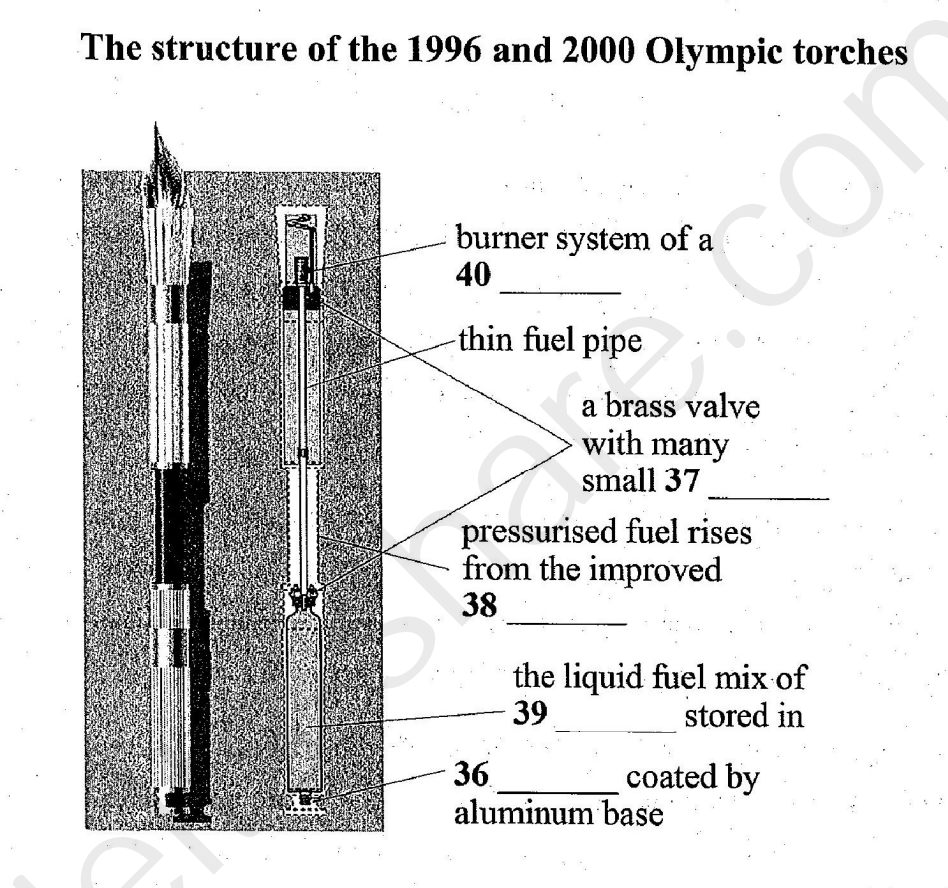
To promote the security rate, liquid fuels made its first appearance at the 1972 Munich Games. Since then, torches have been using fuels which are pressurised into the form of a liquid. When the fuels are burnt, they turn into gas to produce a flame. Liquid fuel becomes safer for the runner and can be stored in a light container. The torch at the 1996 Atlanta Summer Olympics is equipped with an aluminium base that accommodates a tiny fuel tank. As the fuel ascends through the modified handle, it is squeezed through a brass valve that has thousands of little openings. As the fuel passes through the tiny openings, it accumulates pressure. Once it makes its way through the openings, the pressure decreases and the liquid becomes gas so it can burn up.
The torch in 1996 was fuelled by propylene, a type of substance that could give out a bright flame. However, since propylene was loaded with carbon, it would produce plenty of smoke which was detrimental to the environment. In 2000, the designers of the Sydney Olympic torch proposed a lighter and cheaper design, which was harmless to the environment. For the fuel, they decided to go with a combination of 35 per cent propane (a gas that is used for cooking and heating) and 65 per cent butane (a gas that is obtained from petroleum), thus creating a powerful flame without generating much smoke.
Both the 1996 and 2000 torches adopted a double flame burning system, enabling the flames to stay lit even in severe weather conditions. The exterior flame burns at a slower rate and at a lower temperature. It can be perceived easily with its big orange flame, but it is unstable. On the other hand, the interior flame burns faster and hotter, generating a small blue flame with great stability, due to the internal site offering protection of it from the wind. Accordingly, the interior flame would serve as a pilot light, which could relight the external flame if it should go out.
As for the torch of 2002 Olympics in Salt Lake City, the top section was made of glass in which the flame burned, for the purpose of echoing the theme of ‘Light the Fire Within' of that Olympics. This torch was of great significance for the following designs of the torches.
Questions
Questions 27–29 Summary Completion
Complete the summary below.
Choose NO MORE THAN THREE WORDS from the passage for each answer.
The Olympic torch, as requested by the Olympic Committee, will be carefully designed so that it is capable of withstanding all kinds of 27. Generally, the design of the modern Olympic torch enjoys the 28 value. The torch must be copied, and thousands of torches are constructed to accommodate thousands of runners who will carry them through each leg of the Olympic relay. Each runner has an opportunity to purchase the torch as a(n) 29 at the end of his or her leg of the relay.
Questions 30–35 Matching Features
Look at the following statements and the list of Olympic torches below.
Match each statement with the correct Olympic torch, A-H.
A. ancient Greek Olympic flames
B. Berlin Games torch (1936)
C. 1952 Winter Games flame
D. 1956 Games torch
E. Munich Games torch (1972)
F. 1996 torch (Atlanta)
G. 2000 torch (Sydney)
H. 2002 torch (Salt Lake City)
Questions 36–40 Diagram Labeling
Label the diagram below.
Choose NO MORE THAN THREE WORDS from the passage for each answer.
Answers & Explanations Summary
| # | Answer | Evidence | Explanation |
|---|---|---|---|
| Q27 | severe weather conditions | After the torch is completed, it has to succeed in going through all sorts of severe weather conditions | Excerpt/Passage Explanation: The passage says that once the torch is built, it must be strong enough to keep burning and working well in many different types of bad weather, like big storms or very cold temperatures. Answer Explanation: The answer, "severe weather conditions," means very bad weather like strong winds, heavy rain, or extreme cold. Reason For Correctness: The correct answer is "severe weather conditions" because the passage states that after the Olympic torch is made, it must be able to work even in very difficult weather. This shows that the designers need to make sure the torch can handle harsh environments. |
| Q28 | aesthetic and practical / esthetic and practical | The group that wins the competition will come up with a design for a torch that has both aesthetic and practical value | Excerpt/Passage Explanation: The passage says that the people who design the winning torch must make it both pretty to look at ('aesthetic value') and good at its job ('practical value'). Answer Explanation: The answer means that the Olympic torch design should look nice (aesthetic) and also work well and be useful (practical). Reason For Correctness: The correct answer 'aesthetic and practical' is directly stated in the passage as the two important qualities a torch design must have. The passage explains that the group winning the design competition needs to create a torch that is both beautiful to look at and useful for its purpose. |
| Q29 | treasurable souvenir / souvenir | Every single runner can choose to buy his or her torch as a treasurable souvenir when he or she finishes his or her part of the relay | Excerpt/Passage Explanation: The passage says that each person who runs with the torch can decide to buy it. They can keep it as a precious memory after they finish their running part in the race. Answer Explanation: The answer, 'treasurable souvenir,' means a special item that someone wants to keep because it reminds them of a important or happy time. Reason For Correctness: The correct answer is 'treasurable souvenir' because the passage says that after a runner finishes their part of the race, they can buy their torch. The passage explains that they can buy it as a 'treasurable souvenir,' which means it's a special memory to keep. |
| Q30 | E | To promote the security rate, liquid fuels made its first appearance at the 1972 Munich Games | Excerpt/Passage Explanation: The passage says that to make the torch safer, liquid fuel was used for the first time at the Olympic Games held in Munich in the year 1972. Answer Explanation: The answer is E, meaning the 1972 Munich Games torch was the first to use liquid fuel. Reason For Correctness: The correct answer is E because the passage clearly states when liquid fuels were first used for the Olympic torch. It mentions that liquid fuels were introduced at a specific Olympic event. By finding the phrase 'liquid fuels made its first appearance' in the text, we can link it directly to the '1972 Munich Games', which matches option E. |
| Q31 | F | The torch in 1996 was fuelled by propylene, a type of substance that could give out a bright flame. However, since propylene was loaded with carbon, it would produce plenty of smoke which was detrimental to the environment | Excerpt/Passage Explanation: The passage says that the torch from 1996 used a fuel called propylene. This fuel made a lot of smoke because it had a lot of carbon. This smoke was 'detrimental to the environment', meaning it was harmful or bad for nature. Answer Explanation: The answer is the 1996 torch used in Atlanta. This torch was not good for the environment. Reason For Correctness: The correct answer is F because the passage states that the 1996 torch's fuel, called propylene, created a lot of smoke. This smoke was bad for the environment, which means it was 'not environmentally friendly'. The passage specifically mentions this negative impact. You should pay attention to the words 'propylene', 'plenty of smoke', and 'detrimental to the environment'. |
| Q32 | B | The name of the runner was also inscribed on the platform as a token of thanks | Excerpt/Passage Explanation: The passage explains that the 1936 Berlin Games torch had the runner's name written on its top part. This was done to thank the runner for carrying the torch. Answer Explanation: The answer is the torch from the 1936 Berlin Games. This was the first time that runners' names were written on the torch. Reason For Correctness: The correct answer is the 1936 Berlin Games torch because the passage states that this torch was the first to have the runner's name written on it. The text mentions that 'the name of the runner was also inscribed on the platform' of this specific torch. |
| Q33 | D | In the 1956 Olympics, the torch in the final relay was ignited by magnesium and aluminium, but some flaming pieces fell off and seared the runner's arms | Excerpt/Passage Explanation: The passage says that during the 1956 Olympic Games, the torch was lit with special materials. But these materials caused hot pieces of fire to drop off the torch and burn the arms of the person carrying it. This shows it was not safe. Answer Explanation: The answer is D, which means the Olympic torch from the 1956 Games. Reason For Correctness: The correct answer is D because the passage tells us that the torch used in the 1956 Olympics was dangerous. It mentions that parts of the flame fell onto the person carrying the torch and hurt their arms, making it 'risky' as the question asks. The keywords here are '1956 Olympics' and 'seared the runner's arms'. |
| Q34 | H | As for the torch of 2002 Olympics in Salt Lake City, the top section was made of glass in which the flame burned, for the purpose of echoing the theme of ‘Light the Fire Within' of that Olympics | Excerpt/Passage Explanation: The passage says that the torch used in the 2002 Olympic Games in Salt Lake City had a top made of glass where the fire burned. This design was chosen to match the special message of those Games, which was 'Light the Fire Within'. Answer Explanation: The answer is H, which means the Olympic torch from the 2002 Salt Lake City Games. Reason For Correctness: The correct answer is the 2002 torch because the passage says its design was made to match a special idea, or 'theme', about 'Light'. The top part of this torch was made of glass so that the flame inside could be seen, which helped to show the theme of 'Light the Fire Within' for those Olympic Games. This shows it was 'special' for that 'theme'. |
| Q35 | C | However, in that year the torch was lit not in Olympia, Greece, but in Norway, which was considered as the birthplace of skiing | Excerpt/Passage Explanation: The passage says that the Olympic flame for that year (1952) was started in Norway, not in Olympia, Greece, where it usually started. Norway was known as the place where skiing began. Answer Explanation: The answer, C, means the flame for the 1952 Winter Olympics was not lit in Greece. Reason For Correctness: The correct answer is C because the passage explicitly states that for the 1952 Winter Olympics, the torch was not lit in Greece. Instead, it was lit in Norway. This directly answers the question 'not lit in Greek'. |
| Q36 | a fuel tank / tiny fuel tank / fuel tank | The torch at the 1996 Atlanta Summer Olympics is equipped with an aluminium base that accommodates a tiny fuel tank | Excerpt/Passage Explanation: The passage explains that the Olympic torch used in 1996 had a part made of aluminum, and this part held a very small container called a 'fuel tank' inside it. This tank is where the torch's fuel was kept. Answer Explanation: The answer 'fuel tank' means a special container inside the Olympic torch that holds the fuel to make the flame. Reason For Correctness: The correct answer 'fuel tank' or 'tiny fuel tank' is supported by the passage which describes the components of the 1996 Atlanta Summer Olympics torch. It mentions that this torch has an 'aluminium base' that can hold a 'tiny fuel tank', which is where the fuel is stored before it is burned to create the flame. |
| Q37 | openings | As the fuel ascends through the modified handle, it is squeezed through a brass valve that has thousands of little openings. As the fuel passes through the tiny openings, it accumulates pressure. Once it makes its way through the openings, the pressure decreases and the liquid becomes gas so it can burn up | Excerpt/Passage Explanation: The passage says that the fuel inside the torch goes up the handle and then gets pushed through a brass part that has very small holes, called 'openings'. When the fuel squeezes through these tiny holes, it builds up energy. After it gets past these holes, the energy goes down, and the liquid fuel turns into a gas, which can then burn to make the flame. Answer Explanation: The answer 'openings' means small holes or gaps. In the Olympic torch, the fuel goes through these tiny holes. Reason For Correctness: The correct answer 'openings' is found in the passage when describing how the 1996 Atlanta Summer Olympics torch works. The passage explains that the fuel is pushed through a part with many small 'openings'. This process helps the liquid fuel change into gas, which then burns to create the flame. So, these 'openings' are a key part of how the torch's flame is produced. |
| Q38 | handle | As the fuel ascends through the modified handle, it is squeezed through a brass valve that has thousands of little openings | Excerpt/Passage Explanation: The passage says that the fuel inside the torch goes up through a 'modified handle'. This handle is where the fuel moves before it burns. It is a designed part of the torch that helps the fuel flow. Answer Explanation: The answer, 'handle', means the part of the Olympic torch that a person holds. Reason For Correctness: The correct answer is 'handle' because the passage describes how fuel for the 1996 Atlanta torch moves up through a 'modified handle'. This shows that the handle is a part of the torch's design, relating to how it works and where the fuel travels inside it. |
| Q39 | propane and butane | For the fuel, they decided to go with a combination of 35 per cent propane (a gas that is used for cooking and heating) and 65 per cent butane (a gas that is obtained from petroleum), thus creating a powerful flame without generating much smoke | Excerpt/Passage Explanation: The passage explains that for the torch used in the year 2000, the people who designed it chose to use two different gases mixed together: 35% propane, which is a gas used for cooking and heating, and 65% butane, which comes from oil. This created a strong fire without making too much smoke. Answer Explanation: The answer is 'propane and butane'. These are two types of gas that were used as fuel for the Olympic torch in the year 2000. Reason For Correctness: The correct answer is 'propane and butane' because the passage clearly states that for the 2000 Sydney Olympic torch, the designers chose a mix of these two gases as fuel. This 'combination' of 'propane' and 'butane' helped to create a strong flame without making a lot of smoke. |
| Q40 | double flame | Both the 1996 and 2000 torches adopted a double flame burning system, enabling the flames to stay lit even in severe weather conditions | Excerpt/Passage Explanation: The passage states that the torches used in both the 1996 and 2000 Olympic Games had a special 'double flame' system. This means they had two flames. This system helped to keep the fire burning even when the weather was very difficult. Answer Explanation: The answer 'double flame' means that the torch has two fires burning at the same time. This helps it stay lit. Reason For Correctness: The correct answer is 'double flame' because the passage explains that the torches for the 1996 and 2000 Olympic Games used a 'double flame burning system'. This system has two flames, an outer one and an inner one, which work together to make sure the torch stays lit even when the weather is bad. The inner flame can relight the outer flame if it goes out, showing that it's a system with two important flames. |