
The Revolutionary Bridges Of Robert Maillart - IELTS Reading Answers & Explanations
From IELTS Practice Test Plus 1 Academic Reading Test 1 · Part 3 · Questions 27–40
Reading Passage
You should spend about 20 minutes on Questions 27-40, which are based on Reading Passage 3 below.
The Revolutionary Bridges of Robert Maillart
Swiss engineer Robert Maillart built some of the greatest bridges of the 20th century. His designs elegantly solved a basic engineering problem: how to support enormous weights using a slender arch
A Just as railway bridges were the great structural symbols of the 19th century, highway bridges became the engineering emblems of the 20th century. The invention of the automobile created an irresistible demand for paved roads and vehicular bridges throughout the developed world. The type of bridge needed for cars and trucks, however, is fundamentally different from that needed for locomotives. Most highway bridges carry lighter loads than railway bridges do, and their roadways can be sharply curved or steeply sloping. To meet these needs, many turn-of-the-century bridge designers began working with a new building material: reinforced concrete, which has steel bars embedded in it. And the master of this new material was Swiss structural engineer, Robert Maillart.
B Early in his career, Maillart developed a unique method for designing bridges, buildings and other concrete structures. He rejected the complex mathematical analysis of loads and stresses that was being enthusiastically adopted by most of his contemporaries. At the same time, he also eschewed the decorative approach taken by many bridge builders of his time. He resisted imitating architectural styles and adding design elements solely for ornamentation. Maillart's method was a form of creative intuition. He had a knack for conceiving new shapes to solve classic engineering problems. And because he worked in a highly competitive field, one of his goals was economy – he won design and construction contracts because his structures were reasonably priced, often less costly than all his rivals' proposals.
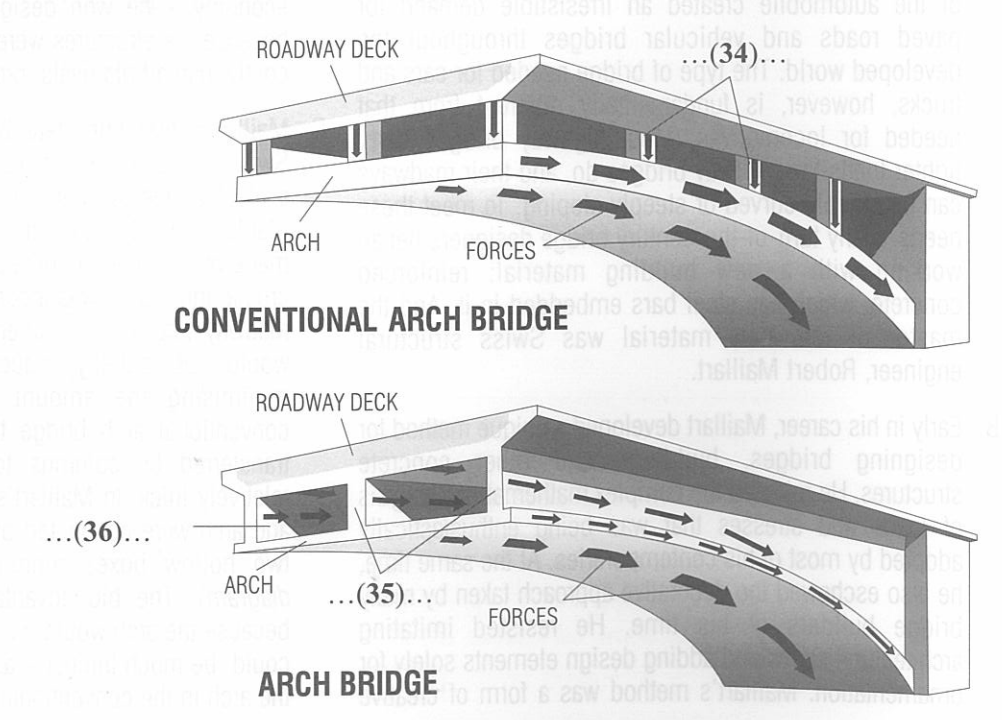
C Maillart's first important bridge was built in the small Swiss town of Zuoz. The local officials had initially wanted a steel bridge to span the 30-metre wide Inn River, but Maillart argued that he could build a more elegant bridge made of reinforced concrete for about the same cost. His crucial innovation was incorporating the bridge's arch and roadway into a form called the hollow-box arch, which would substantially reduce the bridge's expense by minimising the amount of concrete needed. In a conventional arch bridge the weight of the roadway is transferred by columns to the arch, which must be relatively thick. In Maillart's design, though, the roadway and arch were connected by three vertical walls, forming two hollow boxes running under the roadway (see diagram). The big advantage of this design was that because the arch would not have to bear the load alone, it could be much thinner - as little as one-third as thick as the arch in the conventional bridge.
D His first masterpiece, however, was the 1905 Tavanasa Bridge over the Rhine river in the Swiss Alps. In this design, Maillart removed the parts of the vertical walls which were not essential because they carried no load. This produced a slender, lighter-looking form, which perfectly met the bridge's structural requirements. But the Tavanasa Bridge gained little favourable publicity in Switzerland; on the contrary, it aroused strong aesthetic objections from public officials who were more comfortable with old-fashioned stone-faced bridges. Maillart, who had founded his own construction firm in 1902, was unable to win any more bridge projects, so he shifted his focus to designing buildings, water tanks and other structures made of reinforced concrete and did not resume his work on concrete bridges until the early 1920s.
E His most important breakthrough during this period was the development of the deck-stiffened arch, the first example of which was the Flienglibach Bridge, built in 1923. An arch bridge is somewhat like an inverted cable. A cable curves downward when a weight is hung from it, an arch bridge curves upward to support the roadway and the compression in the arch balances the dead load of the traffic. For aesthetic reasons, Maillart wanted a thinner arch and his solution was to connect the arch to the roadway with transverse walls. In this way, Maillart justified making the arch as thin as he could reasonably build it. His analysis accurately predicted the behaviour of the bridge but the leading authorities of Swiss engineering would argue against his methods for the next quarter of a century.
F Over the next 10 years, Maillart concentrated on refining the visual appearance of the deck-stiffened arch. His best-known structure is the Salginatobel Bridge, completed in 1930. He won the competition for the contract because his design was the least expensive of the 19 submitted - the bridge and road were built for only 700,000 Swiss francs, equivalent to some $3.5 million today. Salginatobel was also Maillart's longest span, at 90 metres and it had the most dramatic setting of all his structures, vaulting 80 metres above the ravine of the Salgina brook. In 1991 it became the first concrete bridge to be designated an international historic landmark.
G Before his death in 1940, Maillart completed other remarkable bridges and continued to refine his designs. However, architects often recognised the high quality of Maillart's structures before his fellow engineers did and in 1947 the architectural section of the Museum of Modern Art in New York City devoted a major exhibition entirely to his works. In contrast, very few American structural engineers at that time had even heard of Maillart. In the following years, however, engineers realised that Maillart's bridges were more than just aesthetically pleasing - they were technically unsurpassed. Maillart's hollow-box arch became the dominant design form for medium and long-span concrete bridges in the US. In Switzerland, professors finally began to teach Maillart's ideas, which then influenced a new generation of designers.
Questions
Questions 27–33 Matching Headings
The passage has seven paragraphs A–G.
From the list of headings below choose the most suitable heading for each paragraph.
i. The long-term impact
ii. A celebrated achievement
iii. Early brilliance passes unrecognised
iv. Outdated methods retain popularity
v. The basis of a new design is born
vi. Frustration at never getting the design right
vii. Further refinements meet persistent objections
viii. Different in all respects
ix. Bridge-makers look elsewhere
x. Transport developments spark a major change
Questions 34–36 Diagram Labeling
Complete the labels on the diagrams below using ONE or TWO WORDS from the reading passage.
Questions 37–40 Matching Sentence Endings
Complete each of the following statements with the best ending (A–G) from the box below.
A. prove that local people were wrong.
B. find work in Switzerland.
C. win more building commissions.
D. reduce the amount of raw material required.
E. recognise his technical skills.
F. capitalise on the spectacular terrain.
G. improve the appearance of his bridges.
Answers & Explanations Summary
| # | Answer | Evidence | Explanation |
|---|---|---|---|
| Q27 | x | The invention of the automobile created an irresistible demand for paved roads and vehicular bridges throughout the developed world. The type of bridge needed for cars and trucks, however, is fundamentally different from that needed for locomotives | Excerpt/Passage Explanation: The passage explains that when cars were invented, people really needed new roads and bridges. The bridges for cars and trucks had to be very different from the older bridges used for trains. Answer Explanation: The answer is 'Transport developments spark a major change'. This means that new ways of moving things and people led to big changes. Reason For Correctness: The correct answer is explanation x because Paragraph A talks about how the invention of the automobile, which is a 'transport development', caused a big shift in bridge building. Before cars, railway bridges were important, but with cars, there was a huge need for new types of 'highway bridges' that were 'fundamentally different'. This describes a 'major change' directly linked to changes in transport. |
| Q28 | viii | He rejected the complex mathematical analysis of loads and stresses that was being enthusiastically adopted by most of his contemporaries. At the same time, he also eschewed the decorative approach taken by many bridge builders of his time | Excerpt/Passage Explanation: The passage says that Maillart did not like the difficult math methods that most engineers used. It also says he did not like adding pretty decorations to his bridges like many other builders did. This shows he had a very different way of working. Answer Explanation: The answer means that Robert Maillart liked to do things very differently from everyone else in his field. Reason For Correctness: The correct answer is 'viii. Different in all respects' because Paragraph B clearly explains how Robert Maillart did not follow what most other engineers were doing. It states that he 'rejected the complex mathematical analysis' that his peers used and also 'eschewed the decorative approach' that many bridge builders of his time followed. Instead, he had a 'unique method' and used 'creative intuition' to solve problems, often making his designs more 'reasonably priced' than his rivals'. This shows he was different in his thinking, his design style, and his goals. |
| Q29 | v | His crucial innovation was incorporating the bridge's arch and roadway into a form called the hollow-box arch, which would substantially reduce the bridge's expense by minimising the amount of concrete needed | Excerpt/Passage Explanation: The passage explains that Maillart had a very important and new idea. He put the bridge's curved bottom part (the arch) and the road on top together in a special way, calling it the 'hollow-box arch.' This new way of building helped make the bridge much cheaper because it needed less concrete. Answer Explanation: The answer means that this part of the text describes how Maillart's new way of building bridges first appeared, showing his new idea from the very beginning. Reason For Correctness: The correct answer is 'v. The basis of a new design is born' because Paragraph C details Maillart's 'first important bridge' and introduces his 'crucial innovation,' which was the 'hollow-box arch' design. The paragraph explains how this new design worked, including its unique structure and the significant advantage of reducing concrete use. This clearly marks the beginning or 'basis' of a new and groundbreaking bridge design by Maillart. |
| Q30 | iii | His first masterpiece, however, was the 1905 Tavanasa Bridge over the Rhine river in the Swiss Alps But the Tavanasa Bridge gained little favourable publicity in Switzerland; on the contrary, it aroused strong aesthetic objections from public officials who were more comfortable with old-fashioned stone-faced bridges. Maillart, who had founded his own construction firm in 1902, was unable to win any more bridge projects, so he shifted his focus to designing buildings, water tanks and other structures made of reinforced concrete and did not resume his work on concrete bridges until the early 1920s |
Excerpt/Passage Explanation: The passage states that Maillart's first great work, the Tavanasa Bridge, did not get much good attention and was even disliked by government officials because it looked too new. Because of this, Maillart could not get more jobs building bridges and had to stop working on them for many years. This shows that his brilliant new ideas for bridges were not appreciated or given official recognition at that time. Answer Explanation: The answer means that Robert Maillart showed great talent and made something excellent early in his career, but people did not notice or appreciate it at the time. Reason For Correctness: The correct answer 'iii. Early brilliance passes unrecognised' fits Paragraph D well because the paragraph describes Maillart's 'first masterpiece,' the Tavanasa Bridge, which shows his 'early brilliance.' However, instead of being praised, the bridge 'gained little favourable publicity' and caused 'strong aesthetic objections' from officials. Because of this, Maillart 'was unable to win any more bridge projects,' indicating that his innovative work was not seen as valuable and therefore 'passed unrecognised' in Switzerland at that time. |
| Q31 | vii | His most important breakthrough during this period was the development of the deck-stiffened arch, the first example of which was the Flienglibach Bridge, built in 1923 For aesthetic reasons, Maillart wanted a thinner arch and his solution was to connect the arch to the roadway with transverse walls His analysis accurately predicted the behaviour of the bridge but the leading authorities of Swiss engineering would argue against his methods for the next quarter of a century |
Excerpt/Passage Explanation: The passage says that Maillart created a very important new design called the 'deck-stiffened arch' where he made the arch thinner. But even though his ideas worked well, the main engineers in Switzerland kept fighting against his ways of building for 25 years. Answer Explanation: The answer means that Robert Maillart made new improvements to his bridge designs, but important engineers kept disagreeing with his ideas for a very long time. Reason For Correctness: The correct answer is 'vii. Further refinements meet persistent objections' because Paragraph E describes Maillart's significant new design, the 'deck-stiffened arch', which was a 'breakthrough' and involved making the arch 'thinner'. This shows the 'further refinements' in his work. The passage then states that 'the leading authorities of Swiss engineering would argue against his methods for the next quarter of a century', clearly indicating that these new designs and methods 'meet persistent objections' from other engineers. |
| Q32 | ii | His best-known structure is the Salginatobel Bridge, completed in 1930 In 1991 it became the first concrete bridge to be designated an international historic landmark |
Excerpt/Passage Explanation: The passage says the Salginatobel Bridge is his most famous work. It also states that this bridge was later officially named a very important place in history, a big honor for a concrete bridge. Answer Explanation: The answer means that Paragraph F talks about a very famous and important success. Reason For Correctness: The correct answer is 'A celebrated achievement' because Paragraph F describes the Salginatobel Bridge, which is called Maillart's 'best-known structure'. It also mentions that this bridge was given a special honor, becoming 'the first concrete bridge to be designated an international historic landmark'. These details show that the bridge was highly recognized and celebrated for its importance and beauty. |
| Q33 | i | Maillart's hollow-box arch became the dominant design form for medium and long-span concrete bridges in the US. In Switzerland, professors finally began to teach Maillart's ideas, which then influenced a new generation of designers | Excerpt/Passage Explanation: The passage says that Maillart's bridge design, the 'hollow-box arch', became the main type of design used for many concrete bridges in America. It also states that in Switzerland, teachers started to teach Maillart's ideas, and this helped shape or guide many new bridge designers. This shows the lasting and wide influence of his work. Answer Explanation: The answer, 'i', means that paragraph G talks about the lasting effects or the influence of Robert Maillart's work over a long period. Reason For Correctness: The correct answer is 'i. The long-term impact' because paragraph G explains how Robert Maillart's bridge designs gained recognition and influenced future engineering and design after his death. It mentions that his ideas were eventually taught in Switzerland and became the 'dominant design form' for bridges in the US, showing a lasting and significant effect on the field. |
| Q34 | columns | In a conventional arch bridge the weight of the roadway is transferred by columns to the arch, which must be relatively thick | Excerpt/Passage Explanation: The passage says that in a normal arch bridge, the heavy road's weight goes through 'columns' (the tall posts) down to the curved arch part underneath. This arch then needs to be very thick to support all that weight. Answer Explanation: The answer is 'columns'. These are strong, tall posts that hold things up. Reason For Correctness: The correct answer is 'columns' because the passage explains how a regular, old-style arch bridge works. It says that the heavy road on top of the bridge sends its weight down through these 'columns' to the arch part below. This means columns are a key part of how traditional arch bridges were built, before Maillart created his new designs. |
| Q35 | vertical walls | In Maillart's design, though, the roadway and arch were connected by three vertical walls, forming two hollow boxes running under the roadway (see diagram) | Excerpt/Passage Explanation: The passage says that in Maillart's special bridge design, the part where cars drive (the roadway) and the curved support structure underneath (the arch) were joined together by 'vertical walls'. These walls made empty box shapes under the road. Answer Explanation: The answer is 'vertical walls'. These are the upright parts that join the road to the arch underneath. Reason For Correctness: The correct answer is 'vertical walls' because the passage explains how Robert Maillart’s 'hollow-box arch' bridge design worked. It states that the 'roadway and arch were connected by three vertical walls'. These walls create hollow spaces and help the bridge carry weight more efficiently, making the arch thinner and saving money. |
| Q36 | hollow boxes | In Maillart's design, though, the roadway and arch were connected by three vertical walls, forming two hollow boxes running under the roadway (see diagram) | Excerpt/Passage Explanation: The passage explains that in Maillart's special bridge plan, the road and the arch underneath it were joined together by three tall walls. These connections created two empty, box-like spaces that ran along under the road, forming a key part of his design. Answer Explanation: The answer 'hollow boxes' refers to empty, box-like spaces found within Robert Maillart's bridge design. Reason For Correctness: The correct answer is 'hollow boxes' because the passage explains Robert Maillart's innovative bridge design. His key idea was to connect the roadway and the arch in a new way. This connection, made with 'three vertical walls', created 'two hollow boxes running under the roadway'. This design significantly reduced the amount of concrete needed, making the arch thinner and the bridge more affordable. |
| Q37 | D | His crucial innovation was incorporating the bridge's arch and roadway into a form called the hollow-box arch, which would substantially reduce the bridge's expense by minimising the amount of concrete needed | Excerpt/Passage Explanation: The passage states that Maillart's new idea, the hollow-box arch, helped save a lot of money on building bridges. This was because it used less concrete, which is the main material needed for these bridges. Answer Explanation: The answer means that Maillart created the hollow-box arch design mainly to use less building material, like concrete. Reason For Correctness: The correct answer is D because the passage clearly states that Maillart's hollow-box arch innovation was made to "substantially reduce the bridge's expense by minimising the amount of concrete needed." Concrete is a raw material, so by reducing the amount of concrete required, he was essentially reducing the amount of raw material, thereby cutting costs for the bridge construction. |
| Q38 | C | But the Tavanasa Bridge gained little favourable publicity in Switzerland; on the contrary, it aroused strong aesthetic objections from public officials who were more comfortable with old-fashioned stone-faced bridges. Maillart, who had founded his own construction firm in 1902, was unable to win any more bridge projects, so he shifted his focus to designing buildings, water tanks and other structures made of reinforced concrete and did not resume his work on concrete bridges until the early 1920s | Excerpt/Passage Explanation: The passage explains that his Tavanasa Bridge did not get good reactions in Switzerland. People in charge did not like how it looked, preferring older styles. Because of this, Maillart could not get hired to build any more bridges. So, he started designing other kinds of structures instead, and did not build bridges again until much later. Answer Explanation: The answer means that after building the Tavanasa Bridge, Robert Maillart could not get more jobs or contracts to build new bridges. Reason For Correctness: The correct answer is C because the passage states that after the Tavanasa Bridge, Maillart faced problems. Public officials did not like his bridge's look, and because of this, he 'was unable to win any more bridge projects'. This directly means he failed to get more 'commissions' or jobs for building. |
| Q39 | G | For aesthetic reasons, Maillart wanted a thinner arch and his solution was to connect the arch to the roadway with transverse walls | Excerpt/Passage Explanation: The passage says that Maillart wanted to make the arch part of the bridge thinner because of 'aesthetic reasons'. This means he cared about how the bridge looked. His way to do this was to use 'transverse walls' to connect the arch to the road. Answer Explanation: The answer is G: make his bridges look better. Reason For Correctness: The correct answer is G because the passage clearly states that Robert Maillart used transverse walls in the Flienglibach Bridge to make the arch thinner for 'aesthetic reasons'. The word 'aesthetic' means relating to beauty or appearance. Therefore, making the arch thinner for aesthetic reasons means he wanted to improve the visual 'appearance' of his bridges. |
| Q40 | F | Salginatobel was also Maillart's longest span, at 90 metres and it had the most dramatic setting of all his structures, vaulting 80 metres above the ravine of the Salgina brook | Excerpt/Passage Explanation: The passage states that the Salginatobel Bridge was built in a 'dramatic setting'. This means the natural place where the bridge was located was very striking and impressive. It also says the bridge went 'vaulting 80 metres above the ravine', which paints a picture of the bridge making the most of the deep valley to create a spectacular view. Answer Explanation: The answer means that among all his bridges, the Salginatobel Bridge allowed Robert Maillart to make good use of the very impressive and beautiful natural land around it. Reason For Correctness: The correct answer is F because the passage describes the Salginatobel Bridge's location as its 'most dramatic setting'. This phrase means the area where the bridge was built was very impressive and eye-catching. The passage also mentions the bridge 'vaulting 80 metres above the ravine of the Salgina brook', which shows how the bridge was designed to fit into and highlight this spectacular natural landscape or terrain. Thus, Maillart was able to 'capitalise on' or take advantage of this striking environment with his design. |