
Visual Symbols And The Blind - IELTS Reading Answers & Explanations
From Cambridge IELTS 04 Academic Reading Test 1 · Part 3 · Questions 27–40
Reading Passage
You should spend about 20 minutes on Questions 27-40 which are based on Reading Passage 3 below.
Visual Symbols and the Blind
Part 1
From a number of recent studies, it has become clear that blind people can appreciate the use of outlines and perspectives to describe the arrangement of objects and other surfaces in space. But pictures are more than literal representations.
This fact was drawn to my attention dramatically when a blind woman in one of my investigations decided on her own initiative to draw a wheel as it was spinning. To show this motion, she traced a curve inside the circle (Fig. 1). I was taken aback. Lines of motion, such as the one she used, are a very recent invention in the history of illustration. Indeed, as art scholar David Kunzle notes, Wilhelm Busch, a trend-setting nineteenth-century cartoonist, used virtually no motion lines in his popular figures until about 1877.
When I asked several other blind study subjects to draw a spinning wheel, one particularly clever rendition appeared repeatedly: several subjects showed the wheel's spokes as curved lines. When asked about these curves, they all described them as metaphorical ways of suggesting motion. Majority rule would argue that this device somehow indicated motion very well. But was it a better indicator than, say, broken or wavy lines - or any other kind of line, for that matter? The answer was not clear. So I decided to test whether various lines of motion were apt ways of showing movement or if they were merely idiosyncratic marks. Moreover, I wanted to discover whether there were differences in how the blind and the sighted interpreted lines of motion.
To search out these answers, I created raised-line drawings of five different wheels, depicting spokes with lines that curved, bent, waved, dashed and extended beyond the perimeter of the wheel. I then asked eighteen blind volunteers to feel the wheels and assign one of the following motions to each wheel: wobbling, spinning fast, spinning steadily, jerking or braking. My control group consisted of eighteen sighted undergraduates from the University of Toronto.
All but one of the blind subjects assigned distinctive motions to each wheel. Most guessed that the curved spokes indicated that the wheel was spinning steadily; the wavy spokes, they thought, suggested that the wheel was wobbling; and the bent spokes were taken as a sign that the wheel was jerking. Subjects assumed that spokes extending beyond the wheel's perimeter signified that the wheel had its brakes on and that dashed spokes indicated the wheel was spinning quickly.
In addition, the favoured description for the sighted was the favoured description for the blind in every instance. What is more, the consensus among the sighted was barely higher than that among the blind. Because motion devices are unfamiliar to the blind, the task I gave them involved some problem solving. Evidently, however, the blind not only figured out meanings for each line of motion, but as a group they generally came up with the same meaning at least as frequently as did sighted subjects.
Part 2
We have found that the blind understand other kinds of visual metaphors as well. One blind woman drew a picture of a child inside a heart - choosing that symbol, she said, to show that love surrounded the child. With Chang Hong Liu, a doctoral student from China, I have begun exploring how well blind people understand the symbolism behind shapes such as hearts that do not directly represent their meaning.
We gave a list of twenty pairs of words to sighted subjects and asked them to pick from each pair the term that best related to a circle and the term that best related to a square. For example, we asked: What goes with soft? A circle or a square? Which shape goes with hard?
All our subjects deemed the circle soft and the square hard. A full 94% ascribed happy to the circle, instead of sad. But other pairs revealed less agreement: 79% matched fast to slow and weak to strong, respectively. And only 51% linked deep to circle and shallow to square. (See Fig. 2.) When we tested four totally blind volunteers using the same list, we found that their choices closely resembled those made by the sighted subjects. One man, who had been blind since birth, scored extremely well. He made only one match differing from the consensus, assigning 'far' to square and 'near' to circle. In fact, only a small majority of sighted subjects - 53% - had paired far and near to the opposite partners. Thus, we concluded that the blind interpret abstract shapes as sighted people do.
| Words associated with circle/square | Agreement among subjects (%) |
|---|---|
| SOFT-HARD | 100 |
| MOTHER-FATHER | 94 |
| HAPPY-SAD | 94 |
| GOOD-EVIL | 89 |
| LOVE-HATE | 89 |
| ALIVE-DEAD | 87 |
| BRIGHT-DARK | 87 |
| LIGHT-HEAVY | 85 |
| WARM-COLD | 81 |
| SUMMER-WINTER | 81 |
| WEAK-STRONG | 79 |
| FAST-SLOW | 79 |
| CAT-DOG | 74 |
| SPRING-FALL | 74 |
| QUIET-LOUD | 62 |
| WALKING-STANDING | 62 |
| ODD-EVEN | 57 |
| FAR-NEAR | 53 |
| PLANT-ANIMAL | 53 |
| DEEP-SHALLOW | 51 |
Fig. 2 Subjects were asked which word in each pair fits best with a circle and which with a square. These percentages show the level of consensus among sighted subjects.
Questions
Questions 27–29 One Choice
Choose the correct letter, A, B, C or D.
Questions 30–32 Diagram Labeling
Look at the following diagrams (Questions 30-32), and the list of types of movement below.
Match each diagram to the type of movement A-E generally assigned to it in the experiment.
Choose the correct letter A-E.
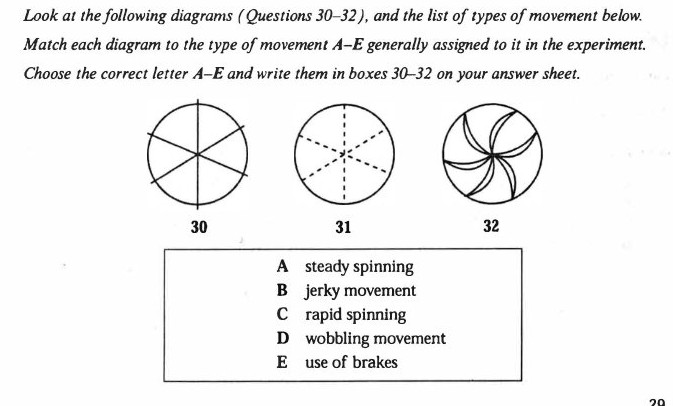
A. steady spinning | B. jerky movement | C. rapid spinning
D. wobbling movement | E. use of brakes
Questions 33–39 Summary Completion
Complete the summary below using words from the box.
NB You may use any word more than once.
associations | blind | deep
hard | hundred | identical
pairs | shapes | sighted
similar | shallow | soft
words
In the experiment described in Part 2, a set of word 33 was used to investigate whether blind and sighted people perceived the symbolism in abstract 34 in the same way. Subjects were asked which word fitted best with a circle and which with a square. From the 35 volunteers, everyone thought a circle fitted 'soft' while a square fitted 'hard'. However, only 51% of the 36 volunteers assigned a circle to 37 . When the test was later repeated with 38 volunteers, it was found that they made 39 choices.
Questions 40–40 One Choice
Choose the correct letter, A, B, C or D.
Answers & Explanations Summary
| # | Answer | Evidence | Explanation |
|---|---|---|---|
| Q27 | C | From a number of recent studies, it has become clear that blind people can appreciate the use of outlines and perspectives to describe the arrangement of objects and other surfaces in space | Excerpt/Passage Explanation: The passage says that new research shows that people who cannot see can understand how lines and angles are used to show where things are located in a flat picture. Answer Explanation: The answer means that people who are blind are able to understand common artistic rules, such as how to show distance or depth in a drawing. Reason For Correctness: The correct answer is C because the first paragraph mentions that blind people can 'appreciate' the use of 'outlines and perspectives'. In this context, to 'appreciate' means to recognize or understand, and 'outlines and perspectives' are examples of artistic conventions (standard ways of showing things). This shows they understand how these visual tools describe where objects are in space. |
| Q28 | C | To show this motion, she traced a curve inside the circle (Fig. 1). I was taken aback. Lines of motion, such as the one she used, are a very recent invention in the history of illustration | Excerpt/Passage Explanation: The passage explains that the woman drew a curved line to show that the wheel was spinning. The author was surprised by this because using lines to show movement is a modern style of drawing. Answer Explanation: The answer means that the woman in the study put a special mark in her drawing to show that the wheel was moving. Reason For Correctness: The correct answer is C because the writer says he was 'taken aback' (which means very surprised) when the blind woman drew a curve to represent 'motion.' This curve is called a 'line of motion,' which is a symbol used to show movement in pictures. The writer was surprised because these kinds of symbols are a relatively new invention in art, yet the blind woman used one naturally without being told to. |
| Q29 | A | Evidently, however, the blind not only figured out meanings for each line of motion, but as a group they generally came up with the same meaning at least as frequently as did sighted subjects | Excerpt/Passage Explanation: The passage explains that the blind people were able to understand what each type of line meant for movement, and they chose the same meanings just as often as the people who can see. Answer Explanation: The answer means that the blind people in the study were able to correctly identify and understand the special signs or lines used to show how an object is moving. Reason For Correctness: The correct answer is A because the experiment in Part 1 tested how blind people matched different types of lines (like curved, wavy, or dashed) to specific types of motion (like spinning, wobbling, or jerking). The author found that the blind subjects were very good at this task, matching the lines to motions in the same way that sighted people did. This shows they understand visual 'symbols' for movement, even though they cannot see them. Keywords like 'meanings', 'line of motion', and 'frequently' show that the blind subjects were successful in understanding these representations. |
| Q30 | E | Subjects assumed that spokes extending beyond the wheel's perimeter signified that the wheel had its brakes on and that dashed spokes indicated the wheel was spinning quickly | Excerpt/Passage Explanation: The passage explains that the people in the experiment believed that when lines go outside the edge of the wheel, it shows that the wheel is braking. Answer Explanation: The answer E represents the movement of using brakes to slow down or stop. Reason For Correctness: The correct answer is E because the passage describes a study where people looked at different drawings of wheels. In this study, people were asked to match specific types of lines to specific movements. The author notes that when the lines inside the wheel (the spokes) went past the outer circle (the perimeter), people understood this as a sign that the wheel was using its brakes. Therefore, a diagram showing lines going outside the circle is matched with movement E. |
| Q31 | C | Subjects assumed that spokes extending beyond the wheel's perimeter signified that the wheel had its brakes on and that dashed spokes indicated the wheel was spinning quickly | Excerpt/Passage Explanation: The passage states that people in the study thought lines that are broken into short pieces (dashed) show that the wheel is moving at a fast speed. Answer Explanation: The answer is C, which stands for "rapid spinning." This means the wheel in the drawing is turning very fast. Reason For Correctness: The correct answer is C because the text describes how blind people gave certain meanings to different types of lines in a drawing. Specifically, the passage says that "dashed spokes"—which are lines made of short, separate marks—represent a wheel that is "spinning quickly." Since the word "rapid" means the same thing as "quick" or "fast," "rapid spinning" is the correct match for those dashed lines. |
| Q32 | A | Most guessed that the curved spokes indicated that the wheel was spinning steadily | Excerpt/Passage Explanation: The passage states that the majority of people in the study believed that smooth, curved lines on the middle part of the wheel showed it was turning at a regular speed. Answer Explanation: The answer A stands for "steady spinning," which means a wheel is turning in a smooth and regular way. Reason For Correctness: The correct answer is determined by matching the description of movement in the passage to the specific drawing styles used in the study. In the experiment, blind participants felt lines on wheels and decided what kind of movement they represented. The passage states that most of these people thought the "curved spokes" (smooth, bending lines) meant the wheel was "spinning steadily." This matches choice A. |
| Q33 | pairs | We gave a list of twenty pairs of words to sighted subjects | Excerpt/Passage Explanation: The passage explains that the researchers showed people who can see a list made up of twenty groups, where each group had two different words. Answer Explanation: The answer "pairs" refers to sets of two things that are grouped together. In this specific experiment, it means sets of two words, such as "soft" and "hard," that were presented to the participants. Reason For Correctness: The correct answer is "pairs" because the passage explicitly describes the materials used in the second part of the study. It mentions that researchers gave participants a list containing twenty "pairs of words." These pairs were used to see if people would match specific words to a circle or a square. By using the word "pairs," the author describes how the words were organized into sets of two for the test. |
| Q34 | shapes | With Chang Hong Liu, a doctoral student from China, I have begun exploring how well blind people understand the symbolism behind shapes such as hearts that do not directly represent their meaning Thus, we concluded that the blind interpret abstract shapes as sighted people do |
Excerpt/Passage Explanation: The passage explains that the researchers studied how blind people understand the meanings of various geometric forms and concluded that blind people interpret these forms in the same way as people with sight. Answer Explanation: The answer "shapes" refers to forms like circles, squares, and hearts that were used in the research experiment. Reason For Correctness: The correct answer is "shapes" because the second part of the passage focuses on whether blind people can understand the hidden meanings (symbolism) of objects like circles and squares. The author refers to these objects as "shapes" throughout the text and concludes that blind people understand "abstract shapes" in a very similar way to people who can see. |
| Q35 | sighted | And only 51% linked deep to circle and shallow to square These percentages show the level of consensus among sighted subjects |
Excerpt/Passage Explanation: The passage mentions that exactly 51% of the people in the first part of the study made a specific choice about the word "deep." The text explaining the table (Fig. 2) tells us that the people who provided these percentages were the "sighted" participants. Answer Explanation: The answer "sighted" refers to people who have the ability to see. In the context of this experiment, they were the group used to establish a standard for how words are normally associated with shapes. Reason For Correctness: The correct answer is "sighted" because the summary mentions a specific statistic (51%) regarding how many volunteers linked a circle to the word "deep". In the passage, this 51% figure is linked to Figure 2. The note under Figure 2 clarifies that these percentages represent the agreement among "sighted subjects" (people who can see). |
| Q36 | sighted | And only 51% linked deep to circle and shallow to square. (See Fig. 2.) These percentages show the level of consensus among sighted subjects |
Excerpt/Passage Explanation: The passage indicates that the specific data point of 51% comes from the research results displayed in Figure 2, and a note for that figure clarifies that these results show the agreement levels of the people who can see. Answer Explanation: The answer "sighted" refers to people who are able to see with their eyes. Reason For Correctness: The correct answer is "sighted" because the text and Figure 2 discuss data collected from participants who could see. The summary mention of "51%" refers back to a specific finding in the passage where only 51% of these people agreed on a certain word match. The passage explicitly states that the percentages in Figure 2, which include the 51% figure, show the "consensus among sighted subjects." |
| Q37 | deep | And only 51% linked deep to circle and shallow to square | Excerpt/Passage Explanation: The passage explains that only about half of the people (51%) in the study thought the word "deep" was a good match for a circle and that "shallow" was a good match for a square. Answer Explanation: The answer "deep" is one of the words used in a word-matching study where people had to decide if it belonged with a circle or a square. Reason For Correctness: The correct answer is "deep" because the second part of the passage describes a study where people matched word pairs to shapes. While some words had very high agreement (like 100% for "soft"), the text mentions that only 51% of the people who could see (sighted subjects) felt that "deep" matched a circle. The summary specifically mentions this 51% figure, making "deep" the missing word. |
| Q38 | blind | When we tested four totally blind volunteers using the same list, we found that their choices closely resembled those made by the sighted subjects | Excerpt/Passage Explanation: The passage explains that the researcher gave the same list of word pairs to four people who cannot see ('totally blind') and discovered that they picked the same words as the people who can see ('sighted subjects'). Answer Explanation: The answer 'blind' refers to people who lack the sense of sight or are unable to see. Reason For Correctness: The correct answer is 'blind' because the summary describes an experiment performed in two stages. In the first stage, 'sighted subjects' (people who can see) were tested on their perception of word associations with shapes. To compare results, the passage explains that the researcher then conducted the same test using 'four totally blind volunteers'. Therefore, the group with whom the test was 'repeated' was the blind volunteers. |
| Q39 | similar | When we tested four totally blind volunteers using the same list, we found that their choices closely resembled those made by the sighted subjects | Excerpt/Passage Explanation: The passage says that when blind people took the test, their answers were almost the same as the answers of the people who can see. Answer Explanation: The answer 'similar' means that two things are almost the same or look much like each other. Reason For Correctness: The correct answer is found in the part of the text discussing the study with blind volunteers. The researcher notes that the choices made by the blind participants 'closely resembled' those of the sighted group. In English, 'closely resembled' is a synonym for 'similar', meaning their answers were nearly the same. |
| Q40 | B | Evidently, however, the blind not only figured out meanings for each line of motion, but as a group they generally came up with the same meaning at least as frequently as did sighted subjects Thus, we concluded that the blind interpret abstract shapes as sighted people do |
Excerpt/Passage Explanation: The passage explains that in two different tasks, blind people chose the same meanings for lines and shapes as people who can see. Because of this, the writer decided that both groups understand visual ideas in a very similar way. Answer Explanation: The answer means that people who cannot see understand the symbolic meanings of pictures and shapes in the same way as people who have sight. Reason For Correctness: The correct answer is correct because the whole passage focuses on comparing how blind people and sighted people understand visual symbols and meanings. In the first experiment involving lines that represent motion, the findings show that the blind participants assigned the same meanings to those lines as the sighted participants. In the second experiment involving abstract shapes, the blind participants' choices again closely matched those of the sighted group. These results show a high level of agreement between the two groups, leading the author to conclude that they interpret these visual metaphors in very similar ways. |