
Walking With Dinosaurs - IELTS Reading Answers & Explanations
From IELTS Trainer 1 Academic Reading Test 1 · Part 1 · Questions 1–13
Reading Passage
You should spend about 20 minutes on Questions 1-13, which are based on Reading Passage 1 below.
Walking with dinosaurs
Peter L. Falkingham and his colleagues at Manchester University are developing techniques which look set to revolutionise our understanding of how dinosaurs and other extinct animals behaved.
The media image of palaeontologists who study prehistoric life is often of field workers camped in the desert in the hot sun, carefully picking away at the rock surrounding a large dinosaur bone. But Peter Falkingham has done little of that for a while now. Instead, he devotes himself to his computer. Not because he has become inundated with paperwork, but because he is a new kind of palaeontologist: a computational palaeontologist.
What few people may consider is that uncovering a skeleton, or discovering a new species, is where the research begins, not where it ends. What we really want to understand is how the extinct animals and plants behaved in their natural habitats. Drs Bill Sellers and Phil Manning from the University of Manchester use a 'genetic algorithm' - a kind of computer code that can change itself and 'evolve' - to explore how extinct animals like dinosaurs, and our own early ancestors, walked and stalked.
The fossilised bones of a complete dinosaur skeleton can tell scientists a lot about the animal, but they do not make up the complete picture and the computer can try to fill the gap. The computer model is given a digitised skeleton, and the locations of known muscles. The model then randomly activates the muscles. This, perhaps unsurprisingly, results almost without fail in the animal falling on its face. So the computer alters the activation pattern and tries again ... usually to similar effect. The modelled 'dinosaurs' quickly 'evolve'. If there is any improvement, the computer discards the old pattern and adopts the new one as the base for alteration. Eventually, the muscle activation pattern evolves a stable way of moving, the best possible solution is reached, and the dinosaur can walk, run, chase or graze. Assuming natural selection evolves the best possible solution too, the modelled animal should be moving in a manner similar to its now-extinct counterpart. And indeed, using the same method for living animals (humans, emu and ostriches) similar top speeds were achieved on the computer as in reality. By comparing their cyberspace results with real measurements of living species, the Manchester team of palaeontologists can be confident in the results computed showing how extinct prehistoric animals such as dinosaurs moved.
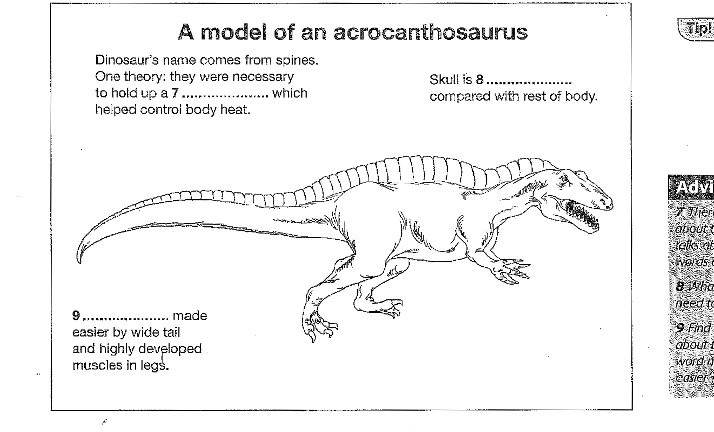
The Manchester University team have used the computer simulations to produce a model of a giant meat-eating dinosaur. It is called an acrocanthosaurus which literally means 'high spined lizard' because of the spines which run along its backbone. It is not really known why they are there but scientists have speculated they could have supported a hump that stored fat and water reserves. There are also those who believe that the spines acted as a support for a sail. Of these, one half think it was used as a display and could be flushed with blood and the other half think it was used as a temperature-regulating device. It may have been a mixture of the two. The skull seems out of proportion with its thick, heavy body because it is so narrow and the jaws are delicate and fine. The feet are also worthy of note as they look surprisingly small in contrast to the animal as a whole. It has a deep broad tail and powerful leg muscles to aid locomotion. It walked on its back legs and its front legs were much shorter with powerful claws.
Falkingham himself is investigating fossilised tracks, or footprints, using computer simulations to help analyse how extinct animals moved. Modern-day trackers who study the habitats of wild animals can tell you what animal made a track, whether that animal was walking or running, sometimes even the sex of the animal. But a fossil track poses a more considerable challenge to interpret in the same way. A crucial consideration is knowing what the environment including the mud, or sediment, upon which the animal walked was like millions of years ago when the track was made. Experiments can answer these questions but the number of variables is staggering. To physically recreate each scenario with a box of mud is extremely time-consuming and difficult to repeat accurately. This is where computer simulation comes in.
Falkingham uses computational techniques to model a volume of mud and control the moisture content, consistency, and other conditions to simulate the mud of prehistoric times. A footprint is then made in the digital mud by a virtual foot. This footprint can be chopped up and viewed from any angle and stress values can be extracted and calculated from inside it. By running hundreds of these simulations simultaneously on supercomputers, Falkingham can start to understand what types of footprint would be expected if an animal moved in a certain way over a given kind of ground. Looking at the variation in the virtual tracks, researchers can make sense of fossil tracks with greater confidence.
The application of computational techniques in palaeontology is becoming more prevalent every year. As computer power continues to increase, the range of problems that can be tackled and questions that can be answered will only expand.
Questions
Questions 1–6 True / False / Not Given
Do the following statements agree with the information given in Reading Passage 1?
TRUE if the statement agrees with the information
FALSE if the statement contradicts the information
NOT GIVEN if there is no information on this
Questions 7–9 Diagram Labeling
Label the diagram below.
Choose NO MORE THAN ONE WORD from the passage for each answer.
Questions 10–13 Flow Chart Completion
Complete the flow-chart below.
Write NO MORE THAN TWO WORDS for each answer.
Peter Falkingham's computer model
Mud is simulated with attention to its texture and thickness and how much 10 it contains.
↓
A virtual foot produces a footprint in the mud.
↓
The footprint is dissected and examined from all angles.
↓
Levels of 11 are measured within the footprint.
↓
Multiple simulations relate footprints to different types of 12.
↓
More accurate interpretation of 13 is possible.
Answers & Explanations Summary
| # | Answer | Evidence | Explanation |
|---|---|---|---|
| Q1 | TRUE | But Peter Falkingham has done little of that for a while now. Instead, he devotes himself to his computer | Excerpt/Passage Explanation: The passage explains that Peter Falkingham does not do much traditional outdoor science work anymore. Instead, he spends his time working on his computer. Answer Explanation: The answer means it is correct to say that Peter Falkingham almost never does science work outside lately. Reason For Correctness: The correct answer is TRUE because the passage states that while most people imagine dinosaur scientists working in the desert (outdoor research), Peter Falkingham has done very little of that recently. Instead of being outside in the sun looking for bones, he spends his time using a computer. This shows he is a "computational palaeontologist" who works indoors with technology rather than doing traditional outdoor work. |
| Q2 | TRUE | The model then randomly activates the muscles. This, perhaps unsurprisingly, results almost without fail in the animal falling on its face. So the computer alters the activation pattern and tries again usually to similar effect |
Excerpt/Passage Explanation: The passage explains that when the computer first tries to move the dinosaur, the animal almost always falls on its face. Because of this failure, the computer has to change the movement and try many more times. Answer Explanation: The answer means that the computer program usually fails many times before it successfully makes the dinosaur model stand and move without falling over. Reason For Correctness: The correct answer is TRUE because the text describes a process where the computer model does not work correctly on the first try. It starts by using random muscle movements which 'almost without fail' cause the dinosaur to fall down. The program must then 'try again' repeatedly, changing the movement pattern each time until it finally finds a way to stay upright and move stably. The phrase 'tries again ... usually to similar effect' confirms that multiple attempts (several) are necessary before the model stops falling. |
| Q3 | FALSE | And indeed, using the same method for living animals (humans, emu and ostriches) similar top speeds were achieved on the computer as in reality | Excerpt/Passage Explanation: The passage explains that when the computer model was used to look at humans and certain birds, it showed the same top speeds that those animals have in the real world. Answer Explanation: The answer means that the computer program did not show people moving at speeds that are impossible for them to reach. Reason For Correctness: The correct answer is FALSE because the passage states that when the researchers tested living species like humans, the computer results for their highest speeds were 'similar' to their speeds in 'reality'. This means the computer accurately showed what people are actually able to do, rather than showing them moving faster than is physically possible. |
| Q4 | NOT GIVEN | By comparing their cyberspace results with real measurements of living species, the Manchester team of palaeontologists can be confident in the results computed showing how extinct prehistoric animals such as dinosaurs moved | Excerpt/Passage Explanation: The passage says that the scientists at Manchester University are sure their computer results are correct because they compared them to how real animals move today. However, the text does not talk about other scientists or whether they have any doubts about this work. Answer Explanation: The answer is NOT GIVEN because the text does not contain any information about what other scientists think of the Manchester team's work. Reason For Correctness: The correct answer is NOT GIVEN because while the passage details the methods and results of the Manchester team, it never mentions the opinions, doubts, or 'reservations' of other palaeontologists regarding these findings. It notes that the Manchester team feels 'confident' in their own results, but it provides no information about feedback or criticism from anyone else in their field. Since the text is silent on the reactions of other scientists, we cannot say if the statement is true or false. |
| Q5 | FALSE | Modern-day trackers who study the habitats of wild animals can tell you what animal made a track, whether that animal was walking or running, sometimes even the sex of the animal. But a fossil track poses a more considerable challenge to interpret in the same way | Excerpt/Passage Explanation: The passage explains that people who track living animals today can learn a lot from a footprint, but it says that figuring out the same things from a fossil footprint is a much bigger challenge (it is harder). Answer Explanation: The answer is FALSE because the text says that studying old fossil footprints is much harder than studying tracks from animals alive today. Reason For Correctness: The correct answer is FALSE because the passage states that a fossil track is a 'more considerable challenge' to understand than tracks made by modern animals. While trackers today can easily identify things like an animal's speed or sex from a fresh footprint, fossilized tracks are much more difficult to analyze. This is because scientists must figure out what the mud and environment were like millions of years ago, which makes the work more complex rather than equally easy. |
| Q6 | NOT GIVEN | A crucial consideration is knowing what the environment including the mud, or sediment, upon which the animal walked was like millions of years ago when the track was made. Experiments can answer these questions but the number of variables is staggering | Excerpt/Passage Explanation: The passage explains that it is important to know what the mud was like a long time ago and that tests can help find this out, even though there are many things to consider. It does not say that any past studies about the mud were incorrect. Answer Explanation: The answer is NOT GIVEN because the article does not say if the studies about what prehistoric mud was made of are wrong. Reason For Correctness: The correct answer is NOT GIVEN because the passage discusses the difficulty of understanding and recreating ancient environments like mud. While it mentions that physical experiments are complex and hard to do exactly the same way every time, it never states that scientific research into the composition (what it is made of) of prehistoric mud has been proven to be inaccurate or wrong. The text describes the process and challenges of research but does not give a judgment on the accuracy of past findings regarding the mud's makeup. |
| Q7 | sail | There are also those who believe that the spines acted as a support for a sail | Excerpt/Passage Explanation: The passage explains that some scientists think the long bones on the dinosaur's back were there to hold up a body part called a sail. Answer Explanation: The answer "sail" refers to a large, thin structure on the back of a dinosaur, which some scientists believe was held up by its long spine bones. Reason For Correctness: The correct answer is correct because the text discusses various theories about the purpose of the "spines" on the acrocanthosaurus dinosaur's back. It explicitly mentions that some researchers "believe" these spines served as a "support" for a "sail". This provides a specific label for a feature connected to the dinosaur's backbone. |
| Q8 | narrow | The skull seems out of proportion with its thick, heavy body because it is so narrow and the jaws are delicate and fine | Excerpt/Passage Explanation: The passage explains that the dinosaur's head (skull) is very thin or slim, which makes it look strange compared to its large, heavy body. Answer Explanation: The answer identifies a physical characteristic of the dinosaur's skull. Reason For Correctness: The correct answer is supported by the text describing the physical appearance of the Acrocanthosaurus. The passage specifically mentions that while the dinosaur has a thick and heavy body, its skull is 'narrow', making it look like it's the wrong size for the rest of its frame. Synonyms for narrow in a beginner context would include 'thin' or 'not wide'. |
| Q9 | Locomotion | It has a deep broad tail and powerful leg muscles to aid locomotion | Excerpt/Passage Explanation: The passage states that the dinosaur had a very large tail and strong legs to help it move. Answer Explanation: The answer refers to the ability to move from one place to another. Reason For Correctness: The correct answer is 'locomotion' because the passage uses this word to describe the purpose of the dinosaur's tail and leg muscles. In the context of animals, locomotion is a synonym for movement or travel. The text specifically links the dinosaur's 'deep broad tail' and 'powerful leg muscles' to their role in helping the animal move around. |
| Q10 | moisture | Falkingham uses computational techniques to model a volume of mud and control the moisture content, consistency, and other conditions to simulate the mud of prehistoric times | Excerpt/Passage Explanation: The passage explains that the researcher uses computer programs to create a digital version of mud. He can adjust how wet the mud is and its thickness to match what the ground was like millions of years ago. Answer Explanation: The answer "moisture" refers to the amount of water or wetness present in the digital soil being modeled by the computer. Reason For Correctness: The correct answer is determined by looking at how the scientist, Falkingham, sets up his computer experiments. The passage states that he uses techniques to create a volume of mud where he can manage specific variables. These variables include the 'consistency' (which matches the flow-chart's mention of texture and thickness) and the 'moisture content'. Therefore, the word describing what the mud contains is 'moisture'. |
| Q11 | stress | This footprint can be chopped up and viewed from any angle and stress values can be extracted and calculated from inside it | Excerpt/Passage Explanation: The passage explains that the computer can cut the footprint into pieces to look at it from many sides and then find out the amount of pressure (stress) that is inside of it. Answer Explanation: The answer "stress" refers to the pressure readings or force levels that the computer finds inside the digital footprint. Reason For Correctness: The correct answer is found in the section of the text that explains how the computer analyzes a digital footprint. After the footprint is created and 'chopped up' (dissected), the scientist uses the computer to find and measure 'stress values' from within it. In the flow-chart, the word 'levels' is used instead of 'values' to describe the measurement of this stress. |
| Q12 | ground | By running hundreds of these simulations simultaneously on supercomputers, Falkingham can start to understand what types of footprint would be expected if an animal moved in a certain way over a given kind of ground | Excerpt/Passage Explanation: The passage explains that by doing many computer tests at once, the researcher can learn how a footprint is shaped by the animal's movement and the specific type of earth it is walking on. Answer Explanation: The answer refers to the surface or type of soil, such as mud or dirt, that an animal walks upon. Reason For Correctness: The correct answer is 'ground' because the passage explains Peter Falkingham's use of computer simulations to study animal tracks. After creating a virtual footprint, he runs many tests (simulations) to see how those prints look under different conditions. The text specifically says these simulations help him understand what footprints look like when an animal moves over a 'given kind of ground.' This process helps scientists match computer models with real prehistoric footprints they find. |
| Q13 | fossil tracks | Looking at the variation in the virtual tracks, researchers can make sense of fossil tracks with greater confidence | Excerpt/Passage Explanation: The passage explains that by studying the differences in footprints made by a computer, scientists can be much more certain when they try to understand real dinosaur footprints found in the ground. Answer Explanation: The answer refers to the footprints or marks left by ancient animals that have turned into stone over millions of years. Reason For Correctness: The correct answer is "fossil tracks" because the flow-chart describes the end goal of Peter Falkingham’s research. The passage states that after running many computer tests, researchers can "make sense of" these prints with "greater confidence." In this context, "make sense of" means to interpret, and "greater confidence" means the interpretation is more accurate. Therefore, the thing being interpreted more accurately is the fossil tracks. |