
Whale Strandings - IELTS Reading Answers & Explanations
From Official Cambridge Guide to IELTS Academic Reading Test 5 · Part 2 · Questions 14–26
Reading Passage
You should spend about 20 minutes on Questions 14–26, which are based on Reading Passage 2 below.
Whale Strandings
Why do whales leave the ocean and become stuck on beaches?
When the last stranded whale of a group eventually dies, the story does not end there. A team of researchers begins to investigate, collecting skin samples for instance, recording anything that could help them answer the crucial question: why? Theories abound, some more convincing than others. In recent years, navy sonar has been accused of causing certain whales to strand. It is known that noise pollution from offshore industry, shipping and sonar can impair underwater communication, but can it really drive whales onto our beaches?
In 1998, researchers at the Pelagos Cetacean Research Institute, a Greek non-profit scientific group, linked whale strandings with low-frequency sonar tests being carried out by the North Atlantic Treaty Organisation (NATO). They recorded the stranding of 12 Cuvier's beaked whales over 38.2 kilometres of coastline. NATO later admitted it had been testing new sonar technology in the same area at the time as the strandings had occurred. 'Mass' whale strandings involve four or more animals. Typically they all wash ashore together, but in mass atypical strandings (such as the one in Greece), the whales don't strand as a group; they are scattered over a larger area.
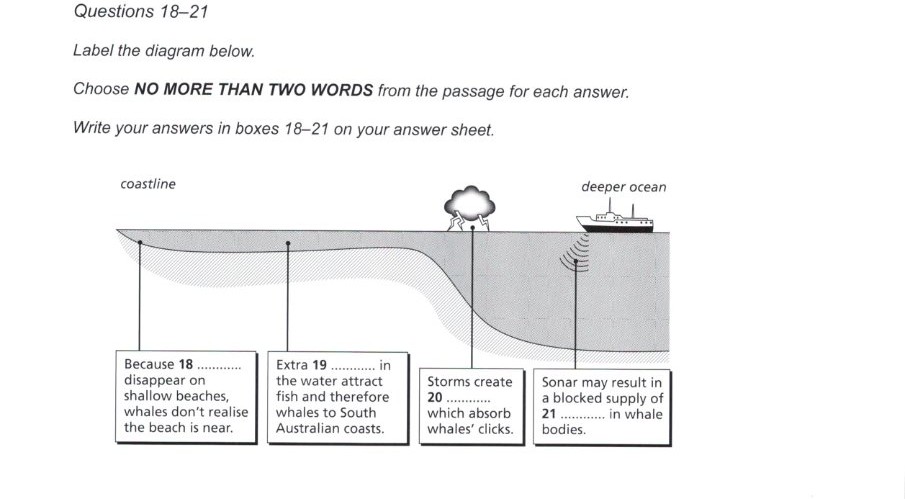
For humans, hearing a sudden loud noise might prove frightening, but it does not induce mass fatality. For whales, on the other hand, there is a theory on how sonar can kill. The noise can surprise the animal, causing it to swim too quickly to the surface. The result is decompression sickness, a hazard human divers know all too well. If a diver ascends too quickly from a high-pressure underwater environment to a lower-pressure one, gases dissolved in blood and tissue expand and form bubbles. The bubbles block the flow of blood to vital organs, and can ultimately lead to death.
Plausible as this seems, it is still a theory and based on our more comprehensive knowledge of land-based animals. For this reason, some scientists are wary. Whale expert Karen Evans is one such scientist. Another is Rosemary Gales, a leading expert on whale strandings. She says sonar technology cannot always be blamed for mass strandings. "It's a case-by-case situation. Whales have been stranding for a very long time – pre-sonar." And when 80% of all Australian whale strandings occur around Tasmania, Gales and her team must continue in the search for answers.
When animals beach next to each other at the same time, the most common cause has nothing to do with humans at all. “They're highly social creatures," says Gales. “When they mass strand – it's complete panic and chaos. If one of the group strands and sounds the alarm, others will try to swim to its aid, and become stuck themselves.”
Activities such as sonar testing can hint at when a stranding may occur, but if conservationists are to reduce the number of strandings, or improve rescue operations, they need information on where strandings are likely to occur as well. With this in mind, Ralph James, physicist at the University of Western Australia in Perth, thinks he may have discovered why whales turn up only on some beaches. In 1986 he went to Augusta, Western Australia, where more than 100 false killer whales had beached. "I found out from chatting to the locals that whales had been stranding there for decades. So I asked myself, what is it about this beach?" From this question that James pondered over 20 years ago, grew the university's Whale Stranding Analysis Project.
Data has since revealed that all mass strandings around Australia occur on gently sloping sandy beaches, some with inclines of less than 0.5%. For whale species that depend on an echolocation system to navigate, this kind of beach spells disaster. Usually, as they swim, they make clicking noises, and the resulting sound waves are reflected in an echo and travel back to them. However, these just fade out on shallow beaches, so the whale doesn't hear an echo and it crashes onto the shore.
But that is not all. Physics, it appears, can help with the when as well as the where. The ocean is full of bubbles. Larger ones rise quickly to the surface and disappear, whilst smaller ones – called microbubbles – can last for days. It is these that absorb whale ‘clicks’. “Rough weather generates more bubbles than usual,” James adds. So, during and after a storm, echolocating whales are essentially swimming blind.
Last year was a bad one for strandings in Australia. Can we predict if this – or any other year – will be any better? Some scientists believe we can. They have found trends which could be used to forecast 'bad years' for strandings in the future. In 2005, a survey by Klaus Vanselow and Klaus Ricklefs of sperm whale strandings in the North Sea even found a correlation between these and the sunspot cycle, and suggested that changes in the Earth's magnetic field might be involved. But others are sceptical. "Their study was interesting ... but the analyses they used were flawed on a number of levels,” says Evans. In the same year, she co-authored a study on Australian strandings that uncovered a completely different trend. "We analysed data from 1920 to 2002 ... and observed a clear periodicity in the number of whales stranded each year that coincides with a major climatic cycle." To put it more simply, she says, in the years when strong westerly and southerly winds bring cool water rich in nutrients closer to the Australia coast, there is an increase in the number of fish. The whales follow.
So what causes mass strandings? “It's probably many different components,” says James. And he is probably right. But the point is we now know what many of those components are.
Questions
Questions 14–17 Short Answers
Choose NO MORE THAN TWO WORDS from the passage for each answer.
Questions 18–21 Diagram Labeling
Label the diagram below.
Choose NO MORE THAN TWO WORDS from the passage for each answer.
Questions 22–26 True / False / Not Given
Do the following statements agree with the information given in Reading Passage 2?
Write
TRUE if the statement agrees with the information
FALSE if the statement contradicts the information
NOT GIVEN if there is no information on this
Answers & Explanations Summary
| # | Answer | Evidence | Explanation |
|---|---|---|---|
| Q14 | skin / skin samples | A team of researchers begins to investigate, collecting skin samples for instance, recording anything that could help them answer the crucial question: why | Excerpt/Passage Explanation: The passage explains that when researchers look for the cause of whale strandings, they take small pieces of skin from the animals to help find answers. Answer Explanation: The answer identifies that scientists take pieces of skin from the whales to study them. Reason For Correctness: The correct answer is found in the first paragraph, which describes what happens when whales die on a beach. It mentions that a group of scientists investigates the bodies to find out why the whales got stuck. During this process, the text says they are "collecting skin samples." The word "collecting" is a synonym for taking something from a body for research. |
| Q15 | noise / noise pollution | It is known that noise pollution from offshore industry, shipping and sonar can impair underwater communication, but can it really drive whales onto our beaches | Excerpt/Passage Explanation: The passage says that loud sounds from ocean businesses and ships can hurt how whales communicate underwater. Answer Explanation: The answer is noise or noise pollution, which means loud and harmful sounds. Reason For Correctness: The correct answer is 'noise' or 'noise pollution' because the text mentions that businesses working in the ocean (offshore industry) and ships (shipping) create sounds that interfere with the way whales talk to each other. These sounds are described as 'noise pollution' and are listed as factors that can 'impair' or damage underwater communication. |
| Q16 | around Tasmania / Tasmania | And when 80% of all Australian whale strandings occur around Tasmania, Gales and her team must continue in the search for answers | Excerpt/Passage Explanation: The passage states that a very high percentage (80%) of all the times whales get stuck on land in Australia, it happens near Tasmania. Answer Explanation: The answer identifies that most whales in Australia are found stuck on beaches in an area called Tasmania. Reason For Correctness: The correct answer is "Tasmania" because the passage mentions that 80% of whale strandings in Australia happen in this specific location. The phrase "80% of all" indicates that the vast majority (most) of these events occur there. |
| Q17 | sperm / sperm whales / sperm whale | In 2005, a survey by Klaus Vanselow and Klaus Ricklefs of sperm whale strandings in the North Sea even found a correlation between these and the sunspot cycle, and suggested that changes in the Earth's magnetic field might be involved | Excerpt/Passage Explanation: The passage says that scientists did a study on why sperm whales got stuck on the land in the North Sea. Answer Explanation: The answer is the sperm whale, which is a specific type of large sea animal that was looked at in a research study. Reason For Correctness: The correct answer is sperm whales because the text mentions a 2005 study conducted by researchers Klaus Vanselow and Klaus Ricklefs. This study specifically focused on where and why these whales were found on beaches in the North Sea area. |
| Q18 | sound waves | Usually, as they swim, they make clicking noises, and the resulting sound waves are reflected in an echo and travel back to them | Excerpt/Passage Explanation: The passage explains that when whales swim, they make clicking sounds. These sounds create waves (sound waves) that hit things and return to the whale as an echo so they can find their way. Answer Explanation: The answer refers to the energy or vibrations created when a whale makes a sound to find its way through the water. Reason For Correctness: The correct answer is based on how whales use echolocation to navigate. When a whale makes a noise (a 'click'), it creates 'sound waves' that move through the water. These waves hit an object and bounce back as an echo, telling the whale where things are. On certain beaches, these waves do not bounce back correctly, causing the whale to get lost and swim onto the shore. |
| Q19 | nutrients | To put it more simply, she says, in the years when strong westerly and southerly winds bring cool water rich in nutrients closer to the Australia coast, there is an increase in the number of fish | Excerpt/Passage Explanation: The passage explains that in certain years, winds move cold water to the shore. This water is full of nutrients, which brings more fish to the area. The whales come to eat these fish. Answer Explanation: The answer "nutrients" refers to the high-quality food or substances found in the water that help fish grow and stay healthy. Reason For Correctness: The correct answer is found in the section discussing Karen Evans' study. She explains a pattern where strong winds push cold water toward the Australian coast. This cold water contains many nutrients, which results in more fish moving into the area. Since whales eat fish, they follow them toward the shore, which explains why more whale strandings happen during those specific years. In this context, nutrients are the reason the fish (and then the whales) move closer to the beach. |
| Q20 | microbubbles | The ocean is full of bubbles. Larger ones rise quickly to the surface and disappear, whilst smaller ones – called microbubbles – can last for days. It is these that absorb whale ‘clicks’ | Excerpt/Passage Explanation: The passage explains that there are different sizes of bubbles in the sea. Tiny ones are called microbubbles, and they stay in the water for many days. These tiny bubbles soak up the clicking sounds that whales make. Answer Explanation: The answer refers to very small bubbles found in the ocean. Reason For Correctness: The correct answer is chosen because the passage describes these small bubbles as 'microbubbles.' They are significant because, unlike large bubbles that vanish quickly, microbubbles remain in the water for days and absorb the sounds (clicks) that whales use to navigate through the water. |
| Q21 | blood | If a diver ascends too quickly from a high-pressure underwater environment to a lower-pressure one, gases dissolved in blood and tissue expand and form bubbles. The bubbles block the flow of blood to vital organs, and can ultimately lead to death | Excerpt/Passage Explanation: The passage explains that when moving from the deep, heavy-pressure ocean to the surface too quickly, gases inside the liquid parts of the body (the blood) grow and turn into bubbles. These bubbles then get in the way of the blood moving through the body, which can cause death. Answer Explanation: The answer is the red liquid inside the body of a whale or person. In this story, it is the place where gas bubbles form and get stuck when a whale swims up to the surface too fast. Reason For Correctness: The correct answer is blood because the text describes a process similar to decompression sickness in human divers. When a whale is surprised by loud sounds, it might swim to the surface too quickly, causing gases in its blood and tissue to expand. These bubbles then stop the blood from flowing correctly to important organs, which can be fatal. |
| Q22 | NOT GIVEN | In 1998, researchers at the Pelagos Cetacean Research Institute, a Greek non-profit scientific group, linked whale strandings with low-frequency sonar tests being carried out by the North Atlantic Treaty Organisation (NATO) | Excerpt/Passage Explanation: The passage states that this group found a link between whales getting stuck and sonar noise, but it does not say what the scientists were trying to do when they first started their work. Answer Explanation: The answer means that the text does not tell us the specific goal or reason why the Pelagos Institute began their study in 1998. Reason For Correctness: The correct answer is NOT GIVEN because the passage mentions that the Pelagos Institute found a connection between whale strandings and sonar tests, but it never explains what their original plan or aim was. While they discovered that sonar might cause whales to get stuck, we do not know if they started the research specifically to prove this, or if it was just something they noticed later. In reading tests, if the specific purpose or 'aim' is not described, we cannot say if a statement about that aim is true or false. |
| Q23 | TRUE | Typically they all wash ashore together, but in mass atypical strandings (such as the one in Greece), the whales don't strand as a group; they are scattered over a larger area | Excerpt/Passage Explanation: The passage explains that in the Greece stranding, the whales did not arrive at the beach as one single group; instead, they were spread out over a big space. Answer Explanation: The answer means that the whales found in Greece were spread out in several locations along the shore instead of being all together in one spot. Reason For Correctness: The correct answer is TRUE because the passage describes the event in Greece as an 'atypical' mass stranding. While normal group strandings happen in one place, the text explains that the whales in Greece were 'scattered over a larger area.' Specifically, it mentions the whales were found along '38.2 kilometres of coastline,' which confirms they were at many different points. |
| Q24 | NOT GIVEN | In 1998, researchers at the Pelagos Cetacean Research Institute, a Greek non-profit scientific group, linked whale strandings with low-frequency sonar tests being carried out by the North Atlantic Treaty Organisation (NATO) Another is Rosemary Gales, a leading expert on whale strandings. She says sonar technology cannot always be blamed for mass strandings |
Excerpt/Passage Explanation: The passage mentions that Greek researchers found a link between sonar and whales getting stuck on beaches, and it also mentions that Rosemary Gales believes sonar is not the only reason this happens, but it never shows her talking about the Greek researchers' work. Answer Explanation: The answer is NOT GIVEN because the text does not say whether Rosemary Gales liked or disliked the way the Greek scientists did their work. Reason For Correctness: The correct answer is NOT GIVEN because while the text mentions Rosemary Gales and it also mentions a study by Greek researchers, it never says that she looked at or criticized their specific research techniques. The passage discusses her opinion that sonar is not always the cause of whale strandings, but it does not record any comment from her regarding the Greek team's methods or study. Therefore, we cannot know her opinion on their research from this text. |
| Q25 | TRUE | If one of the group strands and sounds the alarm, others will try to swim to its aid, and become stuck themselves | Excerpt/Passage Explanation: The passage says that if a single whale gets stuck on land and makes a signal for help, the rest of the group will try to go toward that whale to help it. Answer Explanation: The answer is TRUE because the text confirms that whales usually try to assist members of their group who are in difficulty. Reason For Correctness: The correct answer is TRUE because the expert Rosemary Gales explains that whales are social animals. If one whale gets stuck on a beach (strands) and calls for help, the other whales in the group will try to swim to it to help, which causes them to get stuck as well. The phrase 'swim to its aid' in the text means 'swim to help it'. |
| Q26 | FALSE | But others are sceptical. "Their study was interesting but the analyses they used were flawed on a number of levels,” says Evans |
Excerpt/Passage Explanation: The passage explains that some scientists do not believe the magnetic field theory. They think the research used to support that idea was not done correctly. Answer Explanation: The answer is FALSE because not all scientists agree that changes in the Earth's magnetic fields cause whales to get stuck on beaches. Reason For Correctness: The correct answer is FALSE because the text shows a disagreement between scientists. While one study suggested that changes in the Earth's magnetic field might be related to whale strandings, other experts are 'sceptical' (they have doubts). For example, Karen Evans states that the study suggesting this link was 'flawed' (it had mistakes). Because scientists have different opinions, it is incorrect to say there is 'agreement' among them. |