Our system will evaluate the answer based on this AI-generated description.
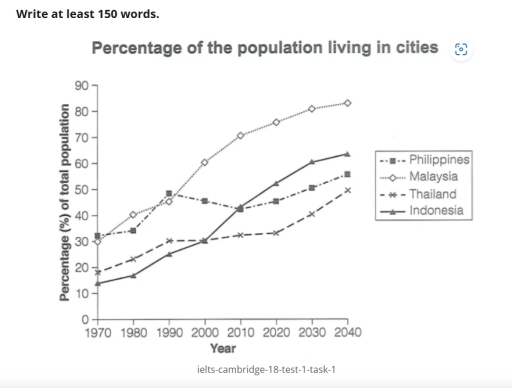
The image displays the urban population percentage from 1970 to 2040 for four countries: Philippines, Malaysia, Thailand, and Indonesia. In 1970, the Philippines had about 30%, Malaysia 25%, Thailand 15%, and Indonesia 10%. By 1980, the Philippines reached approximately 35%, Malaysia 35%, Thailand 20%, and Indonesia 15%. By 1990, the Philippines climbed to about 44%, Malaysia held steady around 45%, Thailand about 25%, and Indonesia around 25%. In 2000, Malaysia peaked at approximately 55%, Philippines 48%, Thailand 30%, and Indonesia 30%. By 2010, Malaysia reached roughly 63%, Philippines around 50%, Thailand 34%, and Indonesia 40%. In 2020, Malaysia's figure was around 70%, Philippines 53%, Thailand 38%, and Indonesia 50%. The projection for 2030 suggests Malaysia will be at about 75%, the Philippines at 58%, Thailand at 42%, and Indonesia at 55%. By 2040, Malaysia is expected to be at approximately 80%, Philippines 63%, Thailand about 46%, and Indonesia about 60%.
Given the complexity of the image, the above description may not be entirely accurate.
Skyrocket your IELTS band score by 1-2 points in under a month with our premium plan!
Note: Both the topic and the answer were created by one of our users.
This graph showcases the percentage of population in the Asian countries: Philippines, Malaysia, Thailand and Indonesia that are residing in urban areas through years 1970 to 2020, as well as comprising future expectations for 2030 and 2040.
Initially, it’s clear that Malaysia has the highest percentage of popoulation in most of the shown years except for 1990 which is lead by Philippines (nearly 50%). The Malaysian population has rised dramatically from only 30% reaching almost 80% in just 30 years and expected to continue increasing in 2030 and 2040 to reach nearly 90% of population, similar to Indonesia which also faced a huge change from 10% in 1970 to 50% in 2020 with predictions to risng till it reaches 60% n 2040. While Philippines has had less of a shocking change as the city barely increased by 15% over the years. However, in 1990 the city experienced a high increase in the amount of residents as we had discussed. Thailand had competed with Malaysia after similarly increasing slope during 1970 until intersecting in 2020 with exactly 30% of the populaton living in cities.
Overall, The graph suggests that all fur Asian countries’ Urban residnts will continue to rise which indicates industrial developments.
Word Count: 202
