Our system will evaluate the answer based on this AI-generated description.
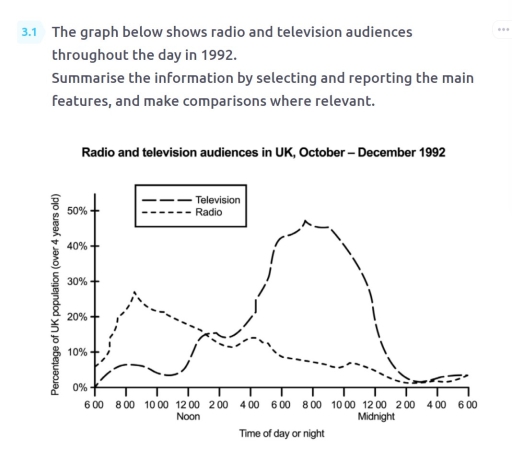
The image displays a line graph titled "Radio and television audiences in UK, October – December 1992", plotting "Time of day or night" on the x-axis (measured in 2-hour increments from 6 AM to 6 AM the next day) against "Percentage of UK population (% of 4+ years old)" on the y-axis (ranging from 0% to 50% in 10% increments). The graph features two lines labeled Television (solid line) and Radio (dashed line). The Television line shows audience percentage starting around 10% at 6 AM, gradually increasing to reach the first peak of 25% at 10 AM, dipping to 15% by 12 PM noon, rising sharply to reach the highest peak close to 45% at 8 PM, and then declining steadily to around 5% by 6 AM the next day. The Radio line begins around 25% at 6 AM, with a sharp increase to approximately 30% by 8 AM, followed by a consistent decline to 10% at 4 PM, a slight increase to 15% at 6 PM, and then a gradual decrease back to around 10% by 6 AM the following day.
Given the complexity of the image, the above description may not be entirely accurate.
Skyrocket your IELTS band score by 1-2 points in under a month with our premium plan!
Note: Both the topic and the answer were created by one of our users.
The chart presents spectators radio and television during the day in 1992. The line graph shows the period in the UK from October to December.
In general, the radio has more audiences and popularity; 10 per cent in the start of day at 6 a.m. Moreover, the radio has a peak of population such as 9 a.m. ; 27%. Afterwards, this type of information was on the decline while television rose. The second highest point was television at 20 in the evening but amounted to 48 percent.
Furthermore, two types of information overlapped at 13 in the noon and had spectators over 10 percent and also, it intersected after 2:00. For comparisons, the television at 12 a.m.. has a 30% of audience whereas the radio has almost 3 per cent. This results might be because people prefer to listen to the radio in the morning when they have a way to work or study, so after workday they want to have a rest and relax and because of that choose to watch a TV.
Word Count: 174
