Our system will evaluate the answer based on this AI-generated description.
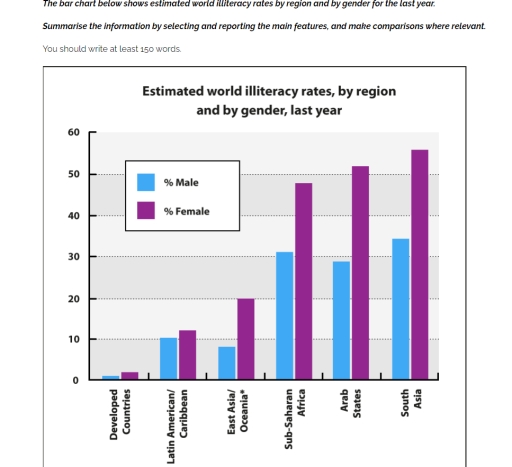
The image displays a bar chart titled "Estimated world illiteracy rates, by region and by gender, last year." It has regions on the x-axis and percentages on the y-axis, ranging from 0 to 60. Data is presented for Developed Countries, Latin America, Caribbean, Oceania, Sub-Saharan Africa, Arab States, South and West Asia, East Asia and the Pacific. For Developed Countries, Male illiteracy is under 5%, Female is likewise. Latin America: Male approx. 10%, Female approx. 8%. Caribbean: Male 10%, Female under 10%. Oceania: Male approx. 20%, Female approx. 25%. Sub-Saharan Africa: Male just over 30%, Female approaching 50%. Arab States: Male approx. 25%, Female approx. 35%. South and West Asia: Male approx. 30%, Female approx. 50%. East Asia and the Pacific: Male under 10%, Female approx. 20%. The data showcases higher female illiteracy rates in every region except for Developed Countries where both genders have similar low rates. Sub-Saharan Africa and South and West Asia have the highest illiteracy rates for both genders, with females reaching almost 50% in both cases.
Given the complexity of the image, the above description may not be entirely accurate.
Skyrocket your IELTS band score by 1-2 points in under a month with our premium plan!
Note: Both the topic and the answer were created by one of our users.
The illustration delineates information on global data on illiteracy rates by gender and region from the previous year. Overall, it is evident that South Asia recorded the highest percentage of illiteracy worldwide, contrasting sharply with the lowest rates observed in developed countries.
Across regions, female illiteracy rates generally exceeded those of males. The disparity between male and female illiteracy rates was minimal in developed countries and Latin America/Caribbean nations, but more pronounced elsewhere.
Specifically, illiteracy rates in developed countries remained consistently below 10%, slightly exceeding 10% in Latin America and the Caribbean. In East Asia/Oceania, the male illiteracy rate stood precisely at 20%, contrasting with just under 10% for females. Similarly, in Arab states, male illiteracy rates approached 30%, while female rates were nearly double. The most significant disparities were evident in South Asia, where male illiteracy surpassed 30%, paralleling female rates exceeding 50%, marking the highest levels globally.
Overall, the data underscores substantial gender-based disparities in global illiteracy rates, with South Asia notably confronting the most significant challenges.
Word Count: 169
