Our system will evaluate the answer based on this AI-generated description.
The image displays a bar chart with vertical bars representing three different years identified by labels: 2003, 2005, and 2007, organized by days of the week from Monday to Sunday along the horizontal axis. The Y-axis measures numerical values from 0 to 50 in increments of 5. Here are the approximate data for each day and year: Monday: 2003 (~10 units), 2005 (~17 units), 2007 (~12 units); Tuesday: 2003 (~12 units), 2005 (~21 units), 2007 (~14 units); Wednesday: 2003 (~15 units), 2005 (~28 units), 2007 (~22 units); Thursday: 2003 (~18 units), 2005 (~32 units), 2007 (~30 units); Friday: 2003 (~48 units), 2005 (~45 units), 2007 (~44 units); Saturday: 2003 (~43 units), 2005 (~40 units), 2007 (~45 units); Sunday: 2003 (~42 units), 2005 (~37 units), 2007 (~40 units). The bars are grouped closely together in sets of three (one bar for each year) under the label of each day, providing a clear visual comparison across the days of the week for each year included in the dataset.
Given the complexity of the image, the above description may not be entirely accurate.
Skyrocket your IELTS band score by 1-2 points in under a month with our premium plan!
Note: Both the topic and the answer were created by one of our users.
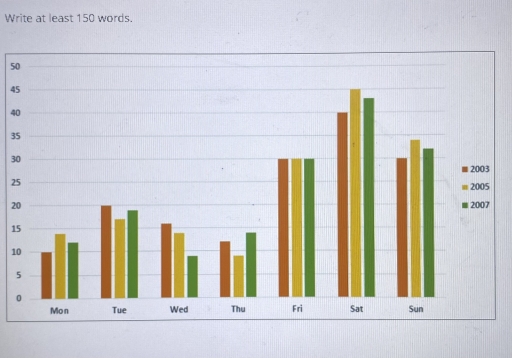
The chart illustrates the proportion of people visiting a cinema during seven days of the week in a European nation from 2003 to 2007.
It is clear that there were only small fluctuations in people’s preference of which day to go to the cinema over the examined period. People in this country tended to go to the cinema on the weekend rather than on Monday to Friday.
In 2003, 40% of people went to cinemas on a Saturday, compared to 30% on Friday or Sunday each. On the other days, the proportion of movie-goers was higher on Tuesday, at 20%, while the lowest figure can be seen on Monday, at only 10%.
Over the next four years, the percentage of people going to the cinema on weekends increased slightly to 45% 35% for Saturday and Sunday respectively. Similarly, Thursday and Monday became more popular among cinema-goers, with about 2% more people choosing these days. However, fewer people went to see movies on Tuesday and Wednesday, with the figures falling to 19% and 9% respectively. Finally, the proportion of movie-goers choosing to go to the cinema on a Friday remained at 30% during the three examined years.
Word Count: 196
