🔥 Today Only: Save 30% on Premium — Offer Ends Soon! - Upgrade Now!
Bar Chart

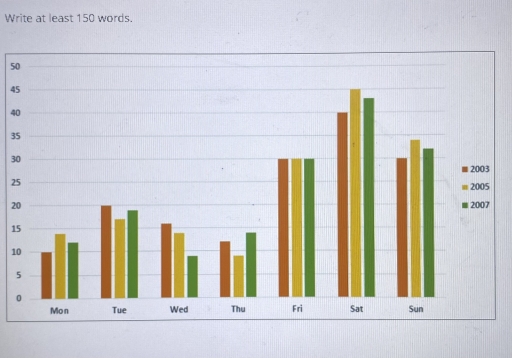
Band 6+: The bar shows the percentage of people going to cinemas in one European country on different days.

Image for topic: The bar shows the percentage of people going to cinemas in one European country on different days.
Our system will evaluate the answer based on this AI-generated description.
The image displays a bar chart with vertical bars representing three different years identified by labels: 2003, 2005, and 2007, organized by days of the week from Monday to Sunday along the horizontal axis. The Y-axis measures numerical values from 0 to 50 in increments of 5. Here are the approximate data for each day and year: Monday: 2003 (~10 units), 2005 (~17 units), 2007 (~12 units); Tuesday: 2003 (~12 units), 2005 (~21 units), 2007 (~14 units); Wednesday: 2003 (~15 units), 2005 (~28 units), 2007 (~22 units); Thursday: 2003 (~18 units), 2005 (~32 units), 2007 (~30 units); Friday: 2003 (~48 units), 2005 (~45 units), 2007 (~44 units); Saturday: 2003 (~43 units), 2005 (~40 units), 2007 (~45 units); Sunday: 2003 (~42 units), 2005 (~37 units), 2007 (~40 units). The bars are grouped closely together in sets of three (one bar for each year) under the label of each day, providing a clear visual comparison across the days of the week for each year included in the dataset.
Given the complexity of the image, the above description may not be entirely accurate.
Note: Both the topic and the answer were created by one of our users.

The given bar graph illustrates the proportion of people going to cinemas from Monday to Sunday in 2003, 2005, and 2007 in a European country.

Overall, Saturdays saw the most people going to cinemas in all three years, while Mondays, Wednesdays, and Thursdays experienced the lowest rate among all groups. Additionally, the percentage of Fridays in 2003 was the same as in two other years.

Looking first at the figure for Saturdays, in 2003, the number of people going to cinemas reached 40 percent, before reaching its peak in 2005 at 45 percent, and then had a slight decrease to approximately 43 percent in 2007. Similarly, on Sundays, the rate had decreased by 10 percent, compared to that of Saturdays.

Looking next at the data of Mondays and Thursdays, in all three years, the rate still below 15 percent, with around 10 percent in 2003, below 15 percent and 10 percent in 2005, and just below 15 percent in 2007. In addition, on Fridays, the rate of people going to cinemas remained unchanged at 30 percent in 2003, 2005, and 2007.

Word Count: 181

Answers On The Same Topic:

The bar shows the percentage of people going to cinemas in one European country on different days.

⸻ The graph illustrates the percentage of people going to the cinema in one European country on seven different days, showing changes in cinema attendance from 2003 to 2007. Overall, it is noticeable that the percentage of people attending the cinema varies depending on the day of the week, with Friday and Saturday showing the […]

The bar shows the percentage of people going to cinemas in one European country on different days.

The graph illustrates the percentage of people going to cinema in one European country on 7 different days showing the changes in cinema attendance from 2003 to 2007. Overall, it is noticiable that the percentage of people attending cinemas varies depending on the days of the week, Friday and Saturday showed the highest peak.There are […]

The bar shows the percentage of people going to cinemas in one European country on different days.

The bar chart illustrates the porprotion of indidual going to cinemas in selected one European country on different days. Overall, it can be concluded from the given information that the figure of saturday experienced and upward trend in European people went to cinemas, while a downward trend was seen in monday and thursday over the […]

The bar shows the percentage of people going to cinemas in one European country on different days.

The provided bar graph illustrates the proportion of people going to cinemas from Monday to Sunday in 2003, 2005, and 2007 in a European country. Overall, Saturdays attracted the highest cinema attendance throughout the years, while Mondays and Thursdays saw the lowest participation rates. Additionally, Fridays maintained a steady attendance across the years. Focusing on […]

See All

Other Topics:

The chart below shows the number of jobs in the tourism-related industry in one UK city between 1989 and 2009. Summarise the information by selecting and reporting the main features, and make comparisons where relevant.

The bar chart illustrates changes in the number of occupations in four different tourism industries in a particular UK urban area over a 20-year period starting in 1989. In general, it is noticeable that different trends were observed in all the given categories throughout the period. Restaurants recorded the highest number of jobs almost for […]

the percentage contribution of the IT and service industries to the GDP

The given data illustrates the percentage contribution of the IT and service industries to the GDP in the UK from 1992 to 2000. Overall, it can be seen that both IT and service industries increased during this period. The IT industry showed a more significant growth, while the service industry increased more slowly. It is […]

The chart below shows the numbers of three types of visitors to a museum between 1997 and 2012.

The bar chart illustrates the number of people visited museum in three age groups, over the year from 1997 to 2012 Overall, adult visitor and speacial exhibition visitors experienced a considerable increase,whereas visitors under the age of 15 followed an opposite trend. It is also noticeable that lowest. At the begining of the period,The number […]

The bar graph shows the percentage of electricity generated from renewable sources in five countries in the years 2000 and 2020.

The bar diagram illustrates renewable energy portion in 5 given countries (Germany, USA, China, India and Brazil) both in 2000 and 2020. Overall, all the countries decided to increase their renewable share prefering a carbon free electrical energy production. In both years Brazil led the countries maintaining the lion’s share of renewables. In stark contrast […]

the percentage contribution of the IT and service industries to the GDP

The given data represents products in the UK IT and service industry as GDP from 1992 to 2000. Overall, on the chart its seen that both the IT and service industry has grown over the years. But IT industry rises sharply while the service industry grew just slightly and throughout all the years didnt overgrew […]

The chart below shows the results of three surveys on absenteeism in a particular European country in the years 2000, 2005, and 2010. The results show the reasons people gave for not going to work.

The bar graph illustrates the reasons for absenteeism across five categories in a particular European country per 5-year period from 2000 to 2010. In general, the percentage of respondents for illness dometics the reasons for not going to work, while the respondents percentage for stress was the lowest share. In terms of mental issues, the […]

See All
We have detected unusual activity on your device.
Please verify your identity to continue.
Note: This verification step won't sign you in. If you have a premium account, please log in to access the service as usual.
Google/Gmail Verification
Or verify using Email/Code
We've sent a verification code to:
youremail@gmail.com (Not your email?)
Enter it below to complete the verification process.
Ensure your email address is correct, your inbox is not full, and you check your spam folder. If no email arrives, consider using an alternative email.
You will need a Premium plan to perform your action!
Note: If you already have a premium account, please log in to access our services as usual.

Plans & Pricing

Our mission is to make quality education accessible for everyone.
However, to keep our hardworking team running and this service alive, we genuinely need your support!
By opting for a premium plan, not only do you sustain us in achieving the mission, but you also unlock advanced features to enrich your learning experience.

Free

For learners who aren't pressed for time

What's included on Free
100+ Cambridge IELTS Tests
Instant IELTS Writing Task 1 & 2 Evaluation (2 times/month)
Instant IELTS Speaking Part 1, 2, & 3 Evaluation (2 times/month)
Instant IELTS Writing Task 1 & 2 Essay Generator (2 times/month)
500+ Dictation & Shadowing Exercises
100+ Pronunciation Exercises
Flashcards
Other Advanced Tools

Premium

For those serious about advancing their English proficiency, and for IELTS candidates aspiring to boost their band score by 1-2 points (especially in writing & speaking) in just 30 days or less

What's included on Premium
Save Your IELTS Test Progress & Analyze Mistakes By Question Type
Save Your Own Flashcard Sets & Use Them On Any Device
Unlock All Courses, IELTS Tests, Section & Part Practice
Unlimited AI Conversations
Unlimited AI Writing Enhancement Exercises
Unlimited IELTS Writing Task 1 & 2 Evaluation
Unlimited IELTS Speaking Part 1, 2, & 3 Evaluation
Checked Answers Will Not Be Published
Unlimited IELTS Writing Task 1 & 2 Essay Generator
Unlimited IELTS Speaking Part 1, 2, & 3 Sample Generator
Unlimited Usage Of Advanced Tools & AI Features
Priority Support within 24h (12-month plan only)

Due to the nature of our service and the provided free trials, payments are non-refundable.