🔥 Today Only: Save 30% on Premium — Offer Ends Soon! - Upgrade Now!
Line Graph

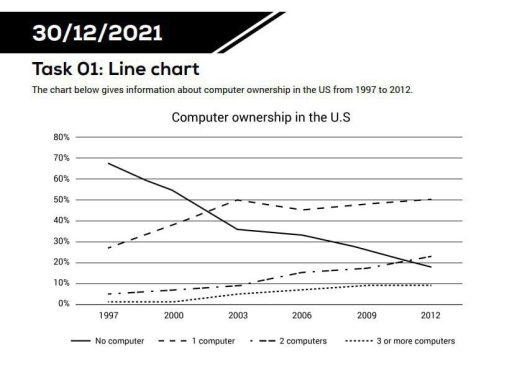
Band 5+: The chart below gives information about computer ownership in the US from 1997 to 2012.

Image for topic: The chart below gives information about computer ownership in the US from 1997 to 2012.
Our system will evaluate the answer based on this AI-generated description.
The image displays a line chart on computer ownership in the US from 1997 to 2012: No computer ownership started at 60% in 1997, declining to about 45% in 2000, further decreasing to just over 30% in 2003, dropping to roughly 25% in 2006, falling beneath 20% in 2009, and reaching around 10% in 2012. Ownership of 1 computer started at 25% in 1997, increased to near 40% in 2000, peaking above 50% in 2003, then dropping back to around 40% in 2006, stabilizing around 35% in 2009, and slightly decreasing to just under 30% in 2012. Ownership of 2 computers began at 10% in 1997, rose to about 15% in 2000, continued increasing to near 20% in 2003, maintained a similar level in 2006, rose slightly again in 2009, and peaked just below 30% in 2012. Ownership of 3 or more computers started at below 10% in 1997, minimally increased in 2000, gradually rose to about 10% in 2003, increased marginally to around 15% in 2006, rose to just below 20% in 2009, and further increased to approximately 25% in 2012.
Given the complexity of the image, the above description may not be entirely accurate.
Note: Both the topic and the answer were created by one of our users.

The line graph below illustates the data about computer ownership in the US from 1997 to 2012.

Overall, more people had a computer in 2012 than in 1997, showing that owning a computer became more common.

In 1997, the figure of people who didn’t own any computer was higher 42% than people who owned one. In the next 2 years the percentage of owners was witnessed an dramatical grew from 28% to 50% and remain constant until the end . While the data of people who did not own computers was decreased significantly over the period.

By contrast, the percentages of homes with 2 or 3 computers in 1997 was at a small number. But then the trend of owning two computers began to went up gradually to 20% in the last year of period. More and more families began to have three computers and it rate rose moderately to 10% in 2006 and stayed almost the same until 2012.

Word Count: 160

Answers On The Same Topic:

The chart below gives information about computer ownership in the US from 1997 to 2012.

The line graph illustrates the percentage of computer ownership in the US between 1997 and 2012. Overall, the proportion of households without a computer fell gradually over the period, whereas single-computer ownership experienced a dramatic increase and became the most common category by the end. Meanwhile, multiple-computer ownership rose only minimally throughout the period. Focusing […]

The chart below gives information about computer ownership in the US from 1997 to 2012.

The line graph gives information demonstates of how many people owning in the US between 1997 and 2012. Overall, the percentage of people who owned 1 2 and 3 or more computers increased while people who did not own computer decreased. In addition, most of them owned 1 computer at the give time. In 1997, […]

The chart below gives information about computer ownership in the US from 1997 to 2012.

The line chart illustrates changes in the percentage of computer ownership in the US over a 15-year period from 1997 to 2012. Overall, there was a clear upward trend in the proportion of Americans owning one or more computers, while the percentage of households without a computer declined significantly. Additionally, throughout the period, having just […]

The chart below gives information about computer ownership in the US from 1997 to 2012.

The line graph shows information about computer ownership in the US from 1997 to 2012. Overall, the number of people without a computer went down, while the number of people with computers went up. One computer became the highest group by the end of the period. In 1997, about 65% of people did not have […]

The chart below gives information about computer ownership in the US from 1997 to 2012.

The graph illsutrates data on owning computers in the US between 1997 and 2012. Overall, while without computers remained dominat at the beggining of the period, a figure that then declined significantly over the period. Several computer owneships opposed to without computer ownerships. At the beginning of the year, it had a lowest figure, but […]

See All

Other Topics:

The graph shows data about the annual earnings of three bakeries in calagry ,2000-2010. Summarize the information by selecting and reporting main features and make comparison where relevant.

The graph illustrates the annual earnings of three bakeries over the span of 10 years from 2000 to 2010. Overall, Mari Backeshop emrged as highest earning bakery throughout the period.In contrast, Amandine Bakery was highest earning bakery at the start of the period but dewindled over the time, while Bolo Cakery showed gradual increase in […]

The line graph shows the number of people using five kinds of public facilities in a town in France at different times during the year 2022. Summarise the information by selecting and reporting the main features and make comparisons where relevant.

The line graph presents information about the number of people using five types of public facilities:library,museum,park,public pool and youth centre in a town in France at different month during the year 2022. Overall,the graph data clearly shows that,the park was unpredictable through the given period and reached the peak of share.In contrast,library stayed constant all […]

The graph below shows changes in the percentage of households with cars in one European country between 1961 and 2001.

The line graph compares the no-car, 1-car, and 2+-car categories in terms of the percentage of owners in European households over a 40-year period, between 1961 and 2001. Overall, ownership of 2+ cars and 1 car exhibited an upward trajectory, whereas the reverse was true for the no-car category. Notably, ownership of 2+ cars witnessed […]

The graph below gives information about total oil use of 4 main consumers from 2009 to 2030

The given line chart illustrate information about oil consumed by main four consumers in year 2009 and 2030 in millions barrel per day. Overall, we can clearly seen that the usa were more oil in 2009 and will be remain highest in year 2030. whereas others remain low comapred as oters. on one hand, oil […]

The graph below gives information about the number of jobs in four sectors economy in the US between 1960 and 2020.

in this report, i will illustrate the multi line graph. This graph, shows the numbers of miilions job in four different sectors from 1960 to 2020 in the US. Firstly, millions of job in manufacturing sector is highly in 1960 from the other sectors, which is slightly increasing in 1980 then continous decreasing in 2020 […]

The chart below shows the percentage of households with different kinds of technology in the UK from 1997 to 2001. Summarise the information by selecting and reporting the main features, and make comparisons where relevant.

The line chart compares the proportion of people who used different types of technology in the UK over the period shown. Overall, the figures for most countries saw an upward trend, with the CD player demonstrated the highest proportion, regardless of the year. Of particual note, the telephone showed a significant increase in usage, while […]

See All
We have detected unusual activity on your device.
Please verify your identity to continue.
Note: This verification step won't sign you in. If you have a premium account, please log in to access the service as usual.
Google/Gmail Verification
Or verify using Email/Code
We've sent a verification code to:
youremail@gmail.com (Not your email?)
Enter it below to complete the verification process.
Ensure your email address is correct, your inbox is not full, and you check your spam folder. If no email arrives, consider using an alternative email.
You will need a Premium plan to perform your action!
Note: If you already have a premium account, please log in to access our services as usual.

Plans & Pricing

Our mission is to make quality education accessible for everyone.
However, to keep our hardworking team running and this service alive, we genuinely need your support!
By opting for a premium plan, not only do you sustain us in achieving the mission, but you also unlock advanced features to enrich your learning experience.

Free

For learners who aren't pressed for time

What's included on Free
100+ Cambridge IELTS Tests
Instant IELTS Writing Task 1 & 2 Evaluation (2 times/month)
Instant IELTS Speaking Part 1, 2, & 3 Evaluation (2 times/month)
Instant IELTS Writing Task 1 & 2 Essay Generator (2 times/month)
500+ Dictation & Shadowing Exercises
100+ Pronunciation Exercises
Flashcards
Other Advanced Tools

Premium

For those serious about advancing their English proficiency, and for IELTS candidates aspiring to boost their band score by 1-2 points (especially in writing & speaking) in just 30 days or less

What's included on Premium
Save Your IELTS Test Progress & Analyze Mistakes By Question Type
Save Your Own Flashcard Sets & Use Them On Any Device
Unlock All Courses, IELTS Tests, Section & Part Practice
Unlimited AI Conversations
Unlimited AI Writing Enhancement Exercises
Unlimited IELTS Writing Task 1 & 2 Evaluation
Unlimited IELTS Speaking Part 1, 2, & 3 Evaluation
Checked Answers Will Not Be Published
Unlimited IELTS Writing Task 1 & 2 Essay Generator
Unlimited IELTS Speaking Part 1, 2, & 3 Sample Generator
Unlimited Usage Of Advanced Tools & AI Features
Priority Support within 24h (12-month plan only)

Due to the nature of our service and the provided free trials, payments are non-refundable.