Our system will evaluate the answer based on this AI-generated description.
The image presents a bar chart comparing average weekly spending by families in percentages of weekly income on different categories for the years 1968 and 2018. In 1968, the expenditure percentages for various categories are as follows: Food (approximately 23%), Housing (roughly 7%), Fuel and power (close to 5%), Clothing and footwear (about 8%), Household goods (nearly 4%), Personal goods (around 2%), Transport (just over 5%), and Leisure (slightly more than 2%). For the year 2018, the spending percentages for the same categories are: Food (approximately 8%), Housing (about 30%), Fuel and power (close to 2%), Clothing and footwear (around 3%), Household goods (nearly 3%), Personal goods (approximately 3%), Transport (about 15%), and Leisure (roughly 10%). The chart illustrates a significant decrease in the percentage of income spent on food, fuel, and power from 1968 to 2018, with an increase in spending on housing, transport, and leisure in the same period.
Given the complexity of the image, the above description may not be entirely accurate.
Skyrocket your IELTS band score by 1-2 points in under a month with our premium plan!
Note: Both the topic and the answer were created by one of our users.
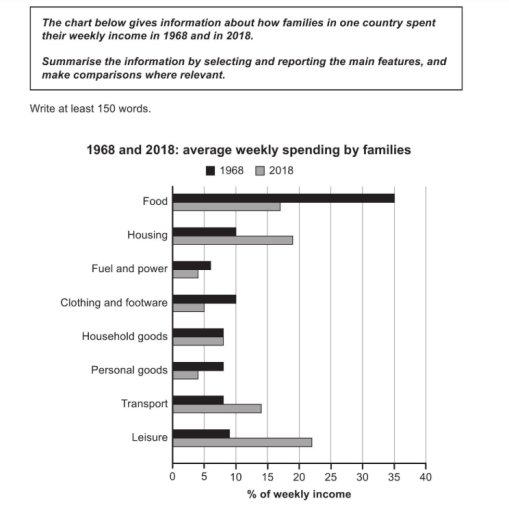
The bar chart compares the average weekly expenditures of families on seven items in the same country in 1968 and 2018. The data is given in percentages.
Overall, In 1968, Although the amount of money spent on food was the highest, fuel and power represented the lowest expenditure in the same year. On the other hand, Leisure indicated the highest spending in 2018, while personal goals, fuel, and power had the same percentage.
In 1968, the proportion of food expenditures peaked at 35%, compared to housing, clothing, and footwear which have a similar percentage of 10%. Additionally, it can be seen that leisure showed approximately 8 percent, while the other 3 items household goods, personal goods, and transport plateaued at almost 7%.
In 2018, the spending on leisure reached the highest at nearly 22%, followed by housing and food, which are almost 18% and 17% respectively. Personal goods, fuel, and power showed the least same percentage 4%, whereas transport indicated less than 15%. The last two goods have different indicators where household goods showed almost 5% and clothing and footwear reached 5% exactly.
Word Count: 183
