Our system will evaluate the answer based on this AI-generated description.
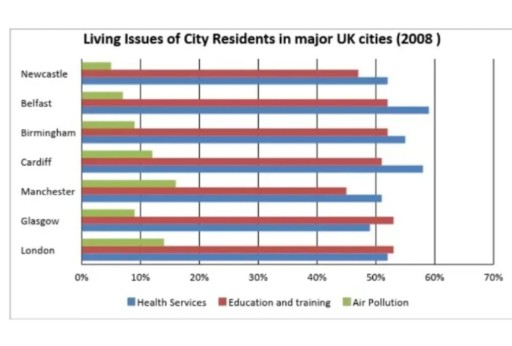
The image depicts a bar graph showing the living issues of city residents in major UK cities in 2008. Newcastle residents report issues with health services (approximately 24%), education and training (approximately 19%), and air pollution (approximately 57%). Belfast residents report issues with health services (approximately 32%), education and training (approximately 30%), and air pollution (approximately 38%). Birmingham residents report issues with health services (approximately 30%), education and training (approximately 40%), and air pollution (approximately 30%). Cardiff has health services (approximately 34%), education and training (approximately 28%), and air pollution (approximately 38%). Manchester reports health services (approximately 45%), education and training (approximately 20%), and air pollution (approximately 35%). Glasgow residents report issues with health services (approximately 50%), education and training (approximately 20%), and air pollution (approximately 30%). London residents report issues with health services (approximately 55%), education and training (approximately 10%), and air pollution (approximately 35%).
Given the complexity of the image, the above description may not be entirely accurate.
Skyrocket your IELTS band score by 1-2 points in under a month with our premium plan!
Note: Both the topic and the answer were created by one of our users.
The bar chart illustrates the percentage of residents in major UK cities who reported various issues in 2008.
The chart reveals that health services were the most prevalent issue for all cities, followed by education and training; however, levels of concern for air pollution varied significantly between different cities.
Newcastle demonstrated the greatest issue with air pollution, with 57% of residents reporting concerns over this issue. On the other hand, their concerns over education and training (19%) were the lowest among the cities. Belfast reported comparable levels of concern over health services (32%) and air pollution (38%), while education and training concerns were slightly higher (30%).
Birmingham had a more balanced distribution of concerns, with 30% reporting health services issues, 40% reporting education and training issues, and 30% reporting air pollution issues. Similar rates of concern were shared by Cardiff, with approximately 34% concerned about health services, 28% concerned about education and training, and 38% concerned about air pollution. Conversely, Manchester, Glasgow, and London had significantly higher levels of concern for health services, ranging from 45% in Manchester to 55% in London, highlighting the importance of this issue in these cities. Education and training concerns remained comparatively low in these cities, while air pollution remained at a relatively consistent level, ranging from 30% to 35%.
Word Count: 215
