Our system will evaluate the answer based on this AI-generated description.
The image depicts a bar graph showing the living issues of city residents in major UK cities in 2008. Newcastle residents report issues with health services (approximately 24%), education and training (approximately 19%), and air pollution (approximately 57%). Belfast residents report issues with health services (approximately 32%), education and training (approximately 30%), and air pollution (approximately 38%). Birmingham residents report issues with health services (approximately 30%), education and training (approximately 40%), and air pollution (approximately 30%). Cardiff has health services (approximately 34%), education and training (approximately 28%), and air pollution (approximately 38%). Manchester reports health services (approximately 45%), education and training (approximately 20%), and air pollution (approximately 35%). Glasgow residents report issues with health services (approximately 50%), education and training (approximately 20%), and air pollution (approximately 30%). London residents report issues with health services (approximately 55%), education and training (approximately 10%), and air pollution (approximately 35%).
Given the complexity of the image, the above description may not be entirely accurate.
Skyrocket your IELTS band score by 1-2 points in under a month with our premium plan!
Note: Both the topic and the answer were created by one of our users.
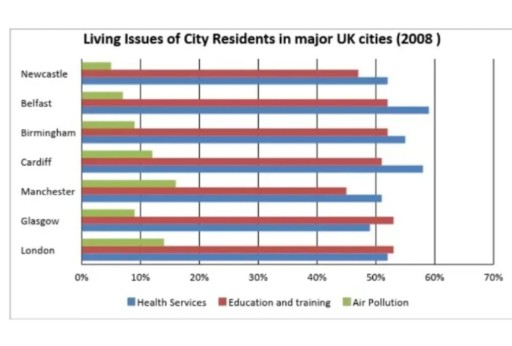
The bar chart depicts the concerns related to healthcare, education and training, and air quality across various UK cities in 2008. Overall, healthcare and educational services emerged as the primary concerns in all locations, whereas the majority of the population did not regard air pollution as a significant problem.
To begin with, healthcare services posed a considerable challenge, with dissatisfaction levels exceeding 50% in most urban areas. Belfast recorded the highest proportion, reaching nearly 60%. In contrast, Glasgow showed the lowest figure, with just under 50% of residents expressing discontent.
In addition, difficulties related to education and vocational training were notable, particularly in Glasgow and London, where dissatisfaction rates stood at approximately 53%. Manchester, however, reported the lowest figure for this category, at 45%.
Conversely, air quality was perceived as a minor issue in many cities. Manchester had the highest level of concern regarding atmospheric pollution, at around 15%. By comparison, only 5% of respondents in Newcastle expressed worries about this environmental problem, marking it as the lowest among all surveyed cities.
Word Count: 172
