Our system will evaluate the answer based on this AI-generated description.
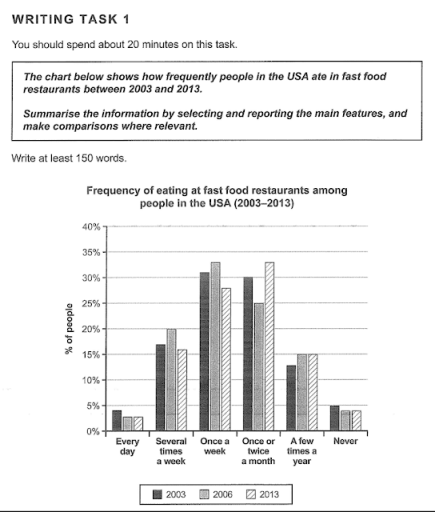
The image shows a bar chart comparing the frequency of eating at fast food restaurants among people in the USA from 2003 to 2013. The percentages of people who ate fast food everyday decreased from 5% in 2003 to 3% in 2013. The number of people who ate several times a week increased from 20% in 2003 to around 26% in 2013. The percentage of people eating fast food once a week saw a slight decrease from 30% in 2003 to around 28% in 2013. The number of people eating fast food once or twice a month remained relatively stable at around 20%. The percentage of people eating fast food a few times a year increased from around 18% in 2003 to 25% in 2013. Lastly, the number of people who never ate fast food dropped from around 10% in 2003 to around 4% in 2013. Overall, there seems to be a shift towards eating fast food more frequently, but less frequently than every day.
Given the complexity of the image, the above description may not be entirely accurate.
Skyrocket your IELTS band score by 1-2 points in under a month with our premium plan!
Note: Both the topic and the answer were created by one of our users.
The given bar chart provides information regarding the frequency of eating in a fast-food restaurant in the USA, from 2003 to 2013.
Overall, it is transparently evident that the consumption of fast foods increases when the frequency decreases.
We can see that the number of people eating fast food every day decreased over the period, declining nearly 4% to almost 3% in 2013. There is then a marked increase in eating at fast food restaurant when the frequency decrease. For instance, in ‘Several Times A Week’ group the percentage is approximately 15% in 2003, but it peaked in ‘Once or Twice A month’ category to 30%.
Turning to comparison between the given period, there is noticeable difference between the amount of fast-food consumption between 2006 and 2013 when individuals consume fast food frequently. There is just one exception, in which there was almost 8% difference, 2013’s data is more than 2006 in ‘Once or Twice a Month’.
Word Count: 157
