🔥 Today Only: Save 30% on Premium — Offer Ends Soon! - Upgrade Now!
Bar Chart

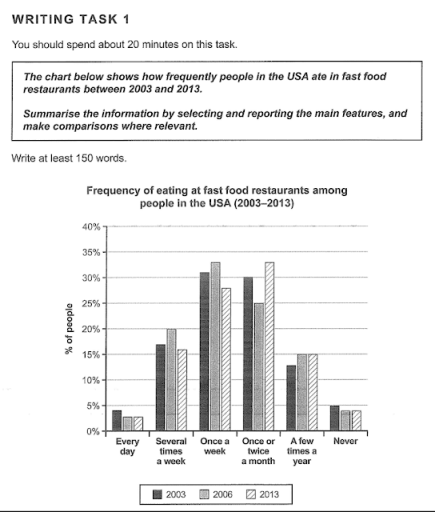
Band 6+: The chart below shows how frequently people in the USA ate in fast food restaurants between 2003 and 2013. Summarize the information by selecting and reporting the main features, and make comparisons where relevant.

Image for topic: The chart below shows how frequently people in the USA ate in fast food restaurants between 2003 and 2013. Summarize the information by selecting and reporting the main features, and make comparisons where relevant.
Our system will evaluate the answer based on this AI-generated description.
The image shows a bar chart comparing the frequency of eating at fast food restaurants among people in the USA from 2003 to 2013. The percentages of people who ate fast food everyday decreased from 5% in 2003 to 3% in 2013. The number of people who ate several times a week increased from 20% in 2003 to around 26% in 2013. The percentage of people eating fast food once a week saw a slight decrease from 30% in 2003 to around 28% in 2013. The number of people eating fast food once or twice a month remained relatively stable at around 20%. The percentage of people eating fast food a few times a year increased from around 18% in 2003 to 25% in 2013. Lastly, the number of people who never ate fast food dropped from around 10% in 2003 to around 4% in 2013. Overall, there seems to be a shift towards eating fast food more frequently, but less frequently than every day.
Given the complexity of the image, the above description may not be entirely accurate.
Note: Both the topic and the answer were created by one of our users.

The bar chart illustrates how often American citizens went to junk food restaurant in the 3 period of time (2003, 2006 and 2013).

It is clear that almost half the Americans eat fast foods at restaurants either a few times or once a week between 2003 and 2013. The only exception to this pattern is not eating fast food, which declined.

Looking first of all, in the start of the period, people having fast food once a week stood at just over 30% and rose by 3% in 2006, after which it experienced a drop to approximately 5% in 2013. In contrast, the group comprised of people who went to restaurants once or twice a month witnessed a decline of 10% between 2003 and 2006. Following this, it surpassed people eating fast food weekly by rising to roughly speaking 33% in the final year of the period. Whereas, in none of the three years were more than 5% of individuals who never ate fast food. The consumers of eating junk food daily slightly declined through the years.

177 words

Word Count: 179

Answers On The Same Topic:

The chart below shows how frequently people in the USA ate in fast food restaurants between 2003 and 2013. Summarize the information by selecting and reporting the main features, and make comparisons where relevant.

The bar chart compares the frequency of going to fast food chains for people living in the USA in 2003, 2006, and 2013. Overall, the groups eating fast food every week and once or twice a month were the predominant ones in all the reported years, whereas customers eating there every day or never going […]

The chart below shows how frequently people in the USA ate in fast food restaurants between 2003 and 2013. Summarize the information by selecting and reporting the main features, and make comparisons where relevant.

The bar chart provides information about the frequency of fast food consumption among people in the United States from 2003 and 2013. Overall, it is clear that the majority of people in the USA ate fast food either once a week or once or twice a month. By contrast, eating fast food every day or […]

The chart below shows how frequently people in the USA ate in fast food restaurants between 2003 and 2013. Summarize the information by selecting and reporting the main features, and make comparisons where relevant.

The bar chart illustrates the frequency of eating at fast food restaurants among people in the USA in 2003, 2006, and 2013. The data is categorized into six groups based on how often people ate fast food, ranging from “Every day” to “Never.” Overall, the most common frequency of eating fast food was “Once a […]

The chart below shows how frequently people in the USA ate in fast food restaurants between 2003 and 2013. Summarize the information by selecting and reporting the main features, and make comparisons where relevant.

The bar chart illustrates the frequency with which people consumed fast food between 2003 and 2013. Overall, the most common frequencies for fast food consumption were once a week and once or twice a month. In contrast, the smallest proportions of people either ate fast food every day or completely avoided it. Both the “several […]

The chart below shows how frequently people in the USA ate in fast food restaurants between 2003 and 2013. Summarize the information by selecting and reporting the main features, and make comparisons where relevant.

The bar chart illustrates how often Americans visited fast food restaurants over a decade from 2003 to 2013. Overall, the most common frequencies of eating at fast food restaurants were “once a week” and “a few times a month,” while the least common were “every day” and “never.” There were noticeable changes in these patterns […]

See All

Other Topics:

Writing Task 1 You should spend about 20 minutes on this task. The chart below shows the percentage of a drug company's total sales, by region, from 2002 to 2006.Summarise the information by selecting and reporting the main features, and make comparisons where relevant. You should write at least 150 words.

The bar chat illustrates the proportions of total sales from drugs facilities in different in three nations; America, Europe and Asia from 2002 to 2006. Overall, American’s consumed alot of drugs at the begining of the period. followed by the Europen country , and Asian the least of them, which topped at the end of […]

The chart below shows the number of visitors to tourist attractions in a European city in 1981, 1991 and 2001.

The bar chart provides a comparative overview of how many people visited sights in a certain European city in 1981, 1991 and 2001. Overall, it can be seen that the Central Amusement Park was the most popular tourist attraction throughought the period studied, whereas the Central Zoo had the smallest number of visitors. The Central […]

The bar chart below shows the number of international tourists (in millions) visiting five cities in 2010 and 2020. Summarise the information by selecting and reporting the main features, and make comparisons where relevant.

This bar chart provides the number of international tourists visiting Paris, Bangkok, Dubai, Istanbul and Tokyo in 2010 and 2020. The figures are given in millions. Overall, tourist arrivals increased in every city over the ten years period, with Bangkok showing by far the highest rise. Paris had the highest tourists in 2010, but in […]

The chart below gives information about the growth of urban population in certain parts of the world including the prediction the future. of

The graph below demonstrates data about rise of population in big cities in specific parts of the world with prediction that can be in perspective. Overall, latin america will have the biggest number of people, while others will be approximately same numbers. Firstly, in 1950 arfica and asia showed least number of popularion ratio, both […]

The chart below shows the percentage of people who ate five portions of fruit and vegetables per day in the UK from 2001 to 2008.

The bar graph illustrates the proportion of individuals who ate the five portions of fruits and vegetables in the country United kingdom between 2001 and 2008. Overall, In 2001 to 2006 the ratio of women sharply rose approximately 20% to 32%. In 2001 to 2007. The ratio of individual men boosted from approximately 18% to […]

The chart below shows the sales figures for children's toys in 2012 and 2016 in six different countries. Summarise the information by selecting and reporting the main features, and make comparisons where relevant.

The graph illustrates the comparison of children’s toy sales in 2012 and 2016 between six countries. Most noticeable growth in sales is from India with a whopping growth of 2 billion US dollar in sales. The UK has sustained a very strong number of sales and growth over the years, with the USA as the […]

See All
We have detected unusual activity on your device.
Please verify your identity to continue.
Note: This verification step won't sign you in. If you have a premium account, please log in to access the service as usual.
Google/Gmail Verification
Or verify using Email/Code
We've sent a verification code to:
youremail@gmail.com (Not your email?)
Enter it below to complete the verification process.
Ensure your email address is correct, your inbox is not full, and you check your spam folder. If no email arrives, consider using an alternative email.
You will need a Premium plan to perform your action!
Note: If you already have a premium account, please log in to access our services as usual.

Plans & Pricing

Our mission is to make quality education accessible for everyone.
However, to keep our hardworking team running and this service alive, we genuinely need your support!
By opting for a premium plan, not only do you sustain us in achieving the mission, but you also unlock advanced features to enrich your learning experience.

Free

For learners who aren't pressed for time

What's included on Free
100+ Cambridge IELTS Tests
Instant IELTS Writing Task 1 & 2 Evaluation (2 times/month)
Instant IELTS Speaking Part 1, 2, & 3 Evaluation (2 times/month)
Instant IELTS Writing Task 1 & 2 Essay Generator (2 times/month)
500+ Dictation & Shadowing Exercises
100+ Pronunciation Exercises
Flashcards
Other Advanced Tools

Premium

For those serious about advancing their English proficiency, and for IELTS candidates aspiring to boost their band score by 1-2 points (especially in writing & speaking) in just 30 days or less

What's included on Premium
Save Your IELTS Test Progress & Analyze Mistakes By Question Type
Save Your Own Flashcard Sets & Use Them On Any Device
Unlock All Courses, IELTS Tests, Section & Part Practice
Unlimited AI Conversations
Unlimited AI Writing Enhancement Exercises
Unlimited IELTS Writing Task 1 & 2 Evaluation
Unlimited IELTS Speaking Part 1, 2, & 3 Evaluation
Checked Answers Will Not Be Published
Unlimited IELTS Writing Task 1 & 2 Essay Generator
Unlimited IELTS Speaking Part 1, 2, & 3 Sample Generator
Unlimited Usage Of Advanced Tools & AI Features
Priority Support within 24h (12-month plan only)

Due to the nature of our service and the provided free trials, payments are non-refundable.