Our system will evaluate the answer based on this AI-generated description.
The image contains two graphs related to fast food consumption in the UK. The first graph, "Expenditure (Pence per person per week) on fast foods, by income groups, UK 1990" shows three income groups: High Income, Average Income, Low Income, with their expenditure on three types of fast foods: Hamburger, Fish & Chips, Pizza. High Income spends around 40 on Hamburgers, 25 on Fish & Chips, and 15 on Pizza. Average Income spends around 25 on Hamburgers, 30 on Fish & Chips, and 15 on Pizza. Low Income spends around 15 on Hamburgers, 20 on Fish & Chips, and 10 on Pizza. The second graph, "Consumption of fast food per person in gram (1970-1990)" is a line graph with three lines representing Pizza, Hamburgers, and Fish & Chips from 1970 to 1990. In 1970, Pizza is around 25 grams, Hamburgers 50 grams, and Fish & Chips 300 grams. In 1975, Pizza is around 50 grams, Hamburgers 150 grams, and Fish & Chips 375 grams. In 1980, Pizza is around 100 grams, Hamburgers 200 grams, and Fish & Chips 375 grams. In 1985, Pizza is around 200 grams, Hamburgers 325 grams, and Fish & Chips 350 grams. In 1990, Pizza is around 300 grams, Hamburgers 475 grams, and Fish & Chips 300 grams.
Given the complexity of the image, the above description may not be entirely accurate.
Skyrocket your IELTS band score by 1-2 points in under a month with our premium plan!
Note: Both the topic and the answer were created by one of our users.
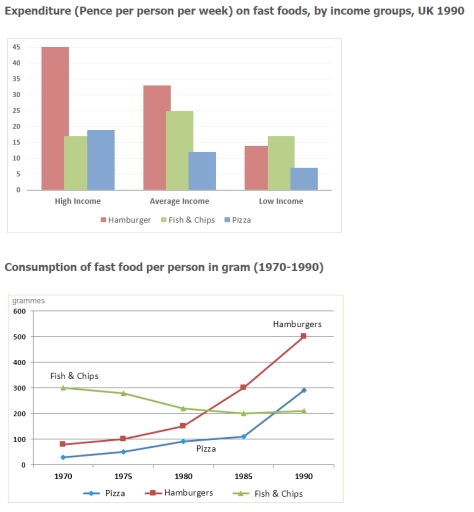
The chart compares the weekly spending of three kinds of fast food products in the UK by income groups in 1990, while the graph illustrates the trend in consumption of fast food in grams between 1970 and 1990.
Overall, it can be seen that individuals with high incomes are the main consumers in all fast food categories, with only one exception for fish and chips, which are usually bought by the middle class. Whereas, the poor tend to spend less on these products. Looking at the graph, it is clear that hamburgers and pizza became more popular; meanwhile, the opposite happened to fish and chips.
According to the chart, rich people were ready to allocate $45 to hamburgers but no more than $20 to fish and chips and pizza. Regarding the average income group, they preferred hamburgers as well, spending $33 per week. In contrast, people with low salaries spent a maximum $20 on junk food, fish and chips, and a minimum $7 on pizza.
In 1970, people ate 300 grams of fish and chips; however, the downward trend decreased the figures to 200 grams by 1990. Conversely, people enjoyed less than 100 grams of hamburgers and pizza at the beginning of the period given, which was followed by an increase, resulting in 500 grams for hamburgers and 300 for pizza in 1990.
Word Count: 223
