Our system will evaluate the answer based on this AI-generated description.
The image depicts a bar graph showing the percentage of adults using the internet from 2003 to 2006, categorized by age group. For 16-24 age group, the percentages are around 110% for 2003, 115% for 2004, 105% for 2005, and 100% for 2006. For 25-44 age group, percentages are 80% for 2003, 85% for 2004, 80% for 2005, and 75% for 2006. For 45-54 age group, percentages are 70% for 2003, 65% for 2004, 60% for 2005, and 50% for 2006. For 55-64 age group, percentages are 40% for 2003, 45% for 2004, 40% for 2005, and 27% for 2006. For the 65+ age group, percentages are 20% for 2003, 25% for 2004, 20% for 2005, and 17% for 2006. The graph highlights a decline in internet usage across all age groups from 2003 to 2006, with the highest percentages observed in the 16-24 age group, followed by the 25-44, 45-54, 55-64, and the lowest in the 65+ age group.
Given the complexity of the image, the above description may not be entirely accurate.
Skyrocket your IELTS band score by 1-2 points in under a month with our premium plan!
Note: Both the topic and the answer were created by one of our users.
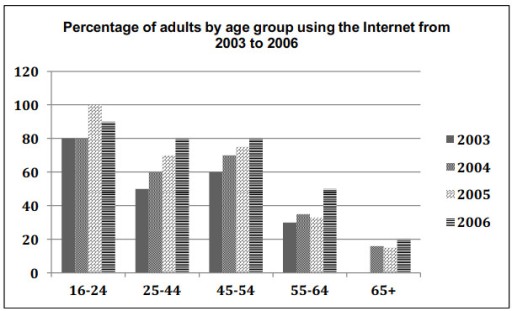
The bar chart illustrates the proportion of adult daily Internet users across five different age groups in the UK from 2003 to 2006.
Overall, Internet usage increased significantly among all the age groups during this period, with the 25-44 age group showing the most substantial growth. While the 65 and older demographic consistently represented the smallest group of Internet users, the youth aged 16 to 24 accounted for the highest proportion of users throughout the four years.
The primary users of the Internet were young adults aged between 16 and 24. In both 2003 and 2004, this group comprised 80% of Internet users. This figure increased significantly to 100% in 2005, before decreasing slightly to 90% the following year.
The chart reveals that all age groups experienced an upward trend in daily Internet usage. Specifically, the 25-44 age group saw a gradual increase in percentage from 50% in 2003 to 80% in 2006. Similar increases were observed among the 45 to 54-year-olds, with their usage rising from 60% in 2003 to 80% by 2006. For the other two groups, although their percentages showed minor fluctuations, the overall trend remained upward.
Word Count: 190
