🔥 Today Only: Save 30% on Premium — Offer Ends Soon! - Upgrade Now!
Bar Chart

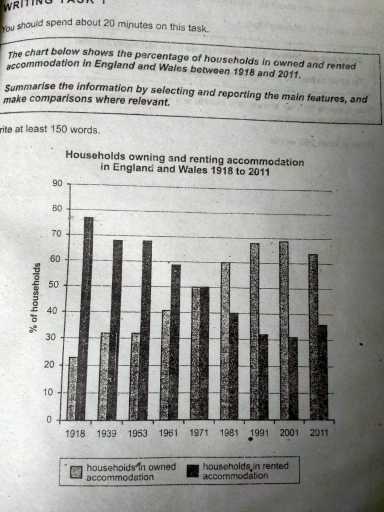
Band 6+: The chart below shows the percentage of households in owned and rented accomodation in England and Wales between 1918 and 2011. Summarise the information by selecting and reporting the main features, and make comparisons where relevant.

Image for topic: The chart below shows the percentage of households in owned and rented accomodation in England and Wales between 1918 and 2011. Summarise the information by selecting and reporting the main features, and make comparisons where relevant.
Our system will evaluate the answer based on this AI-generated description.
The image displays a bar chart comparing the percentage of households owning versus renting accommodation in England and Wales from 1918 to 2011. The chart presents data for the years 1918, 1933, 1953, 1961, 1971, 1981, 1991, 2001, and 2011. In 1918, 23% of households owned and 77% rented. The figures for 1933 are 32% owned and 68% rented. In 1953, ownership increased to 42% while renting decreased to 58%. The 1961 data shows a slight increase in ownership at 47% and a decrease in renting at 53%. The trend continues in 1971 with a majority of 51% owning homes and 49% renting. In 1981, the gap widens with 59% owning and 41% renting. The 1991 data shows 67% ownership and 33% rental. The 2001 figures report 69% ownership and 31% rental. The 2011 data marks a slight decrease in ownership at 64% and an increase in rental accommodation at 36%.
Given the complexity of the image, the above description may not be entirely accurate.
Note: Both the topic and the answer were created by one of our users.

The bar graph compares two different accommodation systems, according to ownership of house and rented house proportion in two big countries from 1918 to 2011.

Overall, it can be seen that the rented accommodation rate decreased gradually year by year whereas house ownership percentage increased rapidly in Britain and Wales except in 2011.

House ownership percentage was lower level in 1918 which was above 20%, and after two decades it rose to around 32%. In 1939 and 1953, this percentage stayed in a similar position. In addition, this household ownership rate risen to a peak in 2001, which is approximately 70%. However, this rate again fell in 2011, then the proportion was just above 60%.

Secondly, the rented accommodation rate was at a peak level in 1918. It’s total opposite to the house ownership rate, it was just below 80%. It decreased around 10% after two decades, and it was the same for 1939 and 1953. Then it started to fall and in 2001 it was approximately 30%. However, in 2011, it can be seen the rented household rate again increased a little bit, and it was just above 35%.

Word Count: 190

Answers On The Same Topic:

The chart below shows the percentage of households in owned and rented accomodation in England and Wales between 1918 and 2011. Summarise the information by selecting and reporting the main features, and make comparisons where relevant.

The chart illustrates the data of households owning and renting accommodation in England and Wales from 1918 to 2011. We can observe that the households in owned accommodation tended to increase gradually until 2001 which then slightly decreased in 2011. On the other hand, the households in rented accommodation seemed gradually decreased until 2001 which […]

The chart below shows the percentage of households in owned and rented accomodation in England and Wales between 1918 and 2011. Summarise the information by selecting and reporting the main features, and make comparisons where relevant.

The bar chart pesent percentages of households in owned accommodation and rented places in England and Wales 1918 to 2021 Overall, In the beginningof the bar chart consistently recored the higher figure of accommodation. where dramatic decline in rented accommodation. In the middle of the period both are following same trande. In the second last […]

The chart below shows the percentage of households in owned and rented accomodation in England and Wales between 1918 and 2011. Summarise the information by selecting and reporting the main features, and make comparisons where relevant.

The graph represents the ratio of families who owned and rented home in England and Wales over 93 years period from 1918 to 2011. At first glance,it is clear that in beginning proportion of households living in rented places were at its peak as compared with those who were living in their own homes .However, […]

The chart below shows the percentage of households in owned and rented accomodation in England and Wales between 1918 and 2011. Summarise the information by selecting and reporting the main features, and make comparisons where relevant.

The percentage of households in owned and rented accommodation in England and Wales between 1918 and 2011 depicted in the bar chart provided In general both of the rented and owned households have risen and dropped through the years from 1918 and 2011. More specifically, households in rented accommodation had dominated in 1918 with 78 […]

The chart below shows the percentage of households in owned and rented accomodation in England and Wales between 1918 and 2011. Summarise the information by selecting and reporting the main features, and make comparisons where relevant.

The percentage of households in owned and rented accommodation in England and Wales between 1918 and 2011 depicted in the bar chart provided In general both of the rented and owned households has raised and dropped through the years from 1918 and 2011. More sppecifically, households in rented accommodation had dominated in 1918 with 78 […]

See All

Other Topics:

The chart illustrates the distances travelled by passengers on 5 types of transport in the UK in 1990 and 2000. The data is presented in kilometers per person per week. Summarize the information by selecting and reporting the main features, and make comparisons where relevant.

The graph demonstrates the travelled distance on 5 categories of transport in the UK in 1990 and 2000. Overall, for the given period were noticed no substsntial changes. Bus occupies a leading position among various transport in both years, while motorbike remains less used transport in the UK. In 1990, air transport made up just […]

The bar chart illustrates the percentage of households in three different countries that owned various types of electronic devices in 2010 and 2020.

The given chart display the proportion of households owning three types electronic devices which includes Television, Computer, Phone in two different years 2010 and 2020. Overall, in 2020 every household possesses more electronic devices than than the year 2010. The major difference is in the ownership of mobiles followed by the computers and then there […]

The bar chart shows the number of visits to a community website in the first and second years of use. Summarise the information by selecting and reporting the main features, and make comparisons where relevant.

The bar chart compares the figures for visits to a community website over different months in its first and second years of operation. Overall, visit numbers in the second year were generally higher than those in the first year, with figures doubling on many occasions despite some fluctuations. Furthermore, the number of visits for both […]

The chart below shows the main reasons why agricultural land becomes less productive in three regions of the world. Summarise the information by selecting and reporting the main features, and make comparisons where relevant.

The bar chart shows by main reasons (over-grazing, deforestation, over-cultivation, and other factors) why agricultural land becomes less productive in three regions of the world, namely North America, Europe, and Oceania. Overall, in Oceania, over-grazing is the main reason, and had the highest percentage compared with other regions. In contrast, caused by over-cultivation in Oceania […]

The chart below shows the main reasons why agricultural land becomes less productive in three regions of the world. Summarise the information by selecting and reporting the main features, and make comparisons where relevant.

The bar chart shows by main reasons (Over-grazing, Deforestation, Over-cultivation, and Other factors) why agricultural land becomes less productive in three regions of the world, namely North America, Europe, and Oceania. Overall, in Oceania, over-grazing is the main reason, and had the highest percentage compared with other regions. In contrast, cause by over-cultivation in Ocenia […]

The chart below shows the amount of energy generated from winds in 4 countries from 1985 to 2000.

The bar graph demonstrates the quantity of energy in megawatts generated by wind in four different countries – India, Denmark, Germany and United States in the given period of 1980 and 2000. Overall, at the beginning the United States showed the highest rate of generated energy. Later, the Denmark grew considerably and became the largest […]

See All
We have detected unusual activity on your device.
Please verify your identity to continue.
Note: This verification step won't sign you in. If you have a premium account, please log in to access the service as usual.
Google/Gmail Verification
Or verify using Email/Code
We've sent a verification code to:
youremail@gmail.com (Not your email?)
Enter it below to complete the verification process.
Ensure your email address is correct, your inbox is not full, and you check your spam folder. If no email arrives, consider using an alternative email.
You will need a Premium plan to perform your action!
Note: If you already have a premium account, please log in to access our services as usual.

Plans & Pricing

Our mission is to make quality education accessible for everyone.
However, to keep our hardworking team running and this service alive, we genuinely need your support!
By opting for a premium plan, not only do you sustain us in achieving the mission, but you also unlock advanced features to enrich your learning experience.

Free

For learners who aren't pressed for time

What's included on Free
100+ Cambridge IELTS Tests
Instant IELTS Writing Task 1 & 2 Evaluation (2 times/month)
Instant IELTS Speaking Part 1, 2, & 3 Evaluation (2 times/month)
Instant IELTS Writing Task 1 & 2 Essay Generator (2 times/month)
500+ Dictation & Shadowing Exercises
100+ Pronunciation Exercises
Flashcards
Other Advanced Tools

Premium

For those serious about advancing their English proficiency, and for IELTS candidates aspiring to boost their band score by 1-2 points (especially in writing & speaking) in just 30 days or less

What's included on Premium
Save Your IELTS Test Progress & Analyze Mistakes By Question Type
Save Your Own Flashcard Sets & Use Them On Any Device
Unlock All Courses, IELTS Tests, Section & Part Practice
Unlimited AI Conversations
Unlimited AI Writing Enhancement Exercises
Unlimited IELTS Writing Task 1 & 2 Evaluation
Unlimited IELTS Speaking Part 1, 2, & 3 Evaluation
Checked Answers Will Not Be Published
Unlimited IELTS Writing Task 1 & 2 Essay Generator
Unlimited IELTS Speaking Part 1, 2, & 3 Sample Generator
Unlimited Usage Of Advanced Tools & AI Features
Priority Support within 24h (12-month plan only)

Due to the nature of our service and the provided free trials, payments are non-refundable.