Our system will evaluate the answer based on this AI-generated description.
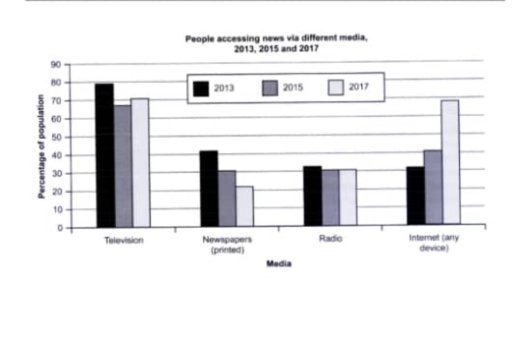
The image displays a bar graph titled "People accessing news via different media, 2013, 2015 and 2017" with the y-axis representing "Percentage of population" ranging from 0 to 90 in increments of 10, and the x-axis denotes "Media" divided into "Television," "Newspapers (printed)," "Radio," and "Internet (any device)." Each media category contains three bars corresponding to the years 2013, 2015, and 2017. In 2013, Television has the highest percentage at approximately 85, Newspapers follows with roughly 35, Radio is near 25, and Internet usage is around 30. In 2015, Television sees a slight decrease to just under 85, Newspapers drop to nearly 25, Radio remains constant at about 25, and Internet use increases to approximately 40. In 2017, Television decreases further to around 82, Newspapers continue to fall to about 18, Radio stays steady at 25, and Internet usage surges to around 70.
Given the complexity of the image, the above description may not be entirely accurate.
Skyrocket your IELTS band score by 1-2 points in under a month with our premium plan!
Note: Both the topic and the answer were created by one of our users.
The bar chart compares the percentage of people who listen news via four ways in a country between 2018 and 2017.
Overall, the highest percentage of people who accessing news by television , while by printed newspapers accessing news was lowest in the given years.
In terms of accessing news, in 2013,by watching television 80% of people known news which was highest than other media. But, after 2 years later,it decreased by 12% and in 2017,it rose at 2%. Similarly, from internet people get over 30% news in 2018, it was popular from 2015 to 2017,an increase of 40% to below 70%.
For the remaining of accessing news,printed newspapers was higher over 40% in 2013,after 4 years later it fall 20%.Radio users were stable over 6 years each almost 30%.
Word Count: 130
