Our system will evaluate the answer based on this AI-generated description.
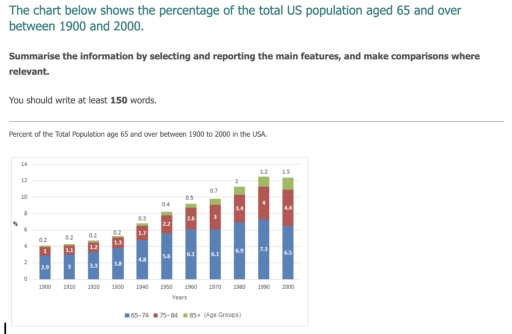
The image is a bar chart with eight bars, representing the percentage of the total US population aged 65 and over between 1900 and 2000, at ten-year intervals. Among all bars, three age groups are represented by segmented colors in each bar: 65-74, 75-84, and 85+. In 1900, 65-74 was 3.1%, 75-84 was 0.2%, and 85+ was 0.01%. In 1910, 65-74 was 3.2%, 75-84 was 0.3%, and 85+ was 0.02%. In 1920, 65-74 was 3.5%, 75-84 was 0.4%, and 85+ was 0.02%. In 1930, 65-74 was 4.1%, 75-84 was 0.6%, and 85+ was 0.03%. In 1940, 65-74 was 4.5%, 75-84 was 0.7%, and 85+ was 0.04%. In 1950, 65-74 was 5.0%, 75-84 was 1.0%, and 85+ was 0.07%. In 1960, 65-74 was 6.0%, 75-84 was 1.4%, and 85+ was 0.1%. In 1970, 65-74 was 7.1%, 75-84 was 2.0%, and 85+ was 0.2%. In 1980, 65-74 was 8.3%, 75-84 was 2.7%, and 85+ was 0.4%. In 1990, 65-74 was 9.6%, 75-84 was 3.4%, and 85+ was 0.7%. In 2000, 65-74 was 10.1%, 75-84 was 3.5%, and 85+ was 1.2%. Overall, the trend shows an increase in the percentage of the population aged 65 and over, with significant growth in the older age groups, especially 85+.
Given the complexity of the image, the above description may not be entirely accurate.
Skyrocket your IELTS band score by 1-2 points in under a month with our premium plan!
Note: Both the topic and the answer were created by one of our users.
The bar chart provided illustrates changes in the percentage of the US population aged 65 and over from 1900 to 2000.
Overall, there was a significant increase in the proportion of individuals aged 65 and above in the US population. The percentage of those aged 65-74 was consistently the highest compared to the other age categories.
According to the given chart, in 1900, the proportion of individuals aged 65-74 was 2.9%, which gradually increased to 3.3% by 1920. Subsequently, there was a noticeable rise to 5.6% by 1950. The percentage then stabilized around 6% during the 1960s and 1970s before peaking at 6.5% in 2000.
Conversely, the percentage of individuals aged 75-84 started at 1% in 1900, while those aged 85 and above were at 0.2%. The percentage of the 75-84 age group consistently surpassed that of the 85+ group, reaching 4% in 1990 and slightly increasing this figure to 4.4% in 2000.
Word Count: 153
