Our system will evaluate the answer based on this AI-generated description.
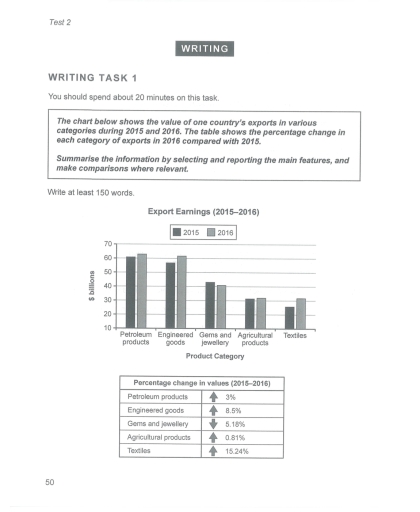
The image displays export earnings data from 2015 to 2016 for five product categories: Petroleum products, Engineered goods, Gems and jewelry, Agricultural products, and Textiles. In 2015, Petroleum products earned approximately $61 billion, increasing to about $63 billion in 2016. Engineered goods rose from $58 billion in 2015 to around $61 billion in 2016. Gems and jewelry decreased from $43 billion in 2015 to approximately $41 billion in 2016. Agricultural products saw an increase from $31 billion in 2015 to about $32 billion in 2016. Textiles increased from $25 billion in 2015 to approximately $28 billion in 2016. The percentage change table shows: Petroleum products with a 3% increase, Engineered goods with an 8.5% increase, Gems and jewelry with a 5.18% decrease, Agricultural products with a 0.81% increase, and Textiles with a 15.24% increase.
Given the complexity of the image, the above description may not be entirely accurate.
Skyrocket your IELTS band score by 1-2 points in under a month with our premium plan!
Note: Both the topic and the answer were created by one of our users.
The bar chart and table both compare the years 2015 and 2016, showing how much one country earned from exports and how this value changed in percentage.
Evidently, except for precious stones, export earnings of all sectors trended upwards over the years, with textiles showing the greatest increase in percentage value. In addition, most of the money was generated through the exports of industrial products.
As stated above petroleum and engineered products contributed most to the export earnings in both 2015 and 2016. Their figures accounted for 60 and about 55 billion dollars initially before respective changes of 3% and 8.5% in value, both reaching just above 60 billion dollars in the following year. Similarly, although the value of gems and jewelry followed a downward trajectory of 5.18%, its contribution to the economy was comparatively high, centering loosely around 40 billion dollars.
Agricultural goods and textiles, on the contrary, were responsible for relatively modest export earnings. While the change for the former was negligible at below 1%, the latter experienced the most pronounced surge of approximately 15% rising from 25 to above 30 billion dollars.
Word Count: 185
