Our system will evaluate the answer based on this AI-generated description.
The image contains two diagrams, the left diagram, titled "A wind turbine," features a wind turbine with labeled parts including rotor diameter (40-90m), hub height (50-80m), and generator (1.5-5MW). Below the turbine, there is a small building labeled electrical systems. The turbine is set on flat terrain with a single tree and vehicle close by. An arrow indicating wind goes through the rotor. The right diagram, title "Wind turbines: optimum locations," presents the same wind turbine with labeled rotor diameter (40-90m), hub height (50-80m), and generator (1.5-5MW). This turbine is placed on a hilly terrain with variable heights indicated (20-80m), a coastline depicted on the right, and a house and tree on the lower left side. An arrow indicating wind is pointing towards the rotor, originating from the higher elevations of the hill.
Given the complexity of the image, the above description may not be entirely accurate.
Skyrocket your IELTS band score by 1-2 points in under a month with our premium plan!
Note: Both the topic and the answer were created by one of our users.
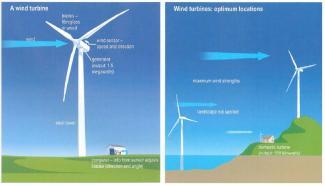
The diagrams illustrate a machine for generating electricity powered by wind and its optimum place of installation.
The machine uses a long steel tower to support the wind turbine at a higher latitude. The process begins when the wind sensor detects a strong wind in a certain direction. Then, a signal is transmitted to the nearby computer to adjust the wind blades, responding to the direction and angle from which the wind comes. Next, when the wind is passing through the wind turbine, it propels the blades, which are made of fiberglass or wood and connected to the generator, producing 1.5 megawatts of electricity.
Alternatively, the optimum location to install a wind turbine in order to receive maximum wind strength is on hills or in higher-latitude places. In contrast, if the wind turbine is placed in the water near the coast of a beach, it would not spoil the landscape; yet, less electricity would be produced. In addition, a domestic turbine can produce 100 kilowatts of electricity to provide for houses.
Overall, while the machine seems optimal when it comes to producing electricity, its problems lie in the location of installation.
Word Count: 191
