Our system will evaluate the answer based on this AI-generated description.
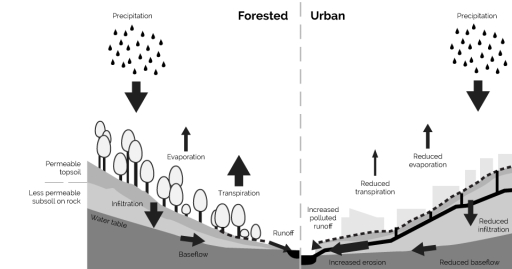
The image presents a comparative graphical depiction of water runoff in forested and urban settings. Both sections of the graph start with precipitation elements at the top. In the forested section, arrows point downward showing "Infiltration" through a "Permeable topsoil" and "Less permeable subsoil on rock" leading to "Water table" and then "Baseflow" with lateral arrows indicating "Evaporation" and "Transpiration" at the tree level, and "Runoff" at surface level. In contrast, the urban section arrows point towards "Reduced transpiration" and "Reduced evaporation" at the building level, with a significant arrow marked "Increased runoff" with side annotation "polluted" leading to "Increased erosion" with a consequential decrease in "Infiltration" and "Baseflow" compared to the forested section. There are no numerical data points or percentages provided.
Given the complexity of the image, the above description may not be entirely accurate.
Skyrocket your IELTS band score by 1-2 points in under a month with our premium plan!
Note: Both the topic and the answer were created by one of our users.
A comparison between the water cycle in forested and urban areas is reported in the diagram shown. Having started in both cases with precipitations, the main changes in each water cycle appear once the water gets to the ground. Some water infiltrates into the earth. In forested environments, an increased infiltration takes place thanks to the existance of a permeable topsoil. However, urban areas are shown to suffer from a reduced infiltration. Once the water enters the soil, it starts to flow, producing a high erosion in urban spaces.
Nonetheless, not all of the precipitated liquid infiltrates the ground. Such a situation produces a water runoff, which, in cities, involves pollution. Whereas, in forests, the aforementioned pollution is not present. Transpiration and evaporation percentages plummet in urban areas, while, they are skyrocketed in rural spaces.
In conclusion, the water cycle does differ slightly depending on the space that it takes place in. Furthermore, it can be accompanied by pollution in urban spaces.
Word Count: 162
