Our system will evaluate the answer based on this AI-generated description.
The image depicts two triangular diagrams representing tropical and temperate mountain altitudes, divided into various ecological zones. Tropical mountain altitude ranges from 0 to 5,500 meters (18,000 feet). Warm zone is 0-1,000 meters (0-3,300 feet) for tropical crops. Temperate zone is 1,000-2,000 meters (3,300-6,600 feet) for coffee and cocos. Cool zone is 2,000-3,000 meters (6,600-10,000 feet) for grain cultivation. Forest begins at 3,000 meters (10,000 feet), with a limit for broad-leaf trees at 3,500 meters (11,500 feet) and pine and firs limit at 4,000 meters (13,000 feet). Alpine meadows start at 4,000 meters (13,000 feet), snow line is at 5,000 meters (16,500 feet), and permanent snow begins at 5,500 meters (18,000 feet). Temperate mountain altitude ranges from 0 to 3,500 meters (12,000 feet). Warm zone is 0-500 meters (0-1,500 feet), Temperate zone is 500-1,000 meters (1,500-3,000 feet), Cool zone is 1,000-1,500 meters (3,000-5,000 feet) for grains, potatoes, flax. Forest begins at 1,500 meters (5,000 feet), with a limit for broad-leaf trees at 2,000 meters (6,500 feet) and spruce limit at 2,500 meters (8,500 feet). Alpine meadows start at 2,500 meters (8,500 feet), snow line is at 3,000 meters (10,000 feet), and permanent snow begins at 3,500 meters (12,000 feet).
Given the complexity of the image, the above description may not be entirely accurate.
Skyrocket your IELTS band score by 1-2 points in under a month with our premium plan!
Note: Both the topic and the answer were created by one of our users.
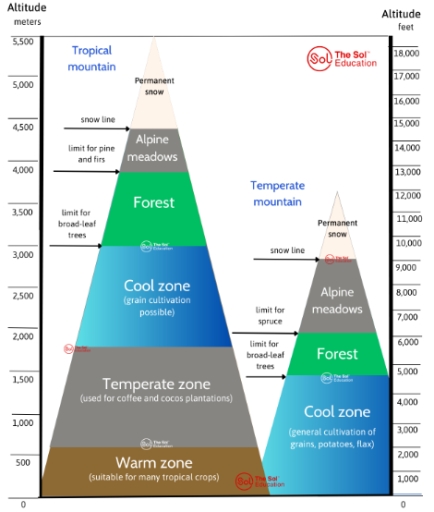
The picture illustrates different layouts in terms of temperatures and altitude between tropical and temperate mountains.
Overall, it is evident that a tropical mountain is much higher compared to a temperate mountain. We can also see that the temperatures fluctuate depending on altitude.
In detail, the warm zone, which is used for tropical crops plantations, is the first layer of the tropical mountains, with more than 500 meters in height, followed by the temperate zone, which has an optimal condition for coffee and cocoa plants’ growth. However, a temperate mountain does not have these two zones, but begins with the cool zone, which is the same as the third zone of a tropical mountain. It is noteworthy that the temperate mountains’ cool zone is suitable for grains, potatoes and flax cultivation, while the one of the tropical mountains is only used for grains’ developments.
From the cool zone onwards, both types of mountains share the relatively same layout, with the forest being the next layer. Whereas both the forest zones limit for broad-leaf trees, the forest from temperate mountains is just half of that in tropical mountains, reaching 6,000 feet and nearly 4,000 meters respectively. On the other hand, the temperate mountains’ alpine meadow, which has spruce limitations, is double the same zone from tropical mountains, which limits pine and firs. Both have the permanent snow zone on the top of the tropical and temperate mountains, reaching 5,500 meters and 12,000 feet respectively.
Word Count: 243
