🔥 Today Only: Save 30% on Premium — Offer Ends Soon! - Upgrade Now!
Process Diagram

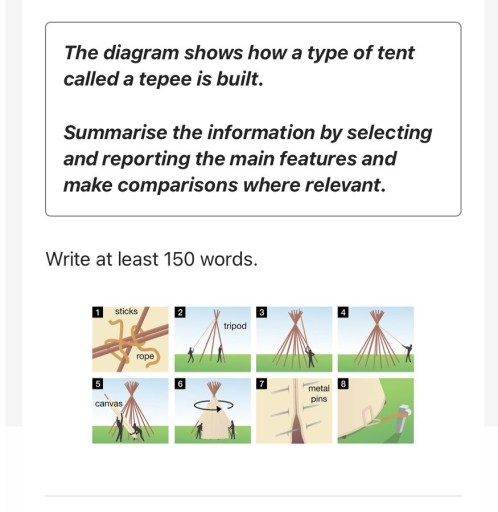
Band 7+: The diagram shows how a type of tent called a tepee is built. Summarise the information by selecting and reporting the main features and make comparisons where relevant.

Image for topic: The diagram shows how a type of tent called a tepee is built. Summarise the information by selecting and reporting the main features and make comparisons where relevant.
Our system will evaluate the answer based on this AI-generated description.
The image consists of a step-by-step diagram on constructing a teepee. Depicted in eight sequential panels, each pane provides a phase of the construction process with labeled elements critical to the setup. Panel 1 shows the arrangement of sticks. In Panel 2, these sticks form a tripod base. By Panel 3, more sticks are added to consolidate the structure. Panel 4 displays ropes tied around the upper section of the sticks. Then, Panel 5 illustrates how canvas is draped over the frame, while panels are adjusted for proper fitting in Panel 6. Panel 7 further highlights the process of securing the canvas with ropes. Finally, Panel 8 introduces metal pins, presumably to anchor the teepee to the ground. Panel numbers are indicated by the surrounding plain dark squares, sequentially numbered from 1 to 8 at each panel’s top-left corner. No numerical data points, percentages, or graphs are presented within this instructional graphic.
Given the complexity of the image, the above description may not be entirely accurate.
Note: Both the topic and the answer were created by one of our users.

The images illustrate the process of making a tepee- a type of tent.

In general, there are eight steps in the process. The eight-cycle commences with structuring sticks to form the tepee and ends with fixing it into the ground.

Firstly, it is clear that to make a tepee, the first step is to tighten the rope around three sticks that are the same height. Secondly, the sticks are pulled up to form a frame with three legs, which is called a tripod. At this stage, more sticks are added to the tepee, and the end is wrapped tightly to create a firm structure. In the following step, a canvas is wrapped in an individual stick. It is lifted against the structure, and the canvas is unrolled around the tepee. Finally, to keep the canvas in place, metal pins are used to pin the end of the canvas. In addition, for more certainty, the bottom of the tepee is secured to the ground.

Word Count: 163

Answers On The Same Topic:

The diagram shows how a type of tent called a tepee is built. Summarise the information by selecting and reporting the main features and make comparisons where relevant.

At those pictures we can see the steps of making a tent which type called a tepee. Firstly you need to take a wooden sticks and tie them with a strong rope. Create a tripod and start by adding more wooden sticks. After that rope the top of the tent for it to stay stable. […]

The diagram shows how a type of tent called a tepee is built. Summarise the information by selecting and reporting the main features and make comparisons where relevant.

The given pictures describe the steps required to build a kind of tent named a tepee. The process contains eight periods, which can be divided into two main stages, including initial frame and outer making. The first stage has four steps. Firstly, we tie three long sticks of the same length together by using a […]

The diagram shows how a type of tent called a tepee is built. Summarise the information by selecting and reporting the main features and make comparisons where relevant.

The given diagram shows the linear process used by humans to build a type of tent called a tepee. The process includes seven steps begins with people use rope to tie three sticks together and finishes when the tent is fixed to the ground. First of all, people use the end of rope to tie […]

The diagram shows how a type of tent called a tepee is built. Summarise the information by selecting and reporting the main features and make comparisons where relevant.

The given diagram shows the linear process used by humans to build a type of tent called a tepee. The process include seven steps begins with people use rope to tie 3 sticks together and finishes when the tent is fix to the ground. First of all, people use the end of rope to tie […]

The diagram shows how a type of tent called a tepee is built. Summarise the information by selecting and reporting the main features and make comparisons where relevant.

The diagrams describe a way to created a tent called tepee. Overall, there are 8 steps, start with prepare some sticks and rope, finally finished the tent with a mount that has wire attach. Firstly, to prepare built a tent, you need some sticks also ropes. You need to wrap the sticks with your rope […]

See All

Other Topics:

The diagram below give information about two road tunnels in one australian city

The diagrams illustrate key information about two different tunnels, namely Tunnel A and Tunnel B, including their construction period, cost, size and structure. The figures are measured in kilometres and metres. Overall, it is clear from the diagrams that Tunnel B is larger, deeper and more expensive than Tunnel A. In addition, both tunnels have […]

The diagram below shows hơ the plastic bottles are recycled

The given image gives information about the process of recycling plastic bottles. Overall, it is clear that the process is cyclical, encompassing nine stages. Meanwhile, the whole process might be separated into physical and thermal phases. In terms of physical phase, the entire recycling process begins with a garbage can picking up plastic bottles thrown […]

The diagram below shows how to recycle organic waste to produce fertiliser (compost). Summarize the information by selecting and reporting the main features, and make comparisons where relevant.

The diagram illustrates the way of how compost is produced, using natural waste products. Overall, the process consists of 5 steps, which can categorized into 3 stages: Collecting organic wastes, maintaining and heating. First of all, different products of waste are collected and placed into plastic jar layer by layer, each one getting about 15 […]

The process diagram shows the mass manufacturing of coconut oil. Summarise the information by selecting and reporting the main features and make comparisons where relevant.

The given process illustrates the various stages involved in the mass production of coconut oil. In general, it is a man-made linear process comprised of 10 distinct stages, beginning with the harvesting of coconuts from palm trees and finishing in the packaging and shipping of the final product. Initially, coconuts are collected from the palm […]

The diagram below shows the life cycle of a frog. Summarize the information by selecting and reporting the main features, and make comparisons where relevant.

This diagram gives information about the transformation of a frog from egg to mature frog. Overall, the life cycle of a frog undergoes seven phases, of which five stages are underwater and two stages are on the ground, and this report will highlight the process. In the beginning, this graph shows the process underwater. The […]

The diagrams below show the life cycle of the silkworm snd the stages in the production of silk cloth.

The life cycle of a silkworm may be simple compared to other animals, but the value of the silkworm is still as important as any other creature. The production of silk cloth is heavily dependent on them. The silkworm takes around 40 days in total complete their life cycle. It all begins when an adult […]

See All
We have detected unusual activity on your device.
Please verify your identity to continue.
Note: This verification step won't sign you in. If you have a premium account, please log in to access the service as usual.
Google/Gmail Verification
Or verify using Email/Code
We've sent a verification code to:
youremail@gmail.com (Not your email?)
Enter it below to complete the verification process.
Ensure your email address is correct, your inbox is not full, and you check your spam folder. If no email arrives, consider using an alternative email.
You will need a Premium plan to perform your action!
Note: If you already have a premium account, please log in to access our services as usual.

Plans & Pricing

Our mission is to make quality education accessible for everyone.
However, to keep our hardworking team running and this service alive, we genuinely need your support!
By opting for a premium plan, not only do you sustain us in achieving the mission, but you also unlock advanced features to enrich your learning experience.

Free

For learners who aren't pressed for time

What's included on Free
100+ Cambridge IELTS Tests
Instant IELTS Writing Task 1 & 2 Evaluation (2 times/month)
Instant IELTS Speaking Part 1, 2, & 3 Evaluation (5 times/month)
Instant IELTS Writing Task 1 & 2 Essay Generator (2 times/month)
500+ Dictation & Shadowing Exercises
100+ Pronunciation Exercises
Flashcards
Other Advanced Tools

Premium

For those serious about advancing their English proficiency, and for IELTS candidates aspiring to boost their band score by 1-2 points (especially in writing & speaking) in just 30 days or less

What's included on Premium
Save Your IELTS Test Progress
Unlock All Courses & IELTS Tests
Unlimited AI Conversations
Unlimited AI Writing Enhancement Exercises
Unlimited IELTS Writing Task 1 & 2 Evaluation
Unlimited IELTS Speaking Part 1, 2, & 3 Evaluation
Checked Answers Will Not Be Published
Unlimited IELTS Writing Task 1 & 2 Essay Generator
Unlimited IELTS Speaking Part 1, 2, & 3 Sample Generator
Unlimited Usage Of Advanced Tools
Priority Support within 24h (12-month plan only)

Due to the nature of our service and the provided free trials, payments are non-refundable.
Nếu bạn là người Việt Nam và không có hoặc không muốn trả bằng credit/debit cards, bạn có thể thanh toán bằng phương thức chuyển khoản:


Chọn gói:
419,000₫ 277,000 ₫ cho gói 1 tháng (chỉ 9,233₫/ngày)
1,239,000₫ 597,000 ₫ cho gói 3 tháng (chỉ 6,633₫/ngày)
2,469,000₫ 1,027,000 ₫ cho gói 6 tháng (chỉ 5,706₫/ngày)
4,929,000₫ 1,417,000 ₫ cho gói 12 tháng (chỉ 3,936₫/ngày)


Sau khi chuyển khoản, vui lòng đợi trình duyệt tự động điều hướng bạn trở lại Engnovate và bạn sẽ ngay lập tức nhận được mã kích hoạt tài khoản premium.
Nếu có lỗi xảy ra, bạn có thể liên hệ với team thông qua một trong các phương thức: email đến helloengnovate@gmail.com hoặc nhắn tin qua facebook.com/engnovate.
Vì toàn bộ công cụ trên website đều có thể sử dụng thử miễn phí, Engnovate không hỗ trợ hoàn tiền.