Our system will evaluate the answer based on this AI-generated description.
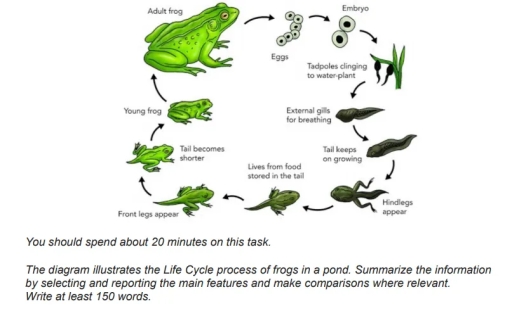
The image displays the life cycle of a frog in a sequential format, starting from eggs to an adult frog. The stages depicted include: eggs, which develop into embryos that cling to water plants; tadpoles with external gills for breathing as they grow; tadpoles whose tails begin to shrink, illustrating the absorption of the tail as they progress; tadpoles living off of the food stored in their tail for energy; appearance of hind legs; emergence of front legs while the tail continues to shorten; and finally, transformation into a young frog and then an adult frog. There are no numerical data points, percentages, or specific measurements provided in the diagram. The focus of each stage emphasizes growth and anatomical changes such as the transition from aquatic gills to air-breathing lungs, the gradual disappearance of the tail, and the development of limbs which denote the frog's transition from an aquatic to a terrestrial life.
Given the complexity of the image, the above description may not be entirely accurate.
Skyrocket your IELTS band score by 1-2 points in under a month with our premium plan!
Note: Both the topic and the answer were created by one of our users.
The diagram elucidates the various phases involved in the natural life cycle of a frog.
Overall, the frog’s life cycle consists of 11 distinct stages, from mating to the transformation into an adult frog.
Initially, the female frog lays eggs in water, where embryos develop and hatch into tadpoles that cling to aquatic plants. These tadpoles acquire external gills for respiration and elongate tails for fluid movement. Subsequently, hind legs emerge, facilitating dependence on stored tail nutrients for survival. Meanwhile, the front legs form, leading to gradual tail absorption until it disappears, enabling the frogs to stand on all limbs.
In the final phase, the frogs reach full maturity, thus completing the life cycle. The transition from eggs to adult frogs showcases a remarkable metamorphosis, emphasizing not only growth but also the development of key anatomical features essential for the frog’s adaptation from an aquatic to a terrestrial environment.
Word Count: 149
