Our system will evaluate the answer based on this AI-generated description.
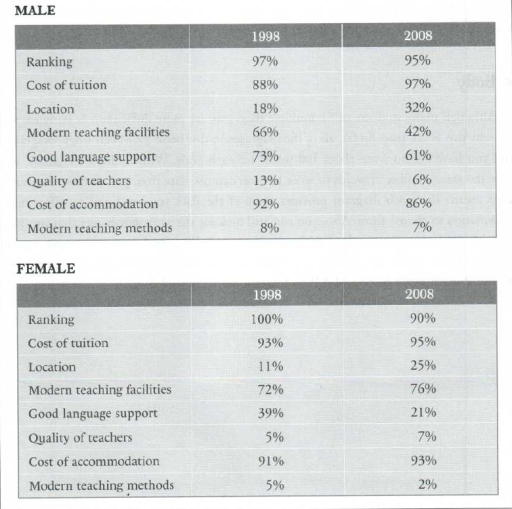
The image presents two tables comparing male and female responses across various factors for the years 1998 and 2008. For males, in 1998: ranking 97%, cost of tuition 88%, location 18%, modern teaching facilities 66%, good language support 73%, quality of teachers 13%, cost of accommodation 92%, modern teaching methods 8%. In 2008: ranking 95%, cost of tuition 97%, location 32%, modern teaching facilities 42%, good language support 61%, quality of teachers 6%, cost of accommodation 86%, modern teaching methods 7%. For females, in 1998: ranking 100%, cost of tuition 93%, location 11%, modern teaching facilities 72%, good language support 39%, quality of teachers 5%, cost of accommodation 91%, modern teaching methods 5%. In 2008: ranking 90%, cost of tuition 95%, location 25%, modern teaching facilities 76%, good language support 21%, quality of teachers 7%, cost of accommodation 93%, modern teaching methods 2%.
Given the complexity of the image, the above description may not be entirely accurate.
Skyrocket your IELTS band score by 1-2 points in under a month with our premium plan!
Note: Both the topic and the answer were created by one of our users.
The tables illustrate proportion of Taiwanese students’ criteria in choosing overseas studying, reported from a university over a 10-year period, from 1998 to 2008.
Overall, the most favored reason in both genders is the prestige of the university, followed by the fee of accommodation in 1998. However, the modern lecturing methods accounts for the lowest portion in male students, while the quality of professors was the smallest contributors in female.
One noticeable point is that the school’s reputation attracts students most, with 97% and 100% respectively in male and female in 1998. Ten years later, tuition fee took up the highest percentage, arriving at 95% in female and more 2% than that in male. Moreover, the cost of living places still remained being the third highest ranked criteria throughout ten years, dropping approximately 5%.
As can be seen, location, quality of teachers, and novel teaching methods were less favored by students. The gap between two genders’ preference in good language support widened significantly, from 34% to 40%. Male students were likely to not prefer well-equipped facilities in 2008, reaching at only two fifths, contrary to that in female ones at seven tenths.
Word Count: 192
