🔥 Today Only: Save 30% on Premium — Offer Ends Soon! - Upgrade Now!
Line Graph

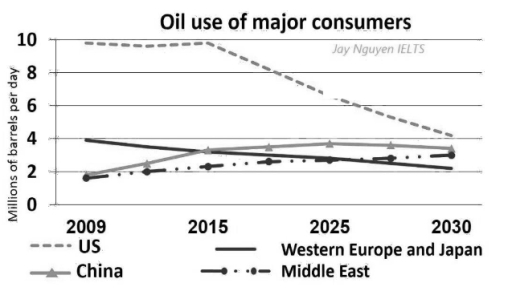
Band 5+: The graph below gives information about the total oil use of 4 major consumers from 2009 to 2030 Summarise the information by selecting and reporting the main features, and make comparisons where relevant.

Image for topic: The graph below gives information about the total oil use of 4 major consumers from 2009 to 2030 Summarise the information by selecting and reporting the main features, and make comparisons where relevant.
Our system will evaluate the answer based on this AI-generated description.
The image is a line graph titled "Oil use of major consumers" with the x-axis representing years (2009, 2015, 2025, 2030) and the y-axis representing millions of barrels per day, ranging from 0 to 10 in increments of 2. Four lines depict the oil use of different consumers: US (dotted line), China (solid line with triangles), Western Europe and Japan (solid line), Middle East (dashed line with circles). In 2009, US used around 9 million barrels per day, Western Europe and Japan about 5, China approximately 3.5, and Middle East nearly 2. By 2015, US declined to around 8, Western Europe and Japan to 4, Middle East increased to 3, and China rose to about 6. The projected use in 2025 shows US at 6, Western Europe and Japan at 3, China at 8, and Middle East at 4. By 2030, US is expected to decrease to 5.5, Western Europe and Japan to 2.5, China to maintain at 8, and Middle East to increase to 5.
Given the complexity of the image, the above description may not be entirely accurate.
Note: Both the topic and the answer were created by one of our users.

The bar chart provides information on how much oil was consumed by four different regions of the world in the past, along with future projections between 2009 and 2030.

Overall, the oil consumption by China and the Middle East increased over the period, whereas the United States, as well as Western Europe and Japan, showed an opposite trend.

The USA, Western Europe, and Japan consumed 9 million barrels and 4 million barrels of oil in 2009, respectively. Western Europe and Japan presented a decline in their oil utilization throughout the given period, and it is predicted that the consumption rate would fall to half by 2030. The United States, however, displayed fluctuations over the period and is likely to reduce its oil consumption to around 8 million barrels in the coming years. Despite this, it would continue to be the highest oil consumer.

On the other hand, China and the Middle East showed a positive growth during the period by beginning at a consumption rate of 2 million barrels each in 2009, and are assumed to raise their consumption to about 3 million barrels each by 2030.

Word Count: 187

Answers On The Same Topic:

The graph below gives information about the total oil use of 4 major consumers from 2009 to 2030 Summarise the information by selecting and reporting the main features, and make comparisons where relevant.

The line graph compares total oil consumption in the US, China, Western Europe and Japan, and the Middle East between 2009 and 2030, measured in millions of barrels per day. Overall, the US remains by far the largest consumer throughout, but its oil use falls sharply after 2015. By contrast, China and the Middle East […]

The graph below gives information about the total oil use of 4 major consumers from 2009 to 2030 Summarise the information by selecting and reporting the main features, and make comparisons where relevant.

The line graph compares oil consumption in the US, China, Western Europe and Japan, and the Middle East between 2009 and 2030, measured in millions of barrels per day. Overall, the US remains the largest oil consumer throughout the period, despite a sharp decline after 2015. By contrast, China and the Middle East show an […]

The graph below gives information about the total oil use of 4 major consumers from 2009 to 2030 Summarise the information by selecting and reporting the main features, and make comparisons where relevant.

The line graph compares aggregate daily oil consumption of four main markets – namely the USA, China, the Middle East and Western Europe combined with Japan – between 2009 and 2030. Overall, China and the Middle East are projected to record an ascending trend in their oil demand, while the USA and Western Europe with […]

The graph below gives information about the total oil use of 4 major consumers from 2009 to 2030 Summarise the information by selecting and reporting the main features, and make comparisons where relevant.

The given line graph represents the usage of oil per day by four major consumers:USA, China, Western Europe & Japan and Middle East, over the period between 2009 and 2030. Overall, it is clear that the all lines of the consume of oil ,fluctuate throughout the period .Although the China and Middle East were only […]

The graph below gives information about the total oil use of 4 major consumers from 2009 to 2030 Summarise the information by selecting and reporting the main features, and make comparisons where relevant.

The given line graphs delineates information on the consumption of oil that use daily in units of barrels during 2009 to 2025 and an estimation for the year of 2030. Overall it can be seen that, The United State remained for the largest consumer of oil throughtout the period. It is apparently seen that, in […]

See All

Other Topics:

The graph below shows the results of a survey among online adults on their use of various social media in the USA between 2012 and 201 5.

The line graph illustrates the usage of different websites, namely Facebook, Pinterest, Instagram, LinkedIn, and Twitter, by adults in the United States from 2012 to 2015. The percentage of people using all the websites showed a slight, steady increase during the 4 years, except for LinkedIn, which showed a mild decline starting in 2014. Facebook […]

The line graph below shows changes in the amount and type of fast food consumed by Australian from 1975 to 2000.

The line graph illustrates how much fast food consumed by teenagers in Australia from 1975 to 2000, which is a 25-year period. Overall, what stands out from the graph is that the consumption of fish and chips declined over the period, while the reverse true for the intake of hamburgers and pizza. Notably, although fish […]

The graph below shows the percentage of Australian exports to 4 countries from 1990 to 2o15.

The graph provides data on the percentage (0 – 30) of Australian export to four countries – Japan, US, China, and India in 22 years from 1990 to 2012. Overail, Japan and United States noticeable decreased, while China and India dramatically rises. Japan was leading at the start but being overtaken by India at the […]

the chart below shows the changes in the amount of coffee exported from three countries between 2002 and 2012

The line graph compares the variation in the figure of exported coffee from three countries – Brazil, Colombia and Costa Rica – over a 10-year period from 2002 to 2012. Overall, coffee exports followed a discernible upward trend in all three countries, although the magnitude and pattern of the rises differed markedly. Colombia and Costa […]

The chart below shows the percentage of households with different kinds of technology in the UK from 1997 to 2001. Summarise the information by selecting and reporting the main features, and make comparisons where relevant.

The line graph illustrates the proportion of residents who used various type of technological pattens in the UK between 1997 and 2001. Overall, while the precentage of technology pattens usage rose during this period, the CD palyer was the most popular among the other pattens. Furthermore, the rate of DVD palyer recoreded the lowest usage […]

You should spend about 20 minutes on this task. The graph below shows the daily consumption of three spreads per person from 1981 to 2007 in a country. Summarise the information by selecting and reporting the main features, and make comparisons where relevant. You should write at least 150 words.

The line graph gives information about margarine,butter,low-fat and reduced spreads from 1981 to 2007 and is measured in grams. The most significant facts to emerge from the graph are that butter and margarine experienceD significant fall. Low fat and reduced spreads, WHICH appeared later, had a high decrease. Butter was the most popular spreads, which […]

See All
We have detected unusual activity on your device.
Please verify your identity to continue.
Note: This verification step won't sign you in. If you have a premium account, please log in to access the service as usual.
Google/Gmail Verification
Or verify using Email/Code
We've sent a verification code to:
youremail@gmail.com (Not your email?)
Enter it below to complete the verification process.
Ensure your email address is correct, your inbox is not full, and you check your spam folder. If no email arrives, consider using an alternative email.
You will need a Premium plan to perform your action!
Note: If you already have a premium account, please log in to access our services as usual.

Plans & Pricing

Our mission is to make quality education accessible for everyone.
However, to keep our hardworking team running and this service alive, we genuinely need your support!
By opting for a premium plan, not only do you sustain us in achieving the mission, but you also unlock advanced features to enrich your learning experience.

Free

For learners who aren't pressed for time

What's included on Free
100+ Cambridge IELTS Tests
Instant IELTS Writing Task 1 & 2 Evaluation (2 times/month)
Instant IELTS Speaking Part 1, 2, & 3 Evaluation (2 times/month)
Instant IELTS Writing Task 1 & 2 Essay Generator (2 times/month)
500+ Dictation & Shadowing Exercises
100+ Pronunciation Exercises
Flashcards
Other Advanced Tools

Premium

For those serious about advancing their English proficiency, and for IELTS candidates aspiring to boost their band score by 1-2 points (especially in writing & speaking) in just 30 days or less

What's included on Premium
Save Your IELTS Test Progress & Analyze Mistakes By Question Type
Save Your Own Flashcard Sets & Use Them On Any Device
Unlock All Courses, IELTS Tests, Section & Part Practice
Unlimited AI Conversations
Unlimited AI Writing Enhancement Exercises
Unlimited IELTS Writing Task 1 & 2 Evaluation
Unlimited IELTS Speaking Part 1, 2, & 3 Evaluation
Checked Answers Will Not Be Published
Unlimited IELTS Writing Task 1 & 2 Essay Generator
Unlimited IELTS Speaking Part 1, 2, & 3 Sample Generator
Unlimited Usage Of Advanced Tools & AI Features
Priority Support within 24h (12-month plan only)

Due to the nature of our service and the provided free trials, payments are non-refundable.