Our system will evaluate the answer based on this AI-generated description.
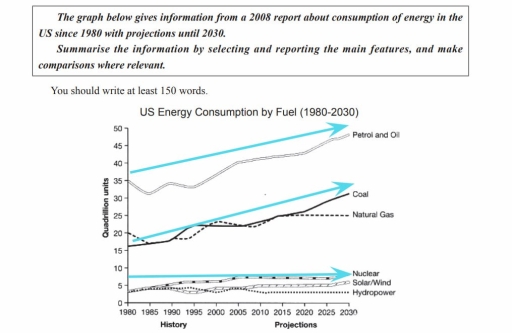
The image presents "US Energy Consumption by Fuel (1980-2030)" with quadrillion units on the y-axis and years 1980-2030 on the x-axis: Petrol and Oil: ~35 (1980), ~30 (1985), ~32 (1990), ~33 (1995), ~34 (2000), ~35 (2005), ~38 (2010), ~40 (2015), ~42 (2020), ~45 (2025), ~47 (2030); Coal: ~15 (1980), ~18 (1985), ~20 (1990), ~20 (1995), ~22 (2000), ~23 (2005), ~22 (2010), ~22 (2015), ~23 (2020), ~25 (2025), ~28 (2030); Natural Gas: ~20 (1980), ~20 (1985), ~22 (1990), ~23 (1995), ~24 (2000), ~25 (2005), ~25 (2010), ~25 (2015), ~25 (2020), ~26 (2025), ~30 (2030); Nuclear: ~3 (1980), ~4 (1985), ~5 (1990), ~6 (1995), ~7 (2000), ~7 (2005), ~7 (2010), ~5 (2015), ~5 (2020), ~5 (2025), ~5 (2030); Solar/Wind: ~0 (1980), ~0 (1985), ~0 (1990), ~0 (1995), ~2 (2000), ~2 (2005), ~3 (2010), ~3 (2015), ~3 (2020), ~4 (2025), ~5 (2030); Hydropower: ~5 (1980), <5 (1985), <5 (1990), <5 (1995), <5 (2000), ~3 (2005), ~3 (2010), ~3 (2015), ~3 (2020), ~3 (2025), ~3 (2030).
Given the complexity of the image, the above description may not be entirely accurate.
Skyrocket your IELTS band score by 1-2 points in under a month with our premium plan!
Note: Both the topic and the answer were created by one of our users.
The line graph illustrates the consumption of different energy sources in the USA since 1980 and predicted figures until 2030.
Overall, it is clear that natural gas, coal, petrol and oil despite some fluctuations will experience an upward trend overall, while hydropower, solar/wind and nuclear are expected to show minimal changes.
Petrol and oil which provided around 35 quadrillion units in 1980 are expected to reach nearly 50 quadrillion units by 2030 and become the dominant category. Starting at approximately 15 quadrillion units and 20 quadrillion units, the amount of coal and natural gas is forecasted to go up reaching about 30 quadrillion units and 25 quadrillion units, respectively by 2030.
Nuclear, solar/wind, and hydropower each produced less than 5 quadrillion units in 1980. Over the following decades, the gap between them widened, with nuclear overtaking the other two. By 2030, the figure for hydropower is expected to stabilize, while nuclear and solar/wind are projected to experience a slight rise, reaching nearly 7 quadrillion units and 5 quadrillion units, respectively.
Word Count: 170
