Our system will evaluate the answer based on this AI-generated description.
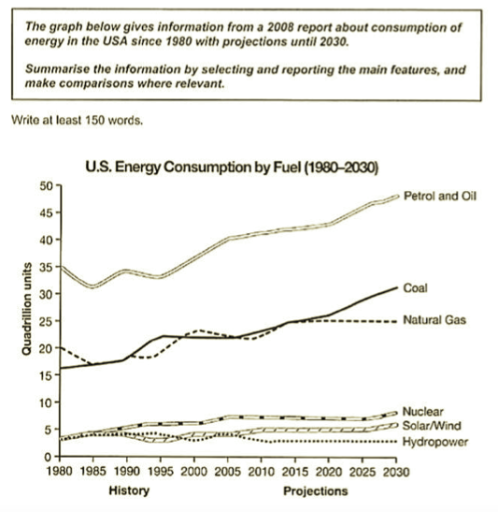
The image shows a line graph titled "U.S. Energy Consumption by Fuel (1980-2030)" with data from 1980 to 2007 as history and projected data from 2010 to 2030. The graph displays energy consumption in quadrillion units on the y-axis and time in years on the x-axis. Petrol and Oil consumption starts at approximately 35 quadrillion units in 1980, reaching nearly 45 quadrillion units in 2007 and projected to reach over 50 quadrillion units by 2030. Coal consumption begins at just over 15 quadrillion units, increasing to almost 25 quadrillion units in 2007 and projected at 30 quadrillion units in 2030. Natural Gas consumption starts at around 15 quadrillion units, with a steady increase to 25 quadrillion units in 2007 and projected to continue to about 30 quadrillion units in 2030. Nuclear, Solar/Wind, and Hydropower have significantly lower consumption levels, all starting below 5 quadrillion units in 1980. Nuclear energy shows a gradual increase to approximately 8 quadrillion units by 2007, with a projection of nearly 10 quadrillion units by 2030. Solar/Wind energy sees the most significant projected increase, starting at nearly 0 quadrillion units in 1980, with a slight increase to almost 3 quadrillion units in 2007 and an anticipated surge to 10 quadrillion units by 2030. Hydropower consumption remains relatively stable, starting at just over 2 quadrillion units, with little change by 2007 and a small projected increase to about 4 quadrillion units by 2030.
Given the complexity of the image, the above description may not be entirely accurate.
Skyrocket your IELTS band score by 1-2 points in under a month with our premium plan!
Note: Both the topic and the answer were created by one of our users.
The line graph compares historical data and future projections for energy consumption by different fuel sources in the USA from 1980 to 2030, according to a report published in 2008. All figures are measured in quadrillion units.
Overall, petrol and oil dominate energy consumption throughout the period and are forecast to continue rising. By contrast, hydropower remains the least used source and shows almost no change. While coal and natural gas follow similar trends in the earlier years, coal is expected to increase markedly in the long term, unlike natural gas, which levels off.
Petrol and oil consumption stood at about 35 quadrillion units in 1980. After experiencing minor fluctuations, it increased steadily to just over 40 units by 2008 and is projected to reach nearly 50 units by 2030.
Coal and natural gas both fluctuated between roughly 15 and 23 quadrillion units until around 2010. Thereafter, coal usage is predicted to rise sharply, surpassing 30 units by 2030, whereas natural gas consumption is expected to stabilise at approximately 25 units.
Consumption of nuclear, solar, and wind energy began at around 5 quadrillion units and is forecast to grow gradually to slightly above this level by the end of the period. In comparison, hydropower also started at about 5 units but is projected to remain virtually unchanged throughout the timeframe.
Word Count: 220
