Our system will evaluate the answer based on this AI-generated description.
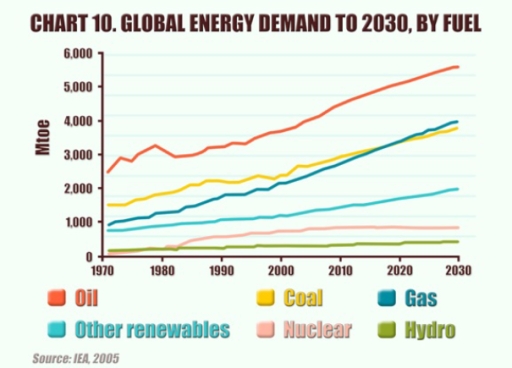
The image, titled "CHART 10. GLOBAL ENERGY DEMAND TO 2030, BY FUEL", is a line graph showing demand in Mtoe from 1970 to 2030. Approximate data points are as follows: Oil starts at 2,500 Mtoe in 1970, registers 3,200 in 1980, 3,100 in 1990, 3,500 in 2000, 4,200 in 2010, 4,900 in 2020, and projects to 5,700 in 2030. Coal records 1,300 in 1970, 1,700 in 1980, 2,200 in 1990, 2,300 in 2000, 3,000 in 2010, 3,700 in 2020, and 3,800 in 2030. Gas shows 800 in 1970, 1,200 in 1980, 1,600 in 1990, 2,100 in 2000, 2,800 in 2010, 3,500 in 2020, and 4,000 in 2030. Other renewables are at 700 in 1970, 800 in 1980, 1,000 in 1990, 1,200 in 2000, 1,400 in 2010, 1,700 in 2020, and 2,000 in 2030. Nuclear starts near 0 in 1970, reaches 200 in 1980, 500 in 1990, 600 in 2000, 700 in 2010, 800 in 2020, and 900 in 2030. Hydro is 150 in 1970, 200 in 1980, 250 in 1990, 300 in 2000, 350 in 2010, 400 in 2020, and 450 in 2030.
Given the complexity of the image, the above description may not be entirely accurate.
Skyrocket your IELTS band score by 1-2 points in under a month with our premium plan!
Note: Both the topic and the answer were created by one of our users.
The line graph depicts international energy consumption, expressed in millions of tonnes on an oil-equivalent basis, over 60 years, from 1970 to 2030.
Over the period 1970 to 2030, oil consumption has risen considerably across all fuel types, but hydro needs are still levelling off by 2030. The most significant point is that at the beginning of the period, oil demand was the most popular globally, whereas nuclear demand was the least popular among users.
After levelling off from 1970 to 1980, nuclear energy began to increase slightly, reaching almost 500 million tonnes and moving into the second-least-popular fuel position. Between gas and coal demand, gas is moving from the third-most-popular fuel position to the second-most-popular, although coal demand consistently exceeded gas demand between 1970 and 2015. Before changing their fuel position, they saw that both had reached the same peak from 2015 to 2020, for just half of the decade.
During the early part of the period, other renewable energies stood at around 0.8 billion tonnes and then increased slightly to around 1.8 billion tonnes in 2030. Its fuel position remains unchanged throughout the period.
Word Count: 186
