Our system will evaluate the answer based on this AI-generated description.
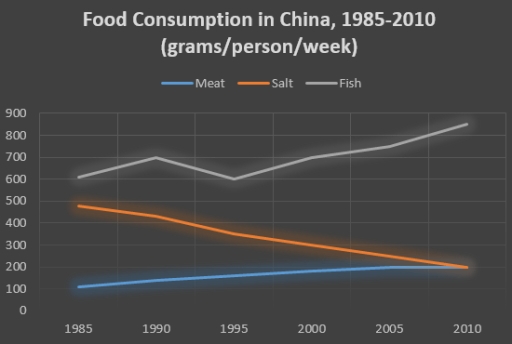
The image depicts a line graph titled 'Food Consumption in China, 1985-2010 (grams/person/week)'. There are three lines representing Meat, Salt, and Fish. In 1985, Meat starts just above 200g, Salt at roughly 500g, and Fish near 300g. By 1990, Meat increases to nearly 300g, Salt decreases to slightly below 500g, and Fish remains near 300g. In 1995, Meat rises above 400g, Salt drops to around 400g, and Fish stays constant. By 2000, Meat exceeds 600g, Salt continues descent to 350g, and Fish maintains around 300g. In 2005, Meat approaches 800g, Salt falls below 300g, and Fish shows a minor increase. Lastly, in 2010, Meat remains close to 800g, Salt levels off slightly above 200g, and Fish climbs to approximately 350g. The horizontal axis ranges from 1985 to 2010 in increments of 5 years, and the vertical axis measures consumption from 0 to 900 grams in increments of 100 grams.
Given the complexity of the image, the above description may not be entirely accurate.
Skyrocket your IELTS band score by 1-2 points in under a month with our premium plan!
Note: Both the topic and the answer were created by one of our users.
The line graph illustrates the percentage of Australian exports to four countries—Japan, the US, China, and India—between 1990 and 2012.
Overall, Japan was the leading export destination in 1990, but by 2012, China had become the largest recipient of Australian exports. Meanwhile, exports to India remained low throughout, though they experienced a slight rise, while exports to the US fluctuated modestly.
In 1990, around 27% of Australia’s exports went to Japan, making it the dominant trading partner. However, this figure declined steadily to approximately 18% by 2012. The US started at about 11%, peaked slightly in 2000, and then dropped to around 6% by the end of the period.
In contrast, exports to China grew dramatically—from under 5% in 1990 to over 30% in 2012, becoming Australia’s top export market. India also saw modest growth, rising from nearly 0% to about 6%, though it remained the smallest recipient overall.
Word Count: 149
